

If two words could sum up Toni DiTommaso’s qualities as professor of weed science at Cornell University, “unbridled enthusiasm” — words from a nomination letter — fit the bill. Yet it’s not just his innovative Integrated Pest Management (IPM) approaches to dealing with weeds that clinched DiTommaso’s Excellence in IPM award.
Colleagues and former students alike repeatedly cite the impact DiTommaso’s contagious love of learning has on their lives — and often their livelihoods. For many, the roots lie in Cornell’s IPM course that DiTommaso resurrected in 2002 and has taught since then with professor of entomology John Losey.
“To say that Toni has ‘educated others about IPM’ and ‘promoted IPM and bolstered the adoption of IPM practices,’ two criteria for earning the award, would be a vast understatement,” says crop-science professor William Cox, a longtime colleague. “I can’t emphasize enough the enormous impact that Toni has had on Cornell students who are now growers or consultants.”
Former student Steve Penning met DiTommaso while in the middle of a tough decision to change majors. “Toni’s support surpassed anything I could have imagined from a professor at a university the size of Cornell,” Penning says. Now Penning is back home, doing what he truly loves — farming. “Without Toni’s guidance and support, I might be doing something else.”
In fact, DiTomasso received the College of Agriculture and Life Sciences (CALS) “Professor of Merit award” in 2012 — all the more meaningful because it is awarded by students.
DiTommaso’s day job includes research, of course, and his website lists ten areas of expertise: weed ecology, biological control, integrated weed management, invasive plants and more. But even here you find this bullet point: “critical thinking, respect, student curiosity.”
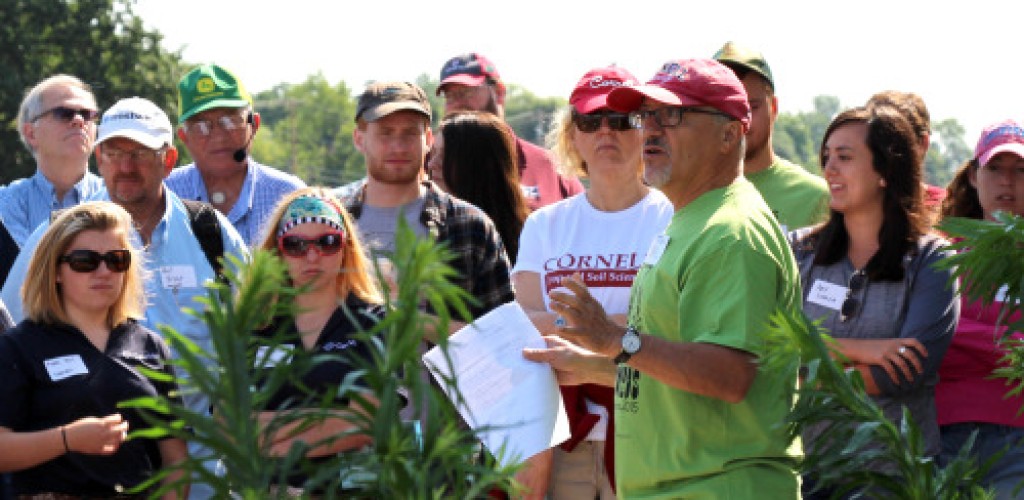
Cornell students aren’t the only ones to benefit from this list; adult learners do too. Cox describes watching DiTommaso at a farm field day, enthralling the 150 attendees with his dynamic presentation. “No wonder he’s in demand to speak at other Extension events.”
DiTommaso’s research and teaching are a seamless fit, says Jennifer Grant, director of the New York State Integrated Pest Management (NYS IPM) Program. “For example, Toni’s pioneering research brings a weed ecology perspective to both farmers and students—often taking herbicides out of the equation” Grant says.
DiTommaso received his award at Cornell’s Aurora Farm Field Day on July 14. NYS IPM strives to lessen the risks of both pesticides and pests, wherever you live and whatever you do. Learn more about IPM at nysipm.cornell.edu.
Keep Exploring
News
Conferences Graduate student Nishat Tasnim presented “The Condolence Clause: The Boundaries of Accountability after the San Diego Mosque Shooting” at the conference Confronting the Rising Tide: Islamophobia, White Nationalism, and the Global...

Field Note
Ananda Portela Fontoura PhD’22 is a postdoctoral associate working in the lab of Michael Van Amburgh , professor of dairy nutrition. Ananda’s research focuses on maintaining or enhancing dairy cow performance through optimizing nutrient use...

We openly share valuable knowledge.
Sign up for more insights, discoveries and solutions.
Please enter a valid email address to subscribe to the newsletter.