By Billy Kepner
Cornell Plantations recently expanded the Fischer Old-Growth Forest natural area in the Town of Newfield, N.Y., through a gift of 17.43 acres donated by David K. Bandler B.S. ′55, MPS ‘71, emeritus professor in the Department of Food Science. The preserve now protects nearly 60 acres, with almost 30 acres of old-growth forest.
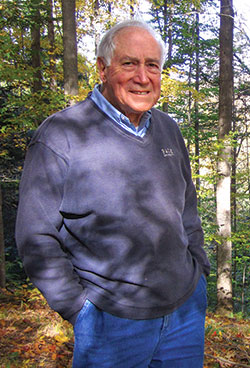
“We are very grateful to the Bandler family for their support of Cornell Plantations,” said Christopher Dunn, the E.N. Wilds Director of Cornell Plantations. “Their gift will allow us to expand our mission to protect and preserve unique and beautiful native landscapes for years to come.”
The new property, named the Bandler Family Tract, is characterized by herbaceous and shrub-dominated old fields and young successional forests. These habitats, together with historic stone walls and old plow lines, evoke the past agricultural uses that reshaped this landscape. The addition also provides an important buffer to the old-growth forest, which now collectively protects a one-half mile stretch of stream within the Cayuga Inlet Valley. Beyond enhancing conservation efforts, the addition includes frontage along Elmira Road/Route 13, which will allow for improvements to visitor parking, orientation and hiking trails.