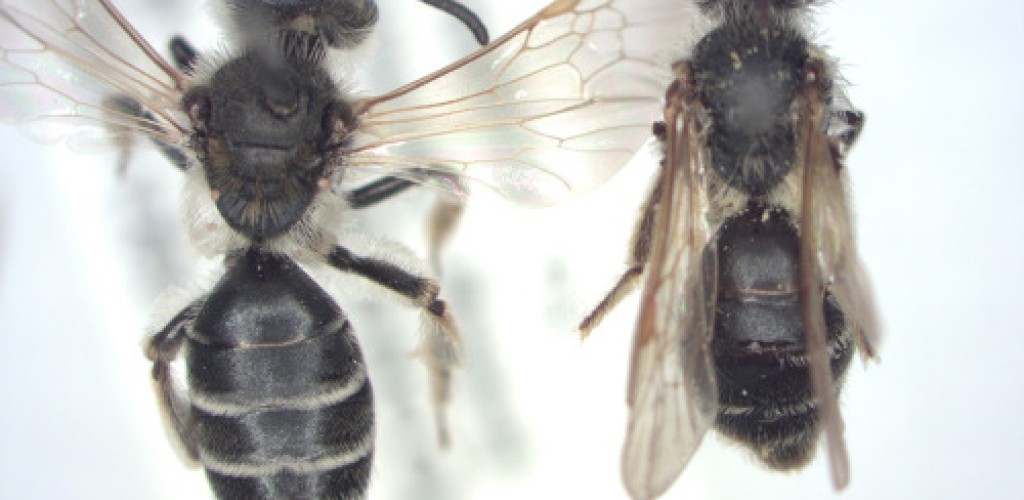
According to a recent study, the size of a common ground-nesting bee — an important crop pollinator — has grown smaller in heavily farmed landscapes.
The link between intensive agriculture and the size of Andrena nasonii bees has important implications for how farmers might diversify these landscapes to benefit bees. It also points out yet another potential threat to pollinators, along with mites, pesticides and loss of habitat.
Cornell researchers, who published the study March 4 in the journal PLoS, discovered that female A. nasonii bees in intensively farmed areas may not be able to find enough pollen sources in the landscape to adequately feed their offspring.
“Once we knew there was an effect of agriculture on the size of the bees, we took a random sample of our largest bees from our natural habitats and smallest bees from these agricultural intensive habitats, and looked at how much pollen the female bees were carrying on their bodies,” said Heather Connelly, a co-author on the paper and a graduate student in the lab ofGregory Loeb, professor of entomology and also a co-author.
“Small bees had a 40 percent smaller pollen load than large bees did, so potentially these small bees might actually be less able to provision their own offspring and we might end up seeing some cascading negative effects on the population of bees there,” said Connelly.
A. nasonii bees are the most important pollinators of strawberries. The study took place in established experimental agricultural plots across a number of different landscapes. Undergraduate researchers Miles Renauld and Alena Hutchinson, the paper’s first two authors, who work in the lab of co-author Katja Poveda, assistant professor of entomology, spearheaded fieldwork and data collection over two summers. They caught bees visiting strawberries and measured each bee’s head and thorax, the space between the wings. The researchers used satellite data to characterize agricultural intensity by analyzing the radius from the center of each plot at scales of 1 kilometer and 760 meters.
“At both these scales, we tended to have smaller bees in landscapes with lots of agriculture around,” Connelly said.
Connelly said she has used published equations to calculate average foraging distance of bees based on body size and found that a large bee can forage twice as far as a small bee.
In preliminary work yet to be published, Connelly and colleagues are investigating whether planting strips of native perennial wildflowers will affect bee size. In early results, “we are seeing when you have a wildflower strip even in a simplified landscape, bees do not get smaller. It suggests that these kinds of wildflower plantings can actually compensate for the lack of diversity at the landscape scale,” she said.
Future work will look at a broader spectrum of ground-nesting bees, and at bees with different behaviors and life histories, to see whether they follow the same patterns.
The study was funded by a Northeast Sustainable Agriculture Research and Extension Graduate Student Grant.
This article originally appeared in the Cornell Chronicle.