The safety and well-being of our community is our highest priority. We know the recent news and allegations are deeply concerning, and we are committed to a safe environment for all. Learn how Cornell is addressing sexual violence.
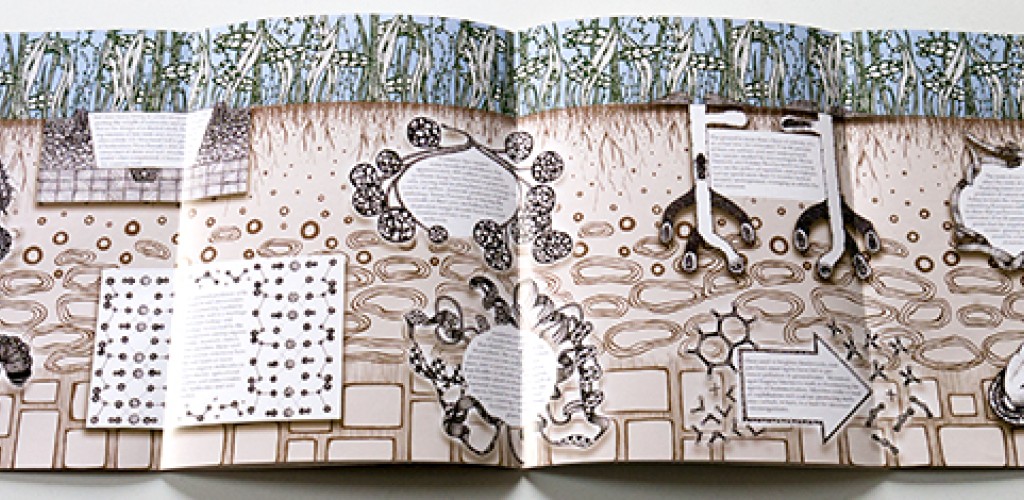
This feature appears in the print edition of periodiCALS as a four-page spread. A pdf of Understanding What's Underfoot is available for viewing.
|
By Amanda Garris, Ph.D. ‘04
Microbiology
School of Integrative Plant Science
Horticulture Section
Plant Breeding and Genetics Section
Plant Pathology and Plant-Microbe Biology Section
Natural Resources and the Environment Section
Biological and Environmental Engineering
Department of Entomology
Ecology and Evolutionary Biology
Share
Daily, we tread on one of the most complex and crucial parts of the ecosystem: the soil. It’s much more than dirt and rocks. Home to a quarter of the planet’s biodiversity, the earth below us holds a densely packed universe where microbes, fungi, plants, and insects cooperate and conspire, where ancient associations blur the lines between species, and microbe-driven chemistry profoundly affects global processes from carbon cycling to water purification. In honor of the United Nation’s International Year of Soils, we illuminate some minutiae of CALS’ dynamic subterranean science.
Illustrations by Olivia McCandless ‘17
Text by Amanda Garris Ph.D. ‘04
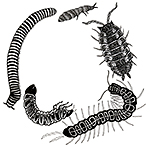
Whose turf is it? Assistant professor of entomology Kyle Wickings estimates that a handful of soil can house 1,000 different animals, from microscopic nematodes to six-legged insects. Wickings’ work is uncovering complex dynamics in plant health and nutrition in turfgrass, including fungi that help feed plants but can also alter grubs’ appetites for grass roots.
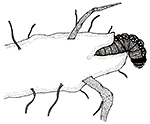
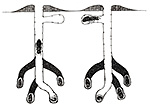
Milkweed’s belowground biology tells a tale of savvy specialization. The wildflower—poisonous to all but 11 species—is favored fare for the red milkweed beetle. Professor of ecology and evolutionary biology Anurag Agrawal is fascinated by the biology of this particular herbivory: Root-eating grubs have evolved ways to safely sequester the toxin, deploying it in their adult beetle bodies to dissuade diners.
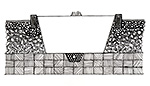
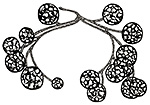
Soil does heavy lifting in urban environments, supporting the weight of sidewalks and pedestrians. But in the design of a shaded stroll, the competing interests of tree roots and civil engineers often collide. CU Structural Soil is professor of horticulture Nina Bassuk’s dirt détente comprised of stone and soil: structurally sound when compressed, it leaves room for roaming roots.
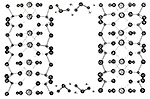
To assistant professor of biological and environmental engineering Ludmilla Aristilde, soil is a marriage between biology and geology. Governed by the interactions among organic matter, minerals, metals, and microbes, these wedded worlds determine how the soil holds or transforms organic molecules in plant matter, agricultural wastes, and contaminants like herbicides and anti-biotics.
Evolution has created some beneficial bedfellows: For approximately 400 million years endosymbiotic fungi have bunked in plant root cells, paying rent in phosphorus in exchange for a cache of carbon. Associate professor of plant pathology Teresa Pawlowska is tracing the tradeoffs of their pact, including how the dependent fungal tenants have survived ceaseless celibacy over millennia.
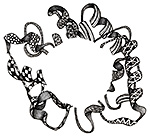
Assistant professor of horticulture Jenny Kao-Kniffin wants to steer the rhizosphere, the area of soil where plant roots secrete and microbes meet, into a canvas for cooperation. Kao-Kniffin is identifying the agents of microbe-plant mutualisms, such as bacterial enzymes that liberate nutrients bound to organic matter in soil, creating a slow-release fertilizer for nearby plants
The ground is more than a hive of activity, it’s an actual hive: An estimated 70 to 80 percent of bees are solitary and nest underground. One species studied by entomologists Bryan Danforth and Kristen Brochu feeds its young only on the pollen of squashes and pumpkins. Larvae spend more than 11 months tucked securely underground, emerging as adults the next summer.
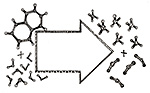
Once used to brighten boulevards, coal gas-fired street lights have led to persistent pollution in groundwater. Microbiologist Eugene Madsen’s work is illuminating the agents of bioremediation. Microbes make a meal of naphthalene-rich coal tar, producing methane—which, in turn, is a feast for successor microorganisms.
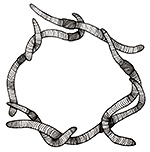
The roots of our nation affect the roots of our trees. Studying forest root growth led professor of natural resources Tim Fahey to track the impact of ravenous, colonizing European earthworms. The first to show that earthworms eat living tissue—an estimated 15 to 20 percent of roots, Fahey posits that the negative effects of the worms’ grazing is counterbalanced by a faster cycling of nutrients.
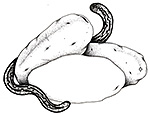
Associate professor of plant breeding and genetics Walter De Jong is searching for gold: golden potatoes, that is, along with Red Marias and Adirondack Blues, two of his creations. Admitting to a child-like excitement, De Jong digs each fall for a trove of taters that can take the heat—not just in the kitchen but from the appetite of the soil-dwelling invasive pest the golden nematode.
Conferences Graduate student Nishat Tasnim presented “The Condolence Clause: The Boundaries of Accountability after the San Diego Mosque Shooting” at the conference Confronting the Rising Tide: Islamophobia, White Nationalism, and the Global...
Ananda Portela Fontoura PhD’22 is a postdoctoral associate working in the lab of Michael Van Amburgh , professor of dairy nutrition. Ananda’s research focuses on maintaining or enhancing dairy cow performance through optimizing nutrient use...