Back

Discover CALS

See how our current work and research is bringing new thinking and new solutions to some of today's biggest challenges.

Share
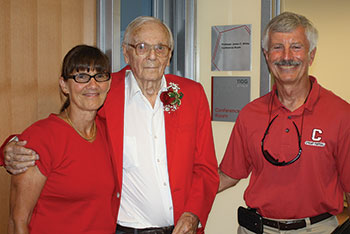
Two men and a woman stand together for a photo
Julie Carter, HumEc ’71; Professor Emeritus James White ’39, Ph.D. ’44; and Jay Carter ’71, MEN ’72.

James White ’39, Ph.D. ’44, first set foot in Stocking Hall when he arrived on campus as a freshman in 1934 to study bacteriology. As faculty member in the former Department of Dairy Industry, he enriched the building with his expertise in milk safety and dairy engineering—and enlivened it with his flair for storytelling—until his retirement in 1972. A gift from Jay ’71, MEN ’72, and Julie Carter, HumEc ’71, that names a conference room for him ensures that his legacy will be honored in the newly renovated Stocking Hall. According to the Carters, who met White through his late daughter Debbie Pavelka, the gift is an expression of gratitude for the privilege and good fortune of decades of knowing him. The room was dedicated in a July ceremony, where White was hailed as a “visionary who has always been ahead of his time,” a passionate advocate for the environment, and the consummate Cornellian.

Keep Exploring

Several red 'Crimson Beauty" raspberries hang from green leaves and stems.

Report

Relevance Raspberry and strawberry production in the United States is concentrated in California and Florida, where climate variability and rising costs challenge long-term sustainability. Demand for locally grown fruit is increasing, creating...
  • Cornell Cooperative Extension
Charles Midega (left) and Roy Odawa display the Kontiki kiln they modified to make biochar from human feces. Credit: Rebecca Nelson

News

Cornell researchers and Kenyan partners have developed a fertilizer made from human excreta. The product improves soil health and food production, while preventing pollution in informal settlements and the aquatic environment.

  • Ashley School of Global Development and the Environment
  • Global Development Section
  • Agriculture