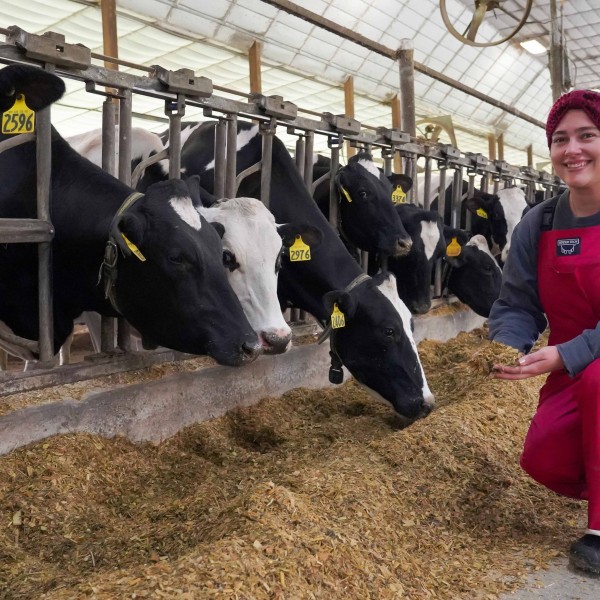
Welcome to the new CALS Alumni Association president, A’ndrea Van Schoick, DVM. Van Schoick earned a B.S. with Honors in Animal Science in 1996, followed by a B.S. in Veterinary Medicine in 1998 and a DVM from the University of Illinois, Urbana-Champaign, in 2000. After eight years as a companion animal veterinarian in northern Virginia, Van Schoick joined the Office of New Animal Drug Evaluation at the F.D.A.’s Center for Veterinary Medicine as a Veterinary Medical Officer. In June 2015, she assumed the role of Director for Scientific Curriculum. In addition, she continues to work in her private companion animal relief veterinary practice, is active in many professional organizations, and serves as a volunteer veterinarian for the Warren County Humane Society.
Since graduating in 1996, Van Schoick has kept her Cornell ties strong through involvement with the Class of 1996 (currently co-President), Cornell Club of Washington, Cornell Association of Class Officers, Cornell University Council, and the Continuous Reunion Club. She has also participated in reunion campaigns, the D.C. regional sesquicentennial steering committee, and various Cornell Alumni Admissions Ambassador Network committees. Since 2012, she has served as the D.C. regional director for the CALS Alumni Association, and she twice served as the Vice President for Recognition.
Originally from New Jersey, Van Schoick now makes her home in the Washington, D.C., area with her cat, Albert.