

Floods, droughts, pests and pathogens were among the weighty topics considered at the New York State Capitol on Tuesday.
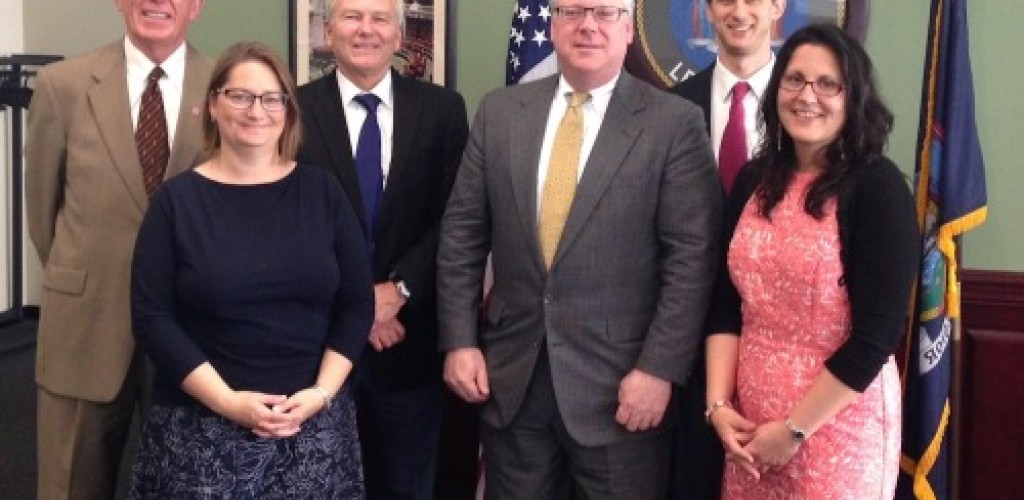
In the middle of a busy legislative session day, Sen. Tom O’Mara and Assembly member Steve Englebright, chairs of the Senate and Assembly environmental conservation committees, hosted a Cornell College of Agriculture and Life Sciences educational forum designed to provide insight into how extreme weather variations are impacting New York’s farm community. O’Mara and Englebright opened the forum, which also saw attendance by Assembly Agriculture Committee Chair Bill Magee, Assembly members Barbara Lifton and Cliff Crouch – along with a packed house of legislative and executive staff, and agricultural and environmental stakeholders.
Assistant Professor Toby Ault from Department of Earth and Atmospheric Sciences entertained and sobered the crowd by explaining radiant heat. Taking a page from famous Cornell alum Bill Nye the Science Guy, Ault walked attendees through a demonstration of radiant heat with an infrared camera, a metal globe and a blowtorch. Explaining how greenhouse gases interact with earth’s surface for good and for bad, Ault pointed out the extremes in weather fluctuations have become far greater over time, how his recent work has predicted a “megadrought” in the US Southwest, and that over time the United States will become progressively drier.
Soils and Crop Sciences Professor David Wolfe, a contributing author to the 2011 New York State ClimAID report, told the audience how increased “growing degree days,” changes in plant hardiness zones and fluctuations in extreme rainfall events are hitting New York’s farmers. With ecosystems changing as direct result of changing weather patterns and more extreme weather events, farmers will face greater challenges in dealing with invasive species, increased overwintering pests, early warming and unseasonable frost events, intensified rainfall and difficulty in predicting what types of crops to plant. Wolfe emphasized the need to focus resources towards Cornell’s New York State Integrated Pest Management program, noting the prevalence of new and different pests will bring more challenges to farmers that should be met with by environmentally sensitive strategies for control.
California farmers have faced severe hardships weathering the impacts of a four-year drought, and Entomology Professor Mike Hoffmann, associate dean of CALS and director of the Cornell University Agricultural Experiment Station, showcased recent research documenting the price increases for consumers nationally as a result of California’s difficult farm economy. Hoffman said price increases, but also an inability to grow certain crops such as red wine grapes and other water-thirsty varieties may create a demand for farmers in New York and the Northeast to supply more fresh market fruits and vegetables.
Allison Chatrchyan, the director the Cornell Institute for Climate Change in Agriculture, spoke about farmer adaptation and mitigation needs for the future. Citing a yet-to-be-published poll that found that 82 percent of New York’s farmers believe that climate change is occurring, Allison’s work has found that farmers are already facing losses from severe weather events. Chatrchyan said the institute is working to create a set of online decision-making tools for New York farmers to better understand and minimize their risk. Using historical data and climate modeling, tools such as a frost free calculator, a growing-degree yield prediction tool, and eventually a carbon-assessment tool will give farmers in New York specific data by which to make better farming decisions.


