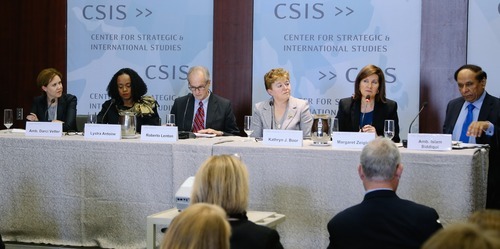
On Tuesday, Nov. 18, Dean Kathryn Boor joined a panel of national and international experts at the Center for Strategic and International Studies in Washington, D.C. for an in-depth look at agriculture, food security and global trade.
Opened by Ambassador Islam A. Siddiqui, senior advisor for the Global Food Security Project, the panel discussion and audience questions-and-answer session explored global progress in agricultural productivity, with a special focus on the developing world. Boor, the only academic leader onthe panel, stressed that local communities need access to vital infrastructure – physical, technical and intellectual – to meet the challenges of the future.
“Science may be global, but solutions have to be local. It has to be a holistic approach.”
In addition, Boor highlighted these challenges, strategies and early successes during the two-hour session:
- Cornell University’s land grant roots gave it a public engagement mission from its birth 150 years ago. That engagement is essential to highlight the contributions science and education must make to help solve our most challenging environmental, social and economic problems – including the prospect of feeding an exploding global population.
- Successful agricultural systems of the future will require public investment, private industry financing, and acceptance and implementation by society. It is absolutely essential that we start making those investments now. Governments must lead by setting directions and creating an environment for success. Businesses must drive implementation through innovation, investment and competition. Communities must build local capacity. Institutions such as Cornell and its peers must push forward with research and development and extension.
- One model for this type of solution is the Tata-Cornell Agriculture and Nutrition Initiative. Led by professor and director Dr. Prabhu Pingali, this initiative reflects investment from the private sector based in India to solve the problems of poverty, malnutrition and rural development. TCi student scholars, faculty fellowsand external research fellows work alongside partner institutions in India – such as the Tata Institute of Social Sciences and Delhi University – and others globally to address the agriculture-nutrition nexus.
- Another model, of particular relevance in India is the Borlaug Global Rust Initiative, a Cornell-led consortium of more than 100 researchers worldwide working to reduce vulnerability to stem, yellow and leaf rusts. Formed in 2008, the initiative also includes the Indian Center for Agricultural Research and State Agricultural Universities, the International Center for Agricultural Research in the Dry Areas, the International Maize and Wheat Improvement Center, and the U.N. Food and Agricultural Organization.
- The Agriculture Innovation Partnership, a consortium of American and Indian universities including Cornell, is working together to increase agricultural production, develop efficient marketing systems and reduce malnutrition in the service of creating a sustainable agriculture business in India. AIP aims to achieve this by improving agricultural education and extension systems and creating a convergence of public and private enterprises working towardensuring prosperity in the region.
The dean also praised the newly created Cornell Alliance for Science, a platform to educate public and policymakers about agricultural biotechnology, with a specific focus on promoting an informed and respectful dialogue around genetically modified crops.
She added that these several initiatives would have been impossible without partners such as the Bill & Melinda Gates Foundation and USAID. Only by leveraging public and private resources, Boor said, can we increase the scientific and technological research, innovation and partnerships needed to create a thriving global agricultural economy.
“The future of funding in agriculture is in public-private partnerships.”
The event also featured a presentation of the Global Harvest Initiative’s 2014 Global Agricultural Productivity Report, a body of research that focuses on the challenge and promise of new global revolutions in agriculture.
The complete video of the panel and Q&A discussion is available here.