By Valeria San Juan
Edward Mabaya, assistant director at the Cornell International Institute forFood Agriculture and Development (CIIFAD), is challenging conventional beliefs about the seed industry.
In the course “GMO Debate: Science and Society” Mabaya argues for the adoption and development of genetically modified crops in Africa within a “smaller, more flexible, company model that permits businesses growth and also caters to the localized needs of smallholder farmers.”
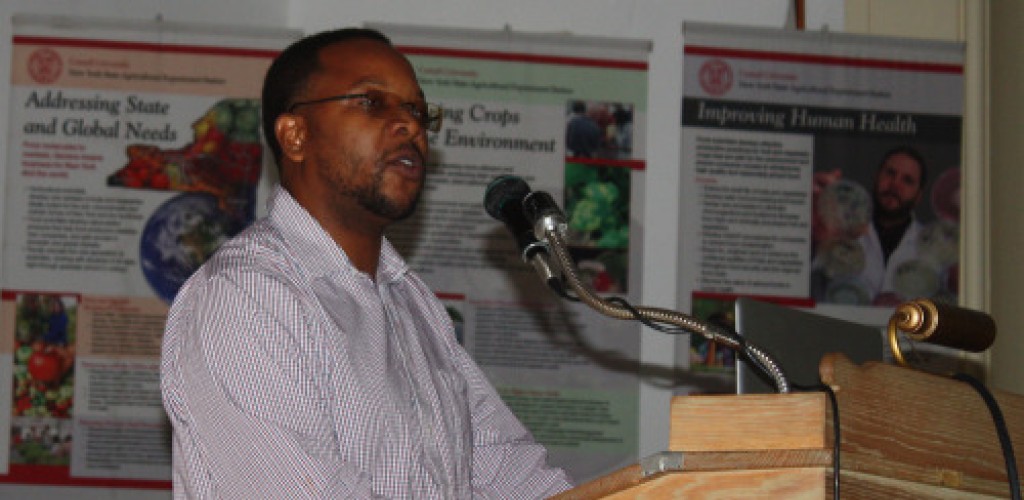
In his presentation Oct. 7, Mabaya urged students to “separate the baby from the bathwater, genetically modified organisms and seed companies are not synonymous with indebted farmers and corporate monopolies.”
Mabaya said there is opportunity for a local, country-specific and public-private approach to research and development of genetically modified technologies because of the structure of Africa’s seed sector. Instead of enormous agribusinesses accounting for all levels of research and development, the African seed sector is comprised of various public and private stakeholders working in collaboration or competition. He said the African seed sector can be the pioneer of a “new wave of GMO politics with locally owned seed companies that cater to the need of the local population and improves food security.”
One of the challenges for the African seed sector, he said, will be to convince national governments to support the seed industry through training, investments and regulation of seed companies. For national governments to approve the use and development of GMO technologies, consumers need to be engaged. Since the development of the seed industry and GMO technologies in Africa is still highly controversial, with only four countries commercially producing GM crops, he said ”consumers need to be aware of production difficulties local farmers face and of the little risk associated with GMO technology.”
“Every GMO debate needs to be argue separately, and no blanket statement is good,” Mabaya said. “Yet the development of the African seed industry alongside the adoption of GMOs will be a step forward in providing smallholder farmers with a healthy amount of both calories and nutrients.”
Valeria San Juan is a student writer in the College of Agriculture and Life Sciences.