


It grows 18 feet tall, bears a cone-shaped flower that begins to form after the summer solstice, has the potential to yield 400 different oils, and claims marijuana as its closest relative in the plant kingdom. What is it? The hop plant, once grown widely in New York and now making its comeback in the Empire State, thanks to innovative farmers, dedicated scientists and extension agents, and growing demand by a growing community of New York craft brewers who together are embracing the promising renewal of a sustainable local industry. These were among the intriguing fun facts that a standing-room-only-sized crowd learned at the lecture delivered by Steve Miller, hops resource specialist at Cornell Cooperative of Madison County, and Randy Lacey ’79 MEng ’99, owner of Hopshire Farms & Brewery in Freeville, N.Y., at Mann Library’s June 6th Reunion event, “Brewing on the Horizon: The Revival of Hops and Craft Beer Production in New York State.”
Hops production has deep roots in New York State, which at its peak in the 1880s supplied 90% of U.S. hops market of the time, or the equivalent of about 10% of world hops production today. That was before the problems of downy and powdery mildew infestation—intractable before the development of effective fungicides—and the effects of Prohibition dealt mortal blows to New York’s hops farms in the 1920s. Now, growing numbers of New York farmers have been bringing the industry back. As Steve Miller was pleased to note, over 100 New York farms produce hops commercially today, up from two in just 2001. Cornell Cooperative Extension has been busy supporting this revival, helping to sprout disease-free plant stock and distribute these to interested farmers, while also breeding and testing new varieties.
Cornell alum and craft brewer Randy Lacey, who “daylights” as a facilities manager on the Cornell campus, described the implications of the New York’s “Farm Brewery” license legislation of 2013, which encourages brewers to source 20% of their hops and other ingredients from New York farmers in return for special privileges, such as the right to sell beer by the glass in tasting rooms. The impact of this legislation is likely to be similar to the impressive growth in NYS wineries that followed the passage of similar legislation relating to local sourcing of grapes—with many spillover effects for local rural economies. Already, the proliferation of craft breweries has been remarkable along the Hudson Valley and in the Finger Lakes, and nationally, the craft brewers’ share of the national beer market is growing by more than 10% a year.
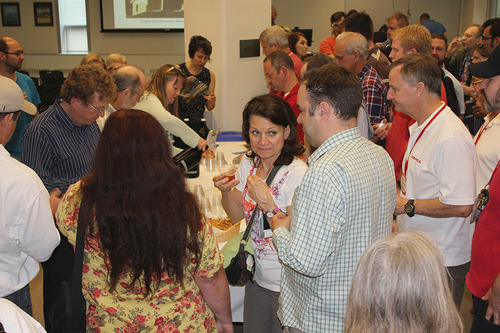
The closing delight at Friday’s presentation: The opportunity to taste several craft varieties currently being produced by Hopshire Farms & Brewery in Freeville, N.Y. Sporting intriguing names like “Nirvana” (an India pale ale) and “Beehave” (flavored with a hint of local honey), the varieties were each distinct in their taste. Judging from audience response, they were crowd-pleasers all…and New York State’s hops and craft brewing industries do have a promising future ahead indeed.
Care to learn more about the history of New York’s hops and beer brewing industries? Mann’s exhibit “For a Quart of Ale Is a Dish for a King: The Craft Beer Tradition and Its Revival in New York State,” will be viewable in the Mann Lobby through November 2014, and a complementary photography exhibit, “From Ground to Glass,” featuring photography from Finger Lakes hops farms, vineyards and apple orchards, is on display in the Mann Gallery through August. We will also be publishing a video of the June 6 talk by Steve Miller and Randy Lacey shortly—check back with us at later in the summer.
– Guest post by Eveline Ferretti, Public Programs and Communication Administrator at the Albert R. Mann Library at Cornell University


