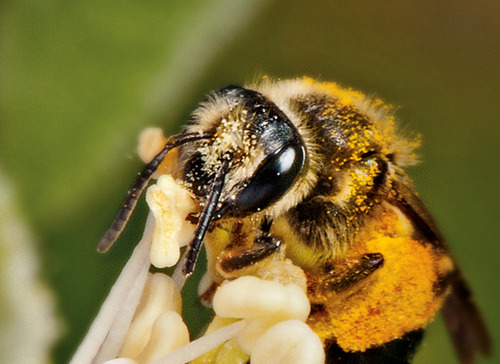
The Northeast Pollinator Partnership is a new initiative at Cornell that aims to work with regional apple growers to explore using wild and native bees species as alternatives to commercially raised European honey bees for the pollination of apple crops.
Traditionally, apple orchards have relied upon colonies of non-native, European honey bees (Apis mellifera) as pollinators. These commercially raised and managed colonies are transported from orchard to orchard during peak apple bloom to pollinate the trees and produce a crop. However, huge numbers of these colonies have been decimated by Colony Collapse Disorder (CCD) in recent years. Caused by a combination of pathogenic and environmental factors, CCD has become a major threat to the food supply and the livelihoods of growers.
But according to research conducted over the past five years in the lab of Bryan Danforth, professor of entomology, some species of New York’s native, wild bees may be more effective apple pollinators on a per-visit basis than honey bees. In addition, the data show that increased native bee diversity and abundance lead to a more robust apple crop. In fact, the researchers believe that there are many apple orchards in the northeast where native bees are sufficiently abundant to meet pollination needs without the use of commercially sourced honey bee colonies.
By working closely with growers, the Northeast Pollinator Partnership project aims to determine the abundance of both wild and managed bees throughout the northeast. The project will create easy-to-use tools and training resources to enable apple growers to survey their own orchards for the size and composition of their local bee populations. These data will be used to make recommendations to individual growers about whether or not to rent honey bee colonies for orchard pollination. Further, the project hopes to develop a long-term monitoring system for New York’s wild pollinators.
Given the costs associated with renting honey bee colonies, there are significant economic benefits for growers to reducing honey bee use. In addition, reducing the use of commercial colonies could help to prevent the spread of viral and fungal pathogens to native bee populations. Finally, shifting to native pollinators will lead to more sustainable land management, reduced pesticide use, and improved safety for orchard workers. It’s a win/win for growers!