

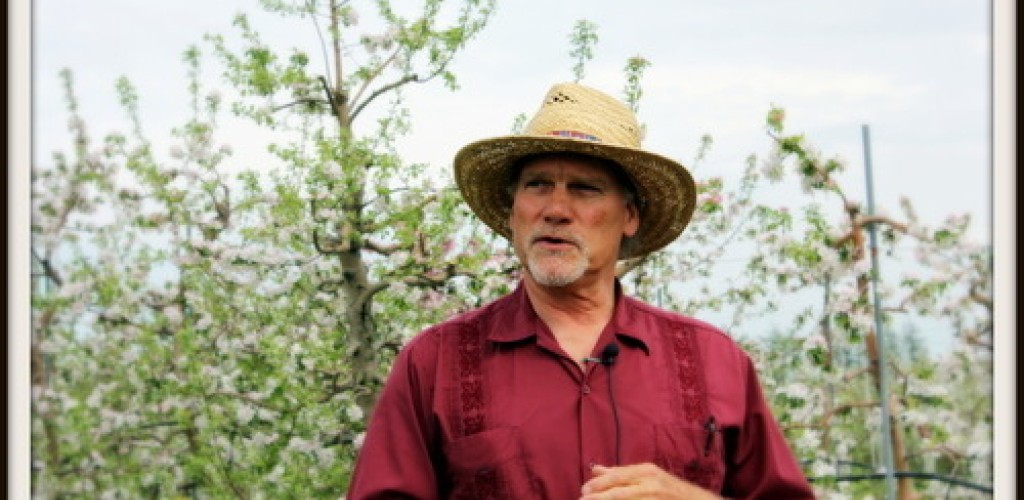
Before he became a world-renowned expert in pomology and viticulture, he was a taxi driver in New York City, a trolley coach conductor in San Francisco, and a Neruda translator exploring Latin America from the back of a motorcycle, all of his worldly possessions packed in one saddle bag.
Ian Merwin has a colorful history, one he has happily shared with students in the 23 years he has been teaching at Cornell. Many of them gathered at Cornell Orchards on May 10, alongside more than 100 colleagues and friends, to hear him recount the tales one more time as he presented a final lecture to commemorate his retirement.
“What will you do when you graduate? It doesn’t really matter,” Merwin said. “It’s all interesting. You learn something from each one.”
Merwin built a career in fruit production, researching biological control of soilborne diseases, soil management and nutrient dynamics. He was also instrumental in the establishment of the viticulture and enology major, and worked closely with undergraduates at the student-run farm Dilmun Hill. And he has been active in Afghanistan and Latin America, providing support to fruit growers intent on improving their production systems.
His first experiences with fruit trees came in 1977, when he bought a house in San Francisco’s Mission District. That was also where he learned about the glories of compost, as a gardener at Golden Gate Park, and developed an appreciation of wine. He brewed his first batch of hard cider upon moving back to New York in 1985—evaluation of apple varieties for cider fermentation was later incorporated into his research, and attendees got to evaluate the fruits of his efforts themselves at the lecture.
While not tending fruit trees at his research plots, Merwin tends 64 acres of apples, peaches, plums, cherries, grapes and blueberries at his Black Diamond Farm in Trumansburg—a task he said he is looking forward to doing even more in his retirement.
Colleague Frank Rossi, a turf grass specialist in the Department of Horticulture who met Merwin as a graduate student and later co-taught the entry-level class Horticultural Systems and Science with him, praised Merwin for his hands-on approach.
Rossi said Merwin exemplified horticulture, where it’s not just about learning, it’s about doing. When Merwin decided to turn his hand to viticulture, for example, he committed himself fully, Rossi said.
“I could care less about my own lawn. But this guy plants a few acres of vines because he wants to be a better instructor,” Rossi said. “He rolls up his sleeves and with the force of his will, he does it.”
The force of his will meant Merwin was well-loved, but not always well-liked, Rossi said. He admitted to being one of Merwin’s biggest sparring partners, but said he relished the role.
“That sparring is where the richness of the Cornell experience comes from,” Rossi said.
Learn more about Merwin in this Appellation Cornell interview


