Pink spotted lady beetle
Biocontrol Agent Factsheet
Unlike strict carnivores, this omnivorous lady beetle persists in the field by feeding on alternative foods (e.g., pollen) when prey is scarce, making them valuable for biological control.
Overview
Pests Targeted: Aphids, Colorado potato beetle, mites, thrips, Mexican bean beetle, corn earworm, European corn borer, fall webworm
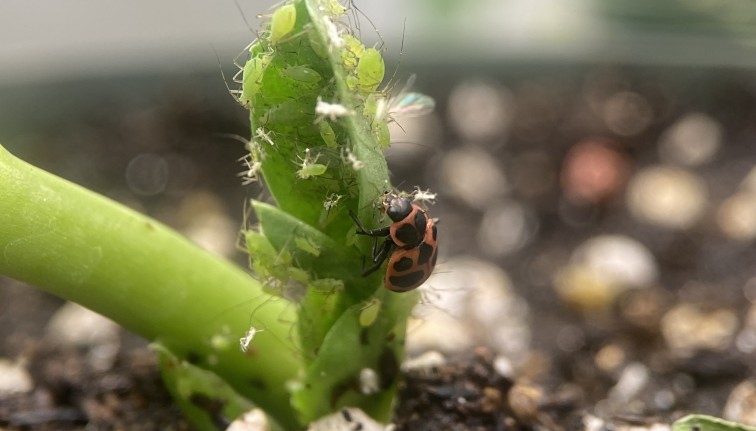
Pest Stage: Primarily an egg predator, but also capable of preying on aphids and other soft-bodied insects, including small larvae.
Commercially Available? Yes (see details in the ‘How to use…’ section below.)
Scientific Name: Coleomegilla maculata (DeGreer)
Biocontrol Agent Type: Predator
Common Names
Pink lady beetle
Pink spotted lady beetle
Twelve spotted lady beetle
Relative effectiveness
The pink spotted lady beetle is an effective generalist predator that targets a wide range of pests. Among these, it can help suppress aphid populations when their populations are low. However, this lady beetle tends to arrive after aphid populations are relatively high. At this point, the aphid action threshold is typically exceeded, and other pest management strategies should be used.
Where to use
Wide range of crops and in personal gardens, mostly outside.
It is most effective in areas with diverse prey, particularly on crops commonly targeted by aphids, such as potatoes, wheat, peas, and beans. It also thrives in crops that provide pollen sources, like sweet corn and field corn.
About the pink spotted lady beetle
The pink spotted lady beetle is an abundant, omnivorous predator native to North America. It feeds primarily on aphids and a variety of pollen sources. It will also eat other soft-bodied pests, and pest eggs. These pests include thrips, mites, some beetles, and some caterpillars. Both adults and larvae are active predators. Although they are generalists, they show a strong preference for aphids when available. For best results, it is recommended to use pink spotted lady beetles alongside other predators or in diverse habitats where pollen is plentiful, to support their persistence and effectiveness as a biocontrol agent.
- Native/Non-native to North America: Native
- Preferred climate: Temperate; cold tolerant
- Region: Can be found throughout most of North America, including parts of Mexico and Canada.
- Established in North America: Yes
- Where established: throughout North America
Pink spotted lady beetle appearance
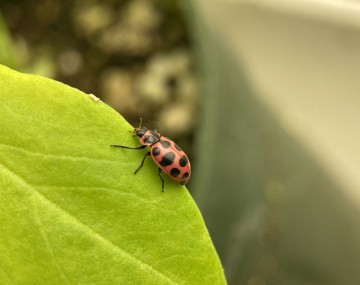
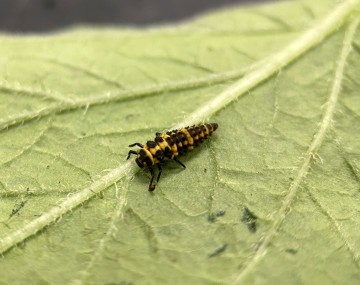
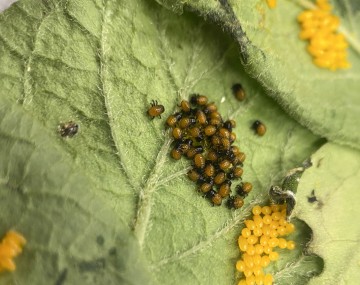
The pink spotted lady beetle does not have the typical lady beetle appearance. This insect is a medium-sized, pink to red beetle, giving it the common name “pink lady beetle.” It has a more oval than round shape, and features six spots on each hard wing cover, which gives its additional common name "twelve spotted lady beetle." The larvae are long, dark, soft-bodied, and often described as alligator-like in appearance. They can be distinguished from other lady beetle larvae by two yellow hourglass-shaped markings close to their head. The eggs are spindle-shaped, rather than oval, and are typically light yellow in color. They look similar to Colorado potato beetle eggs, but are narrower and smaller in size.
Life cycle of the pink spotted lady beetle
Pink spotted lady beetles look different as larvae, pupae, and adults. Photo credit: Laura Martinez created using Biorender.
Because pollen can make up about 50% of their diet, the pink spotted lady beetle is well suited for conservation biological control strategies. Research has shown that their abundance and aphid predation rates increased when dandelions were present in the field (Harmon et al., 2000).
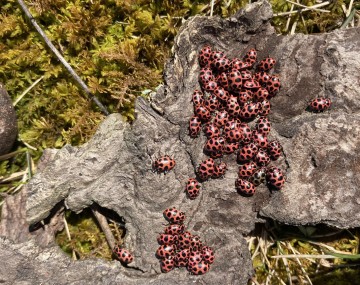
The pink spotted lady beetle has a complete metamorphosis life cycle consisting of egg, larva, pupa, and adult stages. Adults overwinter in large groups under leaf litter, stones, and protected or shaded sites along crop borders, especially near fields that previously grew corn. In early to mid-spring, they emerge and often walk along the ground in search of prey and eventually fly to suitable egg-laying sites in nearby crops.
Females can lay between 200 and over 1,000 eggs during a one- to three-month period starting in spring or early summer. Eggs are typically laid in small clusters near prey, such as aphids, on leaves or stems. After hatching, larvae, which grow from about 1 mm to 5–6 mm in length, actively search for prey and may travel up to 39 feet (12 meters) in pursuit of food. When fully grown, the larva attaches itself to a leaf or other surface to pupate, with the pupal stage lasting 3 to 12 days depending on temperature.
Adults are commonly found from April through late September and are frequently observed in corn, potato, and mixed vegetable fields. Toward the end of the season, adults aggregate again in preparation for overwintering. Depending on environmental conditions, the pink spotted lady beetle can produce two to five generations per year.
How to use the pink spotted lady beetle
Biocontrol category: Conservation
When to use: Thrive at moderate temperatures 75°F–81°F (24°C and 27°C), and may provide better pest control under these conditions.
Rate: Generally, conservation of wild populations is recommended, rather than releasing
Maximizing effectiveness: If you do release pink spotted lady beetles, do so when temperatures are consistently above 55°F (13°C), ideally 61–81°F (16–27°C). Introduce early in the season when soft-bodied pests or insect eggs are present.
Pest stage: Pest stage depends on the pest. Soft-bodied and smaller pests like aphids, thrips, mites are eaten as adults or nymphs. For larger and/or hard-bodied pests, such as caterpillars, Colorado potato beetles, Mexican bean beetles, predation typically occurs at the egg or larval stage, when they are still soft-bodied. Eggs of many pest species are commonly consumed.
Mode of action: Predator; adults and larvae actively hunt and consume soft-bodied insects and insect eggs.
Conservation: To conserve pink spotted lady beetle populations, maintain flowering plants like dandelions, clover, and other pollen sources near fields to provide alternative food when prey is scarce. Minimize the use of broad-spectrum insecticides, especially pyrethroid/pyrethrum (home gardens) or neonicotinoid (commercial farms) insecticides which can harm both adults and larvae. Providing habitat diversity and avoiding unnecessary pesticide applications will help sustain their natural pest control services throughout the season.
Compatibility: Pyrethroid/pyrethrum and neonicotinoid insecticides are known to harm pink spotted lady beetles. Pink spotted lady beetles are generally compatible with other arthropod natural enemies.
Risk: The pink spotted lady beetle does not harm humans or pets. As a generalist predator, it may also feed on non-target beneficial insects, such as butterfly eggs, other predatory insect larvae (e.g., lacewing larvae), or beneficial mite eggs. This is part of a normal, balanced ecosystem.
Commercially available: At the time of publication, pink spotted lady beetles were available from two Canadian companies - GrowLiv Biologicals and Natural Insect Control. Product availability can change quickly, and shipping may not be available to all locations within North America. The Association of Natural Biocontrol Producers can be a resource when sourcing biocontrol agents.
Any time you use a pesticide, you must read and follow the label directions and comply with all applicable laws and regulations related to pesticide use. Also be sure that any pesticide used is approved for use in your country and state/province.
The pink spotted lady beetle develops best between 75°F–81°F (24°C and 27°C) with the most favorable temperature for population growth at 77°F (25°C). Development slows below 55°F (13°C) and populations decline above 82°F (28°C). While larvae can still develop at temperatures up to around 95°F (35°C), survival and reproduction are significantly reduced at higher extremes (Morales-Ramos and Rojas 2017).
Pesticide labels may contain additional information about compatibility of the product with lady bugs and other beneficial organisms. Some insecticides can be highly toxic to beneficial insects, reducing their survival, mobility, and reproduction, and are therefore not recommended in conservation-focused integrated pest management (IPM) programs. Thiamethoxam and chlorantraniliprole have been shown to have sublethal effects on pink spotted lady beetles, and imidacloprid can have both lethal and sub-lethal effects. Because many pesticides have not been fully tested for their effects on all beneficial insects, gardeners and growers should exercise caution and consult pesticide labels and current research when making pest management decisions.
Using other native natural enemies in addition to pink lady beetles can offer effective and compatible pest control across many cropping systems. Most biological control agents are mutually compatible unless intraguild predation occurs—when one beneficial species preys on another. (Lucas et al. 2004; Moscardini et al. 2015; Smith and Krischik 1999)
About pests targeted by the pink spotted lady beetle
- Aphids, including pea (Acyrthosiphon pisum), green peach (Myzus persicae), and potato aphid (Macrosiphum euphorbiae)
- Colorado potato beetle (Leptinotarsa decemlineata)
- Twospotted spider mite (Tetranychus urticae)
- Thrips, including Frankliniella occidentalis, Thrips tabaci, and many others
- Mexican bean beetle (Epilachna varivestis)
- Corn earworm (Helicoverpa zea)
- European corn borer (Ostrinia nubilalis)
- Fall webworm (Hyphantria cunea)
Pink spotted lady beetles feed on a variety of soft-bodied pests and insect eggs, including aphids, mites, and eggs. Prey size does influence predation—smaller or immobile stages are more likely to be consumed, making early detection and control of pests more effective.
Pest damage
- Aphids: Aphids cause leaf curling, yellowing, and distortion by sucking plant sap. Heavy infestations leave behind sticky honeydew, which can lead to sooty mold growth on leaves and fruit, reducing photosynthesis and plant vigor.
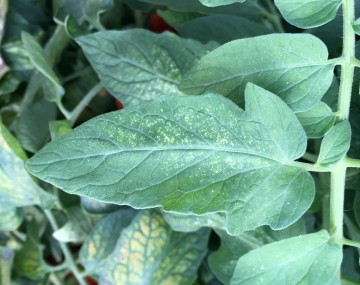
- Mites: Mites cause tiny yellow or white speckling (stippling) on leaves as they feed on plant cells. Severe infestations can lead to bronzing, webbing, and eventual leaf drop, weakening the plant.
- Thrips: Thrips feeding leads to silvering, scarring, and distortion of leaves, buds, and fruits. Damaged areas often have a silvery or bronze sheen and may show small dark flecks of thrips waste.
- Caterpillars (early instars, like cabbageworm or webworm larvae): Young caterpillars create small holes or windowpane feeding (chewing through upper layers of leaves but leaving the lower surface intact). Damage can expand quickly as larvae grow.
- Beetle eggs and larvae (e.g., Colorado potato beetle): Feeding larvae can consume entire leaf sections, often leading to severe defoliation. Egg masses, if untreated, lead to rapid outbreaks of leaf damage.
Authors
Laura Martinez and Brian Nault
Cornell College of Agriculture and Life Sciences (CALS)
Last updated: May 2025
Revised from Coleomegilla maculata in Hoffmann, M.P. and Frodsham, A.C. 1993. Natural Enemies of Vegetable Insect Pests. Cornell University.
Special thanks to Todd Ugine for reviewing the article and providing additional expertise. Thanks to Todd Ugine and Alayna Trejo for additional photos. Supported by a Cornell AgriTech Extension and Outreach Assistantship.
Michaud, J. P. (2012). Coccinellids in biological control. In G. E. Heimpel & N. J. Mills (Eds.), Insect bioecology and nutrition for integrated pest management (pp. 488–519). Wiley-Blackwell. https://doi.org/10.1002/9781118223208.ch11
Groden, E., Drummon, F.A., Casagrande, R.A. and Hayness, D.L.. 1990. Coleomegilla maculata (Coleoptera: Coccinellidae): Its predation upon the Colorado potato beetle (Coleoptera: Chrysomelidae) and its incidence in potatoes and surrounding Crops.” Journal of Economic Entomology 83(4): 1306–15. doi:10.1093/jee/83.4.1306.
Harmon, J.P., Ives, A.R., Losey, J.E., Olson, A.C., and Rauwald, K.S. 2000. Coleomegilla maculata (Coleoptera: Coccinellidae) predation on pea aphids promoted by proximity to dandelions.” Oecologia 125(4): 543–48. doi:10.1007/s004420000476.
Hazzard, R. V., Ferro, D. N., Van Driesche, R. G. and Tuttle, A. F. 1991. Mortality of eggs of Colorado potato beetle (Coleoptera: Chrysomelidae) from predation by Coleomegilla maculata (Coleoptera: Coccinellidae).” Environmental Entomology 20(3): 841–48. doi:10.1093/ee/20.3.841.
Hazzard, R. V., and Ferro, D. N. 1991. Feeding responses of adult Coleomegilla maculata (Coleoptera: Coccinellidae) to eggs of Colorado potato beetle (Coleoptera: Chrysomelidae) and green peach aphids (Homoptera: Aphididae).” Environmental Entomology 20(2): 644–51. doi:10.1093/ee/20.2.644.
Hoffmann, M.P. and Frodsham, A.C. 1993. Coleomegilla maculata. Natural Enemies of Vegetable Insect Pests. Cornell University.
Lucas, É., Giroux, S., Demougeot, S., Duchesne, R.-M. and Coderre, D. 2004. Compatibility of a natural enemy, Coleomegilla maculata Lengi (Col., Coccinellidae) and four insecticides used against the Colorado potato beetle (Col., Chrysomelidae).” Journal of Applied Entomology 128(3): 233–39. doi:10.1111/j.1439-0418.2004.00843.x.
Lynch, C. A., Smith, O. M., Chapman, E. G., Crossley, M. S., Crowder, D. W., Fu, Z., Harwood, J. D.et al. 2022. Alternative prey and farming system mediate predation of Colorado potato beetles by generalists.” Pest Management Science 78(9): 3769–77. doi:10.1002/ps.6553.
Michaud, J. P., and Grant, A. K. 2005. Suitability of pollen sources for the development and reproduction of Coleomegilla maculata (Coleoptera: Coccinellidae) under simulated drought conditions.” Biological Control 32(3): 363–70. doi:10.1016/j.biocontrol.2004.11.001.
Morales-Ramos, J. A., and Rojas, M. G. 2017. Temperature-dependent biological and demographic parameters of Coleomegilla maculata (Coleoptera: Coccinellidae).” Journal of Insect Science 17(2): 55. doi:10.1093/jisesa/iex028.
Moscardini, V.F., Gontijo, P.C., Michaud, J.P. et al. 2015. Sublethal effects of insecticide seed treatments on two nearctic lady beetles (Coleoptera: Coccinellidae). Ecotoxicology 24, 1152–1161. https://doi.org/10.1007/s10646-015-1462-4
Nault, B. A, and Kennedy, G.G. 2000. Seasonal changes in habitat preference by Coleomegilla maculata: Implications for Colorado potato beetle management in potato.” Biological Control 17(2): 164–73. doi:10.1006/bcon.1999.0781.
Orr, D. 2019. C. mac lady beetle. Biological Control Information Center. North Carolina State University Entomology Extension. Retrieved April 18, 2025, from https://entomology.ces.ncsu.edu/biological-control-information-center/beneficial-predators/c-mac-ladybeetle/
Roger, C., Coderre, D. and Boivin, G. (2000), Differential prey utilization by the generalist predator Coleomegilla maculata lengi according to prey size and species. Entomologia Experimentalis et Applicata, 94: 3-13. https://doi.org/10.1046/j.1570-7458.2000.00598.x
Seagraves, M. P., and Yeargan, K. V. 2009. Importance of predation by Coleomegilla maculata larvae in the natural control of the corn earworm in sweet corn.” Biocontrol Science and Technology 19(10): 1067–79. doi:10.1080/09583150903308715.
Smith, S. F., and Krischik, V. A. 1999. Effects of systemic imidacloprid on Coleomegilla maculata (Coleoptera: Coccinellidae).” Environmental Entomology 28(6): 1189–95. doi:10.1093/ee/28.6.1189.
Straub, C. S., Simasek, N. P., Gapinski, M. R., Dohm, R., Aikens, E. O. and Muscella, S. 2013. Influence of nonhost plant diversity and natural enemies on the potato leafhopper, Empoasca fabae, and pea aphid, Acyrthosiphon pisum, in alfalfa.” Journal of Pest Science 86(2): 235–44. doi:10.1007/s10340-012-0465-7.
Warreen, L. O. and Tadic, M. 1967. Biological observations on Coleomegilla maculata and its role as a predator of the fall webworm.” Journal of Economic Entomology 60(6): 1492–96. doi:10.1093/jee/60.6.1492.
Weber, D. C., Pfannenstiel, R. S. and Lundgren, J. G. 2008. Diel predation pattern assessment and exploitation of sentinel prey: New interpretations of community and individual behaviors. In P. G. Mason, D. R. Gillespie, & C. Vincent (Eds.), Proceedings of the Third International Symposium on Biological Control of Arthropods (pp. xxx–xxx). USDA Forest Service, FHTET.
Weber, D. C., Blackburn, M. B. and Jaronski, S. T. 2022. “Chapter 13 - Biological and Behavioral Control of Potato Insect Pests.” In Insect Pests of Potato (Second Edition), eds. Andrei Alyokhin, Silvia I. Rondon, and Yulin Gao. Academic Press, 231–76. doi:10.1016/B978-0-12-821237-0.00013-5.
Weber, D. C. and J.G. Lundgren. 2011. Effect of prior diet on consumption and digestion of prey and non-prey food by adults of the generalist predator Coleomegilla maculata.” Entomologia Experimentalis et Applicata 140(2): 146–52. doi:10.1111/j.1570-7458.2011.01141.x.
Related Links
- (315) 787-2206
- arc55 [at] cornell.edu