Phomopsis Cane and Leaf Spot of Grape (Phomopsis viticola)
Fruit Fact Sheet
Phomopsis Cane and Leaf Spot is a disease of grapevines caused by the fungal pathogen Phomopsis viticola. It occurs in most regions where viticulture is practiced. Infections damage leaves, weaken rachises, and discolor or destroy fruit.
In this fact sheet
- Symptoms and appearance of Phomopsis
- Disease cycle of Phomopsis
- Managing Phomopsis
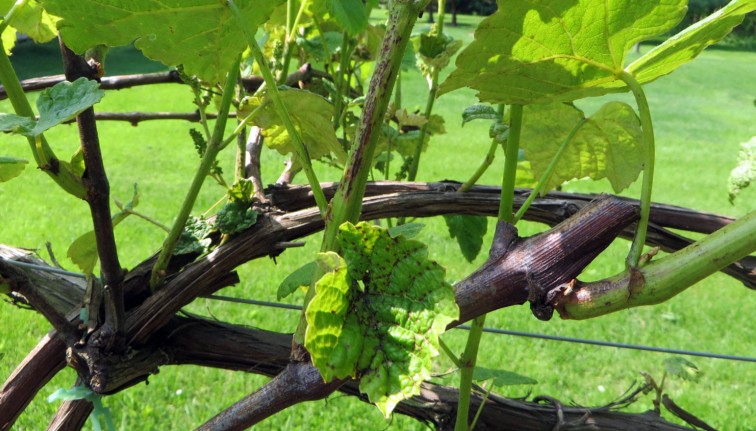
Phomopsis Cane and Leaf Spot is a common disease of grapevines and is caused by the fungal pathogen Phomopsis viticola. Transported by water, infective P. viticola spores ooze out of last year’s diseased wood onto young, susceptible shoots, leaves, and fruiting structures during warm, wet weather after bud break. Yield reductions occur when rachises become infected and girdle or break, or when berries become infected and rot. Losses can be as high as 10% to 40% in heavily infested vineyards. Infection severity and vineyard susceptibility varies across a range of factors including but not limited to weather, cultivar, and pruning and trellising systems. Phomopsis outbreaks can be prevented using vineyard sanitation practices and chemical interventions.
Symptoms and appearance of Phomopsis
- Shoots and petioles: black, elongated lesions appearing most commonly on basal internodes.
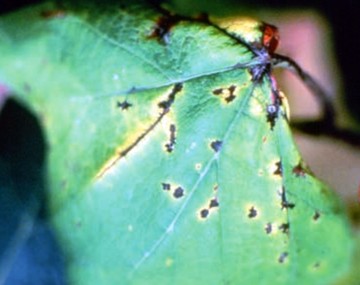
- Foliage: a speckling of dark lesions surrounded by yellow halos.
- Rachises and pedicels: sunken and black lesions causing tissues to become brittle.
- Berries: close to harvest, infected berries become brown, discolored, and are easily detached from pedicels; fungal fruiting bodies sometimes appear, giving berries a rough texture.
- Canes: infected canes can become bleached in the dormant season, and black fruiting structures are sometimes visible.
Phomopsis lesions first appear small and light green, then turn black with yellow margins later in the season. Leaf lesions are rarely economically damaging, though they do indicate pathogen presence.
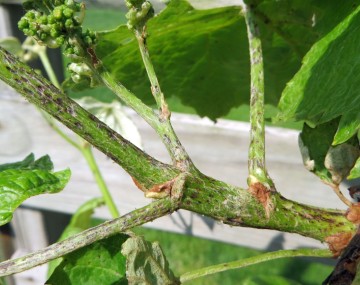
Phomopsis on the shoots, rachises and leaf petioles appear as rounded or elongated black spots.
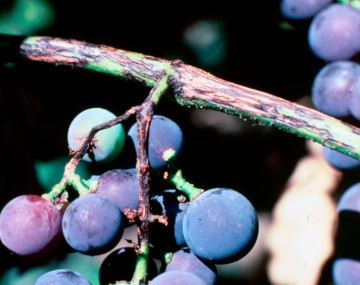
Longitudinal lesions on the shoots, rachises and pedicels become sunken and black later in the season, and may cause it to split and become brittle.
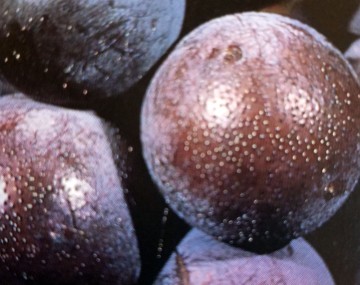
Close to harvest, infected fruit may develop a brown discoloration with raised black fungal bodies on the berry skin. Contrary to black rot, phomopsis-infected berries readily detach from pedicels.
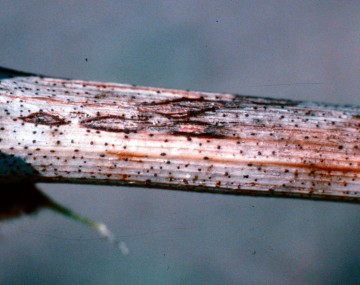
Infected canes can become bleached during the dormant season as the fungus overwinters. Infected canes and old wood accumulate pathogen inoculum and should be removed from the vineyard and destroyed to reduce disease pressure.
Disease cycle of Phomopsis
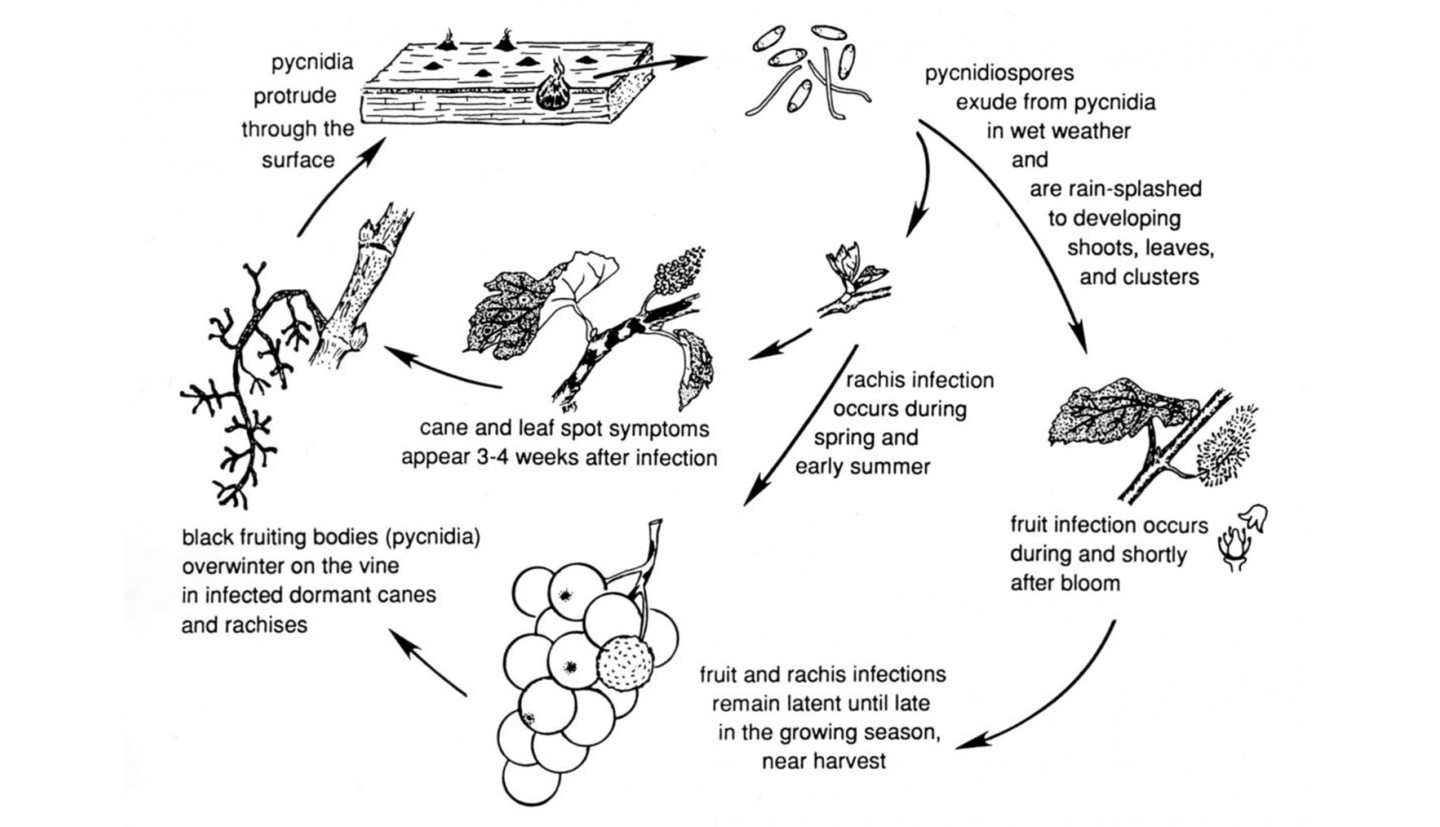
- Phomopsis viticola fruiting bodies overwinter in previously infected woody tissues. These fruiting bodies are called pycnidia.
- They produce pathogenic spores (i.e., pycnidiospores) in the late winter and early spring in the Northeast.
- After bud break, during wet, humid weather, pycnidiospores ooze or splash onto newly-developing tissues which can become infected.
- Lesions can start to appear:
- On leaves and shoots 3-4 weeks after exposure
- On blossoms shortly after bloom
- On rachises after 4 weeks, becoming more severe closer to harvest
- On fruit, close to harvest.
Notes on environmental conditions
- Infection severity is a function of pycnidiospore presence, proximity of susceptible plant tissues, as well as temperature and wetness duration—outbreak years are often characterized by prolonged periods of wet weather in springtime and temperatures at or below the optimal range of 60 to 68 degrees F.
- Generally speaking, once P. viticola disperses all of its inoculum (pycnidiospores), it will not undergo a secondary infection period; therefore, during warm, wet springs, the pathogen may exert all of its inoculum within a punctuated timeframe, whereas if the spring is dry, inoculum may be retained until conditions become favorable for dispersal.
- Shoot, leaf, and rachis tissue becomes more resistant to infection as it matures, and as the shoots lengthen, the vulnerable apical meristems grow farther away from P. viticola inoculum sources (i.e., last year’s infected wood), making them less prone to infection than in early growth stages.
- Presence of inoculum, wet weather, and an abundance of new growth means that grapevines are most vulnerable to infection around shoot growth initiation until a few weeks after bloom.
Management of Phomopsis
- Vineyard sanitation is the first line of defense
- Avoid introducing Phomopsis viticola to the vineyard by choosing pathogen-free propagation materials when establishing a new site.
- Select vineyard sites with direct sunlight and minimal shade to reduce wetting periods that encourage spore dispersal and fungal growth.
- Orient rows to take advantage of sunlight and wind movement in the area.
- During normal pruning in the dormant season, remove infected canes and dispose of them outside the vineyard.
- Consider that spur pruned systems that retain basal cane segments maximize retention of infected wood, and thereby increase infection risk.
- A fungicide program should supplement vineyard sanitation practices. Proper application timing is essential for effective management and to avoid unwanted costs of unnecessary pesticide applications.
- For help with proper application timing, check out the Phomopsis infection period tool on the Network for Environment and Weather Applications (NEWA) website, maintained by Cornell Integrated Pest Management
- For product recommendations, refer to your local Cornell Cooperative Extension or state guidelines when applying fungicides, or contact Cornell IPM or your local extension office.
Any time you use a pesticide, you must read and follow the label directions and comply with all applicable laws and regulations related to pesticide use. Also be sure that any pesticide used is approved for use in your country and state/province.
Authors
Kyle Bekelja
Grape IPM Coordinator, Cornell Integrated Pest ManagementLukas Rood
Temporary Program/Extension Aide, Cornell Integrated Pest Management
Last updated: October 2025
Modified from an article written by J. W. Pscheidt and R. C. Pearson:
Pscheidt, J.W., and Pearson, R.C. “Phomopsis Cane and Leaf Spot of Grape”. eCommons, Cornell University Library, 1991.
- Anco, Daniel J., Erincik, Omer, and Ellis, Michael A. “Phomopsis Cane and Leaf Spot of Grape”. Ohioline, The Ohio State University, 2011, https://ohioline.osu.edu/factsheet/plpath-fru-47.
- Bordelon, Bruce. “Phomopsis cane and leaf spot in grapes”. Facts for Fancy Fruit, Perdue University, 2016, https://fff.hort.purdue.edu/article/phomopsis-cane-and-leaf-spot-in-grapes/.
- Pscheidt, J.W., and Pearson, R.C. “Phomopsis Cane and Leaf Spot of Grape”. eCommons, Cornell University Library, 1991, https://hdl.handle.net/1813/43104.
- Wilcox, Wayne F., Gubler, Walter D., Uyemoto, Jerry K. “Phomopsis Cane and Leaf Spot.” Compendium of Grape Diseases, Disorders, and Pests, Second Edition. The American Phytopathological Society, 2015, pp. 68–71.
- Phomopsis on grapes is…—photo by Bruce Bordelon, Professor Emeritus, Purdue Horticulture and Landscape Architecture
- Phomopsis lesions first appear…—photo by R. Pearson, Cornell IPM
- Phomopsis on the grape…—photo by Bruce Bordelon, Professor Emeritus, Purdue Horticulture and Landscape Architecture
- Longitudinal lesions on the…—photo by R. Pearson, Cornell IPM
- Close to harvest, infected…—photo by R. Pearson, Cornell IPM
- Infected canes can become…—photo by R. Pearson, Cornell IPM
- Illustration showing the…—photo by unknown, Cornell Agritech
- (315) 787-2205
- kmb399 [at] cornell.edu