Pear Psylla (Cacopsylla pyricola)

Fruit Fact Sheet

The pear psylla, (pronounced sil-la). is the primary pear pest in North America. It was accidentally introduced into Connecticut in about 1832 and remained an Eastern pest until it was found in the Spokane Valley of Washington State in 1939.

The pear psylla, (pronounced sil-la). is the primary pear pest in North America. It was accidentally introduced into Connecticut in about 1832 and remained an Eastern pest until it was found in the Spokane Valley of Washington State in 1939. The psylla has since spread to all the pear growing areas of the United States and Canada.

Biology of pear psylla

Adults

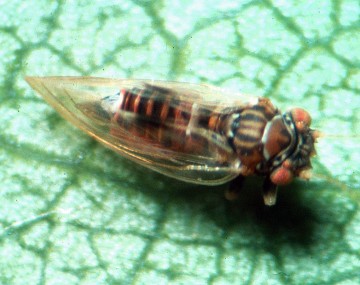
The psylla has three or four generations a year, depending on the length of the growing season for the area. Pear psylla adults (Figs. 1 and 2) resemble very small cicadas and there are two forms. The overwintering adults are dark reddish brown in color and are slightly larger (2.12 mm) than the tan to light brown colored summer adults (1.95 mm). The overwintering adults pass the winter in litter on the ground or in cracks in the tree bark. These adults become active at temperatures between 4.4 C and 10 C (40 F-50 F). On warm spring days, prior to the trees breaking dormancy, the overwintering adults can be found on the trunks, twigs, and branches. The psylla must mate prior to egg laying in the spring. On warm days, male psylla can be seen attempting to copulate with females. A female may lay 500 or more eggs.

Eggs

Pear psylla eggs are laid singly, often in a row or line. The eggs are whitish when first laid and then turn yellow. The first eggs in the spring are laid prior to bud burst, at temperatures between 10 C and 15.6 C (50 F-60 F). They are laid along cracks, ridges, or scars on the terminals and spurs. As the foliage appears and for succeeding generations, the eggs are laid on the new, more tender leaves. The eggs can be laid anywhere but the majority are laid along leaf midribs (Fig. 3). The early spring eggs may take up to 30 days to hatch, depending on the temperature. First egg hatch occurs about the time foliage appears.

Nymphs

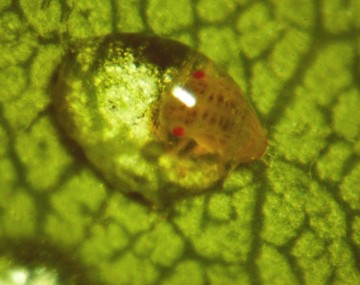
The pear psylla is a "flush feeder", meaning that the nymphs feed and develop primarily on the newer, more tender growth. By midway through the growing season, the majority of leaves are hardened off and psylla development then may be limited primarily to the water sprouts. Pear psylla nymphs are commonly grouped as small nymphs (instars 1, 2, and 3) and large nymphs (instars 4 and 5). The first instar nymph is yellow with red eyes and is flat and oval. Instars 2 and 3 closely resemble the first instar but are progressively larger. The first instar nymph may search for a suitable place to feed prior to settling down. Once it begins to feed, a characteristic honeydew drop forms over the nymph (Fig. 4). The psylla develops within the honeydew drop for the first four instars. Under extremely dry conditions, the honeydew can dry to become a white crystalline substance. In such situations, the nymph normally is killed. The fourth and fifth instars are conspicuously larger and darker than the small nymphs. They have black areas interspersed with bluish green to brown areas. The wing pads in the large nymphs become larger and more noticeable. The fifth instar does not produce as much honeydew or live within the droplet. It is called a hard shell (Fig. 5).

Damage of pear psylla

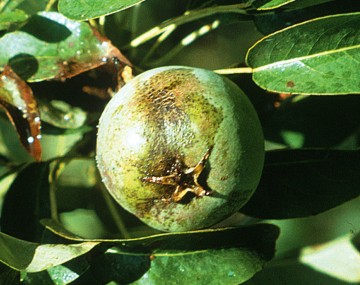
Honeydew injury occurs when excess honeydew drips onto and congregates on lower leaves and fruit. Under bright sunlight and dry conditions, the honeydew can kill the leaf tissue and produce a symptom called "psylla scorch". The honeydew is a good medium for sooty mold growth. When it occurs on the fruit, it russets the skin (Fig. 6) and makes the fruit unsalable. Pear trees with past problems of excessive honeydew characteristically have black bark due to the sooty mold. Excessive feeding and the injection of toxic saliva by large populations of psylla can cause a tree to wilt and lose its leaves prematurely. This reduces tree vigor which can take the tree several years to recover. This type of injury is called "psylla shock". In the West, the pear psylla has been associated with the transmission of a mycoplasma which produces symptoms similar to "psylla shock". The injury from the disease is called "pear decline" and can only be alleviated by treating the infected trees with antibiotics.

A pear psylla adult is pictured. It is a brown green in color and resembles a small cicada. The eyes are red and it has lighter stripes following its abdominal tergites. The wings are light green.

Figure 1. Pear psylla adult

Pear psylla adults are pictured. They are reddish brown in color and resemble small cicadas.

Figure 2. Pear psylla adults

Pear psylla eggs are shown in the image. The eggs are yellow in color and oval in shape. The eggs can be laid anywhere but most of the eggs are laid along the leaf midribs.

Figure 3. The eggs can be laid anywhere but the majority are laid along the leaf midribs.

Honeydew drops form over a pear psylla nymph. It appears to be a translucent drop of liquid pooled over the nymph atop a green leaf.

Figure 4. Once it begins to feed, a characteristic honeydew drop forms over the nymph.

The 5th instar is dark green in color with prominent wing pads, dark facial markings, a black abdomen, and red eyes.

Figure 5. The fifth instar does not produce as much honeydew or live within the droplet. It is called a hard shell.

A green apple is seen hanging from the tree with a light brown rough looking russeting seen from the side of the fruit.

Figure 6. When sooty mold growth occurs, it russets the skin of the fruit.

Management of pear psylla

Ladybird beetles, lacewings, syrphids, snake flies, and predatory bugs are recorded feeding on the psylla. There are two chalcid parasites of pear psylla in the United States. Pear psylla nymphs are parasitized and become mummies in the large nymph stage. To obtain commercially acceptable fruit, pear psylla must be controlled with insecticides. The psylla has become resistant to various insecticides in different areas of North America. Consult your local recommendations for the materials to use in your area.

Guide to pear psylla stages

  • Adults
    Timing: Dormant to bud burst, green cluster through leaf drop
    Where to look: On the spurs and branches on warm days, on the tender of new leaves
  • Eggs
    Timing: Late dormant to bud burst, green cluster through leaf drop
    Where to look: Placed singly or in rows on the spurs and twigs or around bud scales, on the tender new growth, along the leaf midribs, particularly the leaf under-surfaces
  • Small nymphs
    Timing: Green cluster through leaf drop
    Where to look: On the tender new growth, they can be exposed or in honeydew drops
  • Large nymphs
    Timing: Bloom through leaf drop
    Where to look: On leaves that are hardening off. The 4th instar can be in a honeydew drop. The hard shell stage is exposed.

Authors

  • John Leeper
    Cornell Integrated Pest Management, Cornell University

  • James Tete
    Cornell Integrated Pest Management, Cornell University

Published: 1978

  • Figure 1. Pear psylla adult. Photo: NYSAES, Cornell University
  • Figure 2.  Pear psylla adults. Photo: NYSAES, Cornell University
  • Figure 3. Pear psylla eggs. Photo: NYSAES, Cornell University
  • Figure 4. Pear psylla nymph with droplet. Photo: NYSAES, Cornell University
  • Figure 5. Fifth instar pear psylla nymph. Photo: NYSAES, Cornell University
  • Figure 6. Russeting from pear psylla damage.  Photo: NYSAES, Cornell University
  • Figure 7. Illustration of life cycle. Illustration: Hannah Tolz, Cornell Integrated Pest Management 
portrait of Anna Wallis
Anna Wallis

Fruit IPM Coordinator

Cornell Integrated Pest Management

Anna Wallis
  • aew232 [at] cornell.edu