Peachtree borer (Synanthedon exitiosa)

Fruit Fact Sheet

The peachtree borer (PTB), a native insect, is a major destructive pest of peach, cherry, plum, and other stone fruits in the United States and Canada.

The peachtree borer (PTB), a native insect, is a major pest of stone fruits in the United States and Canada. Prior to the introduction of the peach, it lived on native wild cherries and plums. The majority of PTB have a one-year life cycle, but some larvae may require two years to complete development.

Biology of peachtree borer

Adults

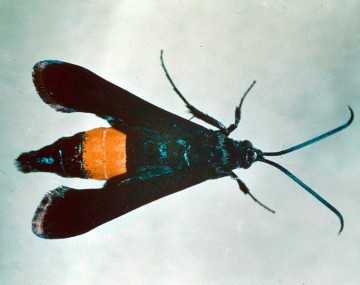
The adults are clear-winged, day-flying moths which, to the casual observer, are often mistaken for wasps. The sexes are strikingly distinct. The female (Fig. 1) is steel blue with an orange band on the fourth and sometimes also fifth abdominal segment. The forewings are opaque, covered with blue scales; the hind wings are transparent. The wing spread is 35-38 mm. The male (Fig. 2) is smaller (wing spread 27-30 mm) with both pairs of wings clear except for the margins and a line across the forewing. The blue abdomen is marked with 3 or 4 narrow yellow stripes. Adult emergence commences early in July, peaks in August, and may extend into October. Mating occurs soon after emergence. Several hours later, egg laying begins. A female may produce up to 800 eggs, the average being about 400. Ovipositing females seem to be attracted to trees previously infested by PTB or to trees on which mechanical injury has occurred. The moths die a few days after the short period of egg deposition ends.

Eggs

The oval (0.5 by 0.7 mm) reddish-brown eggs are deposited singly or in small groups on the trunk, lower scaffold limbs, or on debris or soil near the base of the tree, and are difficult to find. The incubation period varies with the temperature and averages about 10 days. First egg hatch occurs in mid-July.

Larvae

Upon hatching, the larvae immediately start burrowing into the bark, usually entering at a crack or wound near the soil surface. The larvae feed on the cambium or growing tissues and tunnel between the inner bark and the sapwood. PTB larvae are white or cream colored with a yellowish-brown to dark brown head. When half to full grown, the prothorasic and anal shields become yellow to dark brown in color (Fig. 3). Like other lepidopterous larvae, they have 3 pairs of jointed thoracic legs plus prolegs on the 3rd, 4th, 5th, 6th, and last abdominal segment. There are 7 larval instars, varying in size from 1.6 mm to 38 mm. The larvae normally attack the tree trunk between 76 mm (3 in) below ground to 254 mm (10 in) above ground. Some of the earlier hatching borers are nearly mature by fall, but most are only half-grown. The larger larvae hibernate in their burrows beneath the bark, while the smaller larvae usually pass the winter on the bark under a thin silken covering or hibernaculum. With the advent of warm weather in April and May, feeding is again resumed. Prior to pupation, the mature larvae normally enter the soil. There they construct silken cocoons containing particles of chewed-up bark, frass and soil particles (Fig. 4). The cocoons are elongate, brownish to sand colored capsules averaging about 22 mm long. They are usually situated in an upright position just beneath the soil surface.

Pupae

Within the cocoons, the larvae pupate into dark brown to black pupae measuring about 14 mm long. The pupae possess stiff spines on their backs which assist them in working themselves out of the cocoons. The combined period of cocooning and pupation averages about 28 days.

An adult female peachtree borer is pictured. It is steel blue in color with an orange band on the fourth and sometimes fifth abdominal segment. The forewings are opaque and covered with blue scales. The hind wings are transparent. It has a wing spread of 35-38 mm.

Figure 1. An adult female peachtree borer

An adult male peachtree borer is shown in the image. It is steel blue in color with 3 or 4 narrow yellow stripes. Both pairs of wings are clear except for the margins, and a line across the forewing. It has a wingspan of 27-30 mm.

Figure 2. An adult male peachtree borer

A peachtree larva is pictured. The larva is a pale white or cream color with a yellow to dark brown colored head. When larvae are half to full grown their prothorasic and anal shields become yellow or dark brown in color.

Figure 3. When half to full grown the prothorasic and anal shields become yellow to dark brown in color.

The mature larva constructs silken cocoons within the soil. The cocoons contain small particles of chewed-up bark, frass, and soil particles. The cocoon is brown in color and about 22 mm long.

Figure 4. Larvae construct silken cocoons containing particles of chewed-up bark, frass and soil particles.

Damage of peachtree Borer

Injury is caused by the larvae feeding on the cambium and inner bark of the trunk close to the soil level. Occasionally larger roots are also attacked. Areas attacked often have masses of gum, mixed with frass, exuding from the bark. All ages of trees are injured (Figs. 5, 6, 7). Young trees are at times completely girdled and subsequently die. Older trees are often so severely injured that their vitality is lowered and they are rendered especially susceptible to attack by other insects or by diseases.

A young tree is pictured with a dark brown mass of gum and frass build up around the tree.

Figure 5. Young tree injured.

An injured tree is shown with dark brown frass and gum exuding from the tree’s bark.

Figure 6. Tree injured with masses of gum and frass exuding from the bark.

An older tree is pictured with a brownish red buildup of frass and gum exuding from the base and roots of the tree.

Figure 7. Larger roots attacked on older tree

Management of peachtree borer

The PTB can be controlled by thorough, well-timed insecticide applications. An orchard spray directed against the adults will also control other pests present at the time. PTB pheromone trap catches can be used to time these sprays. Another treatment directed at the larvae calls for the application of a trunk spray anytime between July 20 to August 1. Young peach trees can be protected for a year or more by dipping the roots and crowns in a systemic insecticide solution prior to planting. Current recommendations and proper handling procedures are available from your local extension office.

Any time you use a pesticide, you must read and follow the label directions and comply with all applicable laws and regulations related to pesticide use. Also be sure that any pesticide used is approved for use in your country and state/province.

Guide to peachtree borer stages

  • Adults
    Timing (in New York State): Early July through October
    Where to look: On trunk and lower scaffolds. Flights may be monitored with pheromone traps.
  • Eggs
    Timing (in New York State): Early July through October
    Where to look: On trunk, lower scaffold, or at base of the tree.
  • Larvae
    Timing (in New York State): Any time of the year
    Where to look: Beneath bark in wound identified by exuding mixture of frass and gum.
  • Pupae
    Timing (in New York State): Early June through October
    Where to look: Within cocoons in soil.

Authors

  • S.E. Lienk
    New York State Integrated Pest Management Program

Last updated: 1980

  • Figure 1. An adult female peachtree borer. Photo: NYSAES, Cornell University
  • Figure 2. An adult male peachtree borer. Photo: NYSAES, Cornell University
  • Figure 3. Peachtree borer larva. Photo: NYSAES, Cornell University
  • Figure 4. Peachtree borer cocoons. Photo: NYSAES, Cornell University
  • Figure 5. Young tree injured. Photo: NYSAES, Cornell University
  • Figure 6. Tree injured with masses of gum and frass. Photo: NYSAES, Cornell University
  • Figure 7. Larger roots attacked on an older tree. Photo: NYSAES, Cornell University
  • Figure 8. Illustration of guide to stages. Illustration: Hannah Tolz, Cornell Integrated Pest Management 
portrait of Anna Wallis
Anna Wallis

Fruit IPM Coordinator

Cornell Integrated Pest Management

Anna Wallis
  • aew232 [at] cornell.edu