Mexican Bean Beetle (Epilachna varivestis)
Vegetable IPM Fact Sheet
Mexican Bean Beetle (MBB) is a pest species in the lady beetle family. MBB will feed on beans including dry beans, snap beans, lima beans and soybeans. MBB can defoliate and feed on different parts of the bean and pea crops, reducing yields in serious infestations (20% to 50%).
In this fact sheet
- Identification of Mexican Bean Beetle
- Life cycle of Mexican Bean Beetle
- Managing Mexican Bean Beetle
MBB is a pest insect that has been in the United States for over a century. MBB is native to Mexico, and was only found in the western part of the United States until it was introduced to Alabama in 1920. By 1938, nearly all states east of the Mississippi had active MBB populations. The MBB mainly feeds on bean crops, such as dry beans, snap beans, lima beans and soybeans. In the Northeast, there are two generations of MBB per year. Both the larvae and the adults will feed on crop species, almost exclusively eating the undersides of plant leaves. This causes damage to the leaves, giving them a lace-like appearance. Heavier infestations will cause complete defoliation of bean plants and reduced yields.
Identification of Mexican Bean Beetle
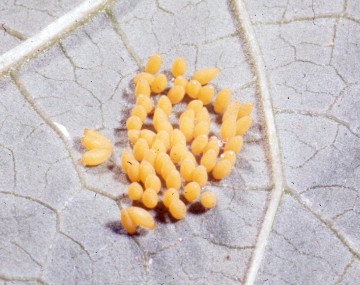
- Eggs: Eggs are deposited by the adult beetles on the underside of leaves. The eggs are yellow, approximately 1.2 mm long and are laid in groups of 40 to 50 eggs.
- Larvae: The larvae of MBB have bright yellow bodies with spined backs. The spines are arranged in 6 rows and have black tips. Larvae typically grow to 8 mm in length by the end of the larval stage
- Pupae: MBB pupae are yellowish-orange in color and are usually found on the undersides of leaves.
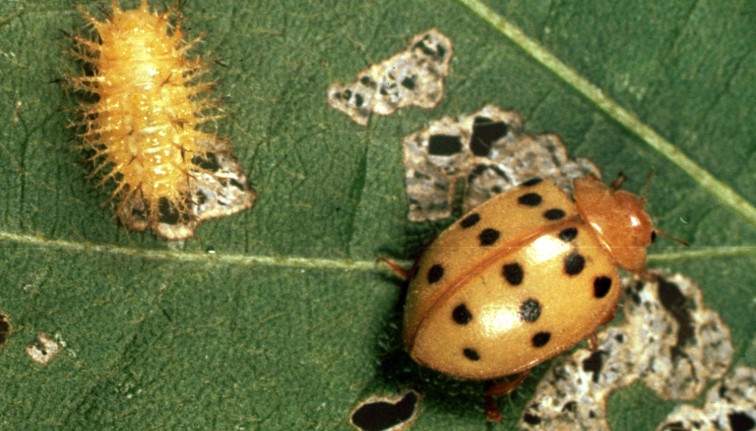
- Adults: The adult MBB is approximately 6-8.5 mm long with 16 black dots on its back wings. The color of its body varies, as younger adults have a yellow color while older or overwintering adults have a coppery-brown color.
Eggs are laid on the underside of bean leaves. They are yellow and laid in clusters of 40 to 50 eggs.
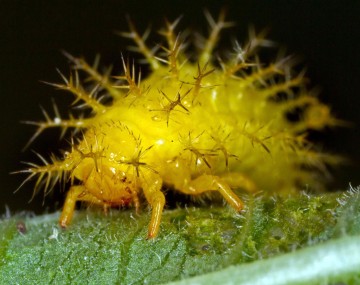
MBB larvae are bright yellow in color with 6 rows of spines on their back. These spines are yellow with a black tip.
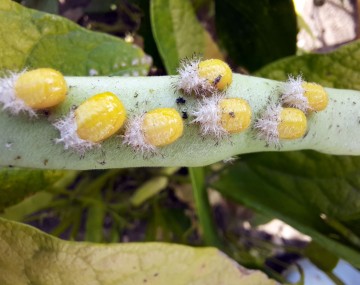
The pupae of MBB have a yellowish-orange color and are attached to their pupation site via the larva’s old skin.
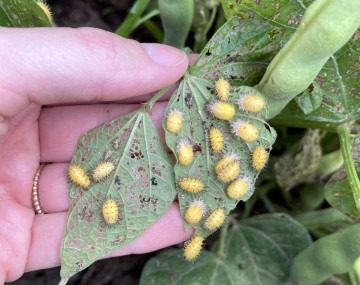
The pupae can attach to many different parts of the bean plant, including the stalk, leaves and beans.
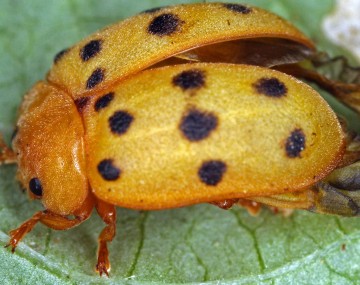
MBB adults are around 6-8.5 mm long, with a yellow to brown colored body and black spots on its back.
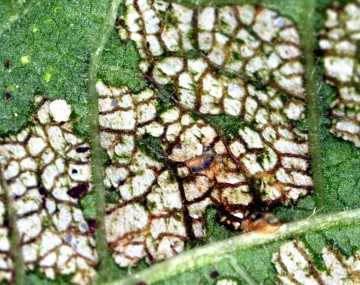
Life cycle of Mexican Bean Beetle
- Adult beetles overwinter in ground cover in protected places such as hedgerows near bean fields. They return to the bean fields in June to feed on plants and lay their eggs.
- MBB eggs are mostly laid on the underside of plant leaves and hatch after 5 to 14 days, depending on the temperature.
- The larvae and adult MBB feed almost exclusively on the undersides of bean plants. The larval stage lasts about 2 to 5 weeks.
- Pupation mostly occurs on bean leaves, where adults emerge after about 10 days.
- The average development time from egg to adult is 33 days. Two generations of MBB are typical per season in infested fields in the Northeast.
- Heavy infestations of MBB can cause yield losses between 20% and 50% due to bean defoliation. Cool, moist weather is associated with heavier infestations, while hot weather suppresses MBB development.
- There are usually two peak periods of bean damage from both generations of MBB. The first is from the first generation in July, while the next is from the second generation in late August.
- MBB larvae and adults will feed on the undersides of leaves, giving the leaves a distinct lace-like appearance.
Management of Mexican Bean Beetle
Cultural control
- Using reflective plastic mulch (metallic or white) on bean plants reduces colonization rates of MBB, since MBB has a low tolerance for direct sunlight. Other methods include planting in early spring or late summer to avoid peak MBB damage. An early-planted trap crop can attract overwintering adults, allowing control measures to be targeted specifically to the trap crop.
- On a small-scale farm or garden, MBB can be physically removed by hand, since most of the population is found on the foliage of bean plants.
Biological control
- Certain predatory insect species of MBB can be used to help control infestations. Few native predators of MBB exist in the US, except for stink bugs and other species of lady beetles.
- The most effective species to use for MBB infestations is the eulophid wasp (Pebiobus foveolatus). It does not overwinter in the US, so re-introduction is required every season.
Chemical control
- Refer to your local Cornell Cooperative Extension or state guidelines when applying insecticides to crops.
- Responsible pesticide application should be planned when applying any insecticide to crops. This should be done to ensure that resistance to pesticides is minimized in the targeted pest population, while minimizing damage to beneficial insects and pollinator populations.
- Use Cornell IPM's EIQ (Environmental Impact Quotient) calculator to access the environmental and health impacts different pesticides have before selection.
Any time you use a pesticide, you must read and follow the label directions and comply with all applicable laws and regulations related to pesticide use. Also be sure that any pesticide used is approved for use in your country and state/province.
MBB larvae and adults feed on the underside of bean leaves, damaging them and causing defoliation.
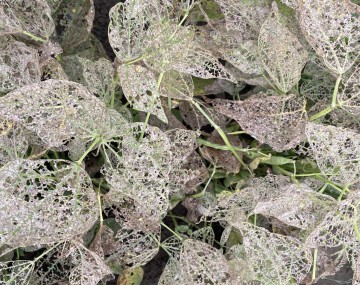
Excessive feeding from MBB will cause defoliation of bean plants, giving them a lace-like appearance.
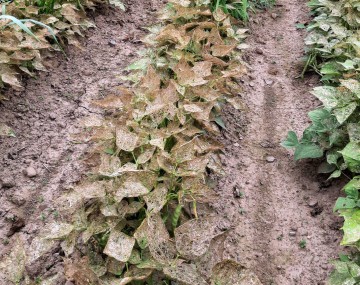
Heavier infestations of MBB can cause significant defoliation of bean plants, resulting in lower yields at harvest.
Authors
Marion Zuefle
Vegetable IPM Coordinator, Cornell Integrated Pest ManagementLukas Rood
Temporary Program/Extension Aide, Cornell Integrated Pest Management
Last updated: December 2025
Modified from an article written by A. A. Muka:
Muka, A.A. “Mexican Bean Beetle”. eCommons, Cornell University Library, 1983, with url https://hdl.handle.net/1813/43283.
This factsheet was developed in part with funding support from the New York State Department of Agriculture and Markets.
- Muka, A.A. “Mexican Bean Beetle”. eCommons, Cornell University Library, 1983, https://hdl.handle.net/1813/43283.
- “Mexican Bean Beetles.” Purdue University College of Agriculture, https://ag.purdue.edu/department/entm/extension/field-crops-ipm/soybean/mexican-bean-beetles.html.
- L. B. Nottingham, G. P. Dively, P. B. Schultz, D. A. Herbert, T. P. Kuhar, Natural History, Ecology, and Management of the Mexican Bean Beetle (Coleoptera: Coccinellidae) in the United States, Journal of Integrated Pest Management, Volume 7, Issue 1, January 2016, 2, https://doi.org/10.1093/jipm/pmv023.
- The adult MBB is…—photo by USDA Cooperative Extension Slide Series, Clemson University
- Eggs are laid on…—photo by Jim Baker, North Carolina State University
- MBB larva are bright…—photo by David Cappaert, Quamash EcoResearch
- The pupae of MBB…—photo by Marion Zuefle, Cornell IPM
- The pupae can attach…—photo by Marion Zuefle, Cornell IPM
- MBB adults are around…—photo by David Cappaert, Quamash EcoResearch
- MBB larvae and adults…—photo by David Cappaert, Quamash EcoResearch
- Excessive feeding from MBB…—photo by Marion Zuefle, Cornell IPM
- Heavier infestations of MBB…—photo by Marion Zuefle, Cornell IPM
- (315) 787-2379
- mez4 [at] cornell.edu