


Geese on School Grounds
Although beautiful in flight and valued as a symbol of the wild, Canada Geese (referred to hereafter simply as geese) have become an increasing issue on lawns and other open turf areas. Geese occur as subspecies and populations, each with distinctive breeding, wintering, and migratory behaviors. Populations that cause problems are usually what have become known as resident or local-breeding geese. Most of these birds belong to the physically largest subspecies that many had believed to be extinct. Scattered flocks were re-discovered in the middle of the 20th century, and extensive introduction efforts followed within both the historic range of the subspecies, and areas where they were not known to have previously existed. These introductions were very successful, and geese now occupy not only most marshes and similar wild habitats, but also urban and suburban landscapes that readily meet the major habitat requirements for geese: an open area with a wide view, turf for grazing, and a nearby body of water.
Problems at schools and other public properties
Issues with geese include messy accumulations of feces, degraded water quality, the potential for disease transmission, traction issues on athletic fields and playing surfaces, turf damage, traffic hazards, noise, and aggression during the nesting season. Geese impact schools by not only aesthetically degrading the grounds, but also in terms of community relations and costs associated with management.
A high school in upstate New York was reprimanded by a regional athletic association for the condition of the athletic fields due to geese. The school decided to cancel use of the 30-acre complex for an entire season.
An integrated pest management approach
There is no uniformly successful technique for dealing with goose problems, and programs must be tailored to the particular situation.
Feeding bans
People feeding geese not only can result in increased numbers at a site, but also is generally considered unhealthy for the birds. Policies and signage discouraging feeding are desirable. However, if not enforced, they tend to be ignored. One municipality had success in recruiting children to organize a no-feeding campaign.
Exclusion
Exclusion is most effective on small ponds and along shorelines of larger water bodies when geese are flightless during the summer molting period. Geese prefer to be able to easily walk back and forth from the water to the land. Any barrier at least a foot high can reduce this easy access. Options include dense vegetation, rocks, high banks, and wire or plastic fences. Electric fences should be installed and maintained by a knowledgeable individual using UL-approved fence chargers. Do not install electric fences near water along shoreline edges. Due to the presence of children, use of electric fencing at schools is generally not advisable.
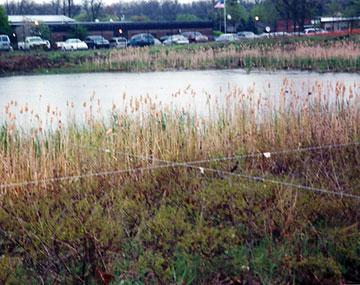
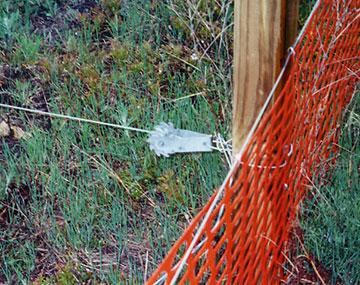
On retention ponds and other ponds where human use is discouraged, installing a grid or parallel lines of cable, wire, or heavy-test fishing line will discourage goose use. The lines may be ten to twenty feet apart. To prevent geese from walking under the lines, install plastic net fencing on the support posts around the perimeter of a pond.
Habitat modification
Any landscaping changes that reduce preferred goose habitat will also lower the attraction for the birds. The practicality of accomplishing this will vary depending on the site. Options include allowing grass to grow taller to discourage grazing, growing less palatable grass species, or replacing turf with non-grass groundcovers. Reducing the amount of fertilization may be a possible strategy. Planting trees, especially near water, can reduce the appeal of a site for geese.
Growing less palatable grasses on athletic fields is a dilemma, because the best performing species for athletic turf are Kentucky bluegrass and perennial rye grass. Geese favor both but dislike tall fescue. Turf varieties with tall fescues are starting to be used on athletic fields.
Lethal control of Geese
Geese are protected by the Migratory Bird Treaty Act. However, federal and state agencies may issue permits for lethal control of adult geese, and egg or nest destruction. There are no legal chemical toxicants for use on goose adults and goslings.
Hunting seasons and regulations targeting resident geese have become very liberal. While shooting on school property would rarely, if ever, be considered, encouraging hunting in the region surrounding rural schools might be an option.
During summer, young geese and most of the adults are flightless. If the appropriate permits are obtained, experienced professionals can conduct a round-up and removal of the birds. In most cases, the birds must be humanely euthanized. Sometime the geese are sent to a poultry processor, and the meat is donated to local food banks.
Reproductive control
Until recently, there was a product for the temporary sterilization of geese. The active ingredient was nicarbazin. The product did not receive registration in all states and had logistical issues. The company making the product voluntarily dropped the federal registration in 2015.
Finding nests and oiling, puncturing, or replacing the eggs may reduce goose reproduction. Simply destroying the eggs will only result in the birds re-nesting. The two major methods are to pierce the egg shell with a long, thin needle, and covering the egg with vegetable oil which suffocates the embryo. Alternatively, eggs may be removed and be replaced with fake ceramic eggs. The permit process for accomplishing this has been simplified by the US Fish and Wildlife Service. Visit the Resident Canada Goose Nest and Egg Registration Site for information. Note that not all states have opted into this on-line registration approach.
Harassment
A wide range of techniques is available for harassing or hazing geese at a particular site. Permits are not needed as long as the birds are not nesting, flightless young are not present, or geese are not injured. Methods include pyrotechnics (utilizing loud explosive sounds), lasers, recorded distress calls, trained dogs, abatement falconry, and remote-controlled model cars and boats, among others. Research at Cornell with several techniques had the best results with trained dogs during the day and lasers at night. Note that regulations on laser purchase and use have recently been tightened.
Habituation of the birds to the harassment techniques can be reduced, but not eliminated. Movement, either incorporated into the device or moving the device around, may increase effectiveness. Installing a device when geese become a concern, or right before they cause a problem, is preferable over constantly deploying a device. Reinforcement of a device may also delay habituation. For example, one practitioner had some success with using canine effigies, reinforced by occasional harassment with trained dogs. Geese and other birds are smart, and they will quickly determine if a device or situation poses real danger, or not.
Technique efficacy is not the only important criteria. The method must be compatible with the desires and workday of the school staff that will be utilizing it. For example, partnerships with two upstate New York school districts resulted in a preference for different techniques. The facilities staff of one district favored the use of a radiocontrolled model truck for harassing geese off of school grounds. The staff of a least one school in the second district preferred to use an “air dancer” which they installed early in the morning and removed at the end of their workday.
Repellents
Registered goose repellents contain the active ingredients methyl anthranilate or anthraquinone. These formulations may be applied on the turf or water, or in at least one case, as an aerosol (fogger). Repellents are regulated as pesticides. Check with the appropriate state agency if a product is registered for your state, and if it needs to be applied by a certified pesticide applicator. A limitation of chemical repellents is that repeated applications are often necessary, which can result in considerable expense.
Community Collaboration
A population of resident geese is rarely limited to one property. Community interaction and collaboration is necessary for long-term, sustainable management of goose issues, especially if a reduction in numbers is desired. One New York State municipality reduced goose numbers by developing a community-wide collaboration utilizing egg oiling, educational outreach, and habitat modification.
Resources for Community Collaboration
Author
Lynn Braband, New York State Integrated Pest Management Program, Cornell University
Date Published: 2016
Acknowledgement: Paul D. Curtis, Cornell University’s Department of Natural Resources, provided helpful feedback and editing of this document.