Colorado potato beetle (Leptinotarsa decemlineata)
Vegetable IPM Fact Sheet
The Colorado potato beetle (Leptinotarsa decemlineata), a leaf beetle native to the Southwestern U.S. and Mexico, is a major potato pest. First described in 1824 by Thomas Say near the Colorado Rockies, it has since spread across North America, Europe, and Asia, becoming one of the most destructive defoliators of potato crops.
In this fact sheet
- Signs and symptoms of Colorado potato beetle
- Life cycle of Colorado potato beetle
- Management of Colorado potato beetle
- Insecticide resistance of Colorado potato beetle
What makes the Colorado potato beetle (CPB) such a formidable pest is its extraordinary ability to adapt to unfavorable conditions. For example, CPB adults can survive by burrowing underground to overwinter as well as during the summer when conditions are hot and dry, feeding on non-crop plants in the nightshade (Solanaceae) family when potato is not available, and developing resistance to insecticides. In fact, CPB has evolved resistance to over 50 different insecticides, often within just a few years of their introduction. CPB’s survival characteristics makes managing its infestations a constant challenge for potato growers.
Signs and symptoms of Colorado potato beetle
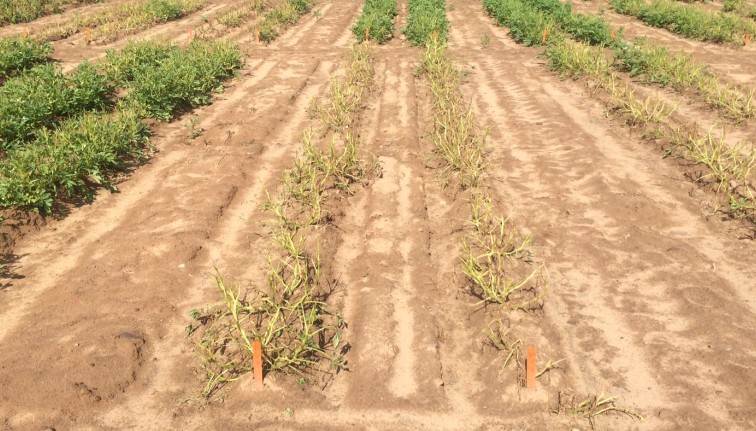
The Colorado potato beetle (CPB) is the most significant insect pest of potatoes. Larvae and adults cause severe defoliation, reducing tuber yield. Unmanaged infestations can lead to complete defoliation. CPB also attacks other Solanaceous crops like eggplant and tomato, causing similar damage and yield loss.
Life cycle of Colorado potato beetle
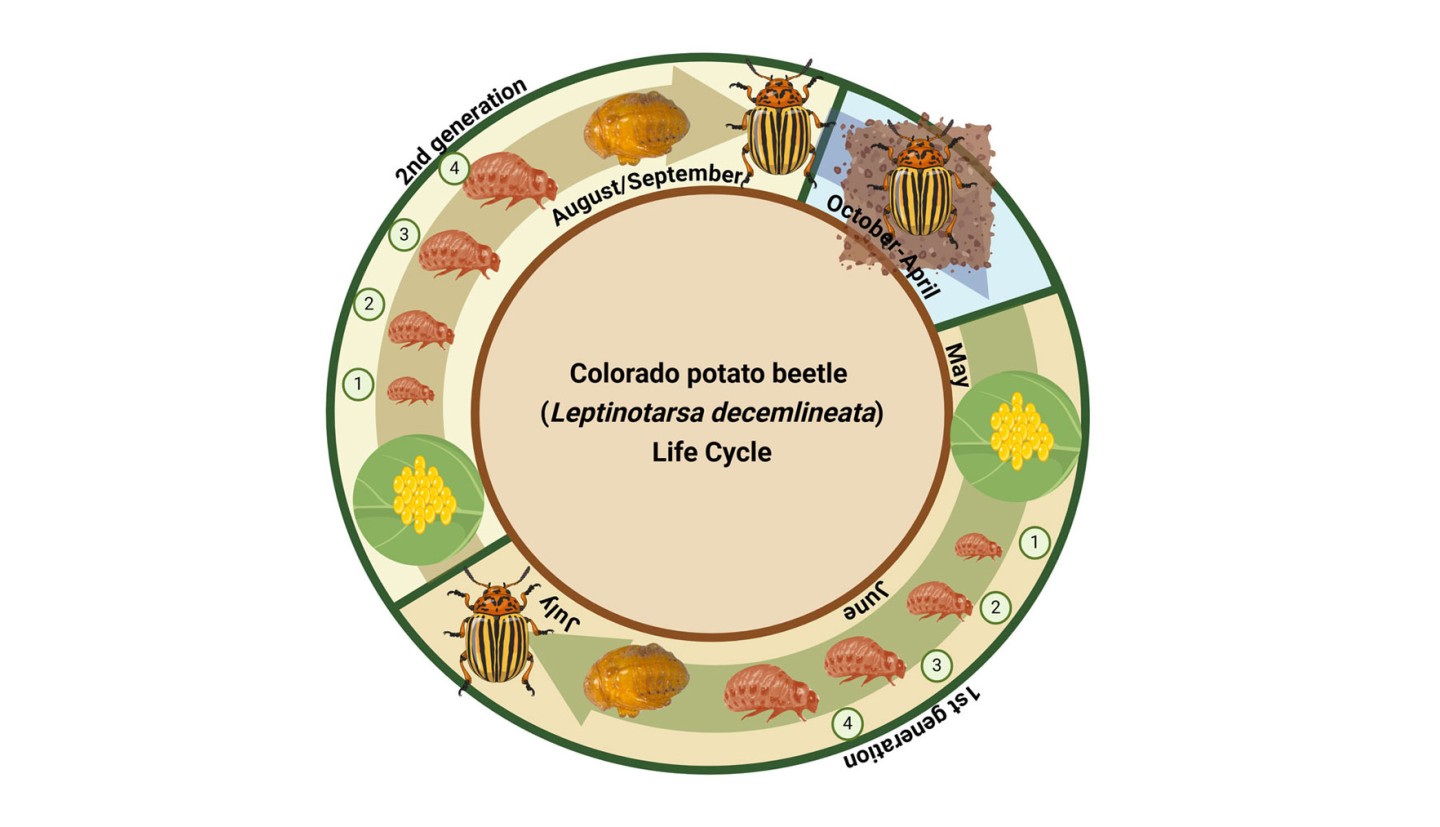
Life cycle information (two generations)
Depending on the area, some populations can have 1-3 generations per year. The following dates are applicable to two-generation seasonal life cycles in New York State.
Overwintering adults (October – April)
- Adults survive overwinter in the soil during the cold months. Overwintering locations may be in the previous season’s potato field or along nearby field borders.
First generation (May – July)
- May-July: With warmer soil temperatures (~55 F or 13 C), adults begin to emerge from overwintering sites to move toward the nearest crops. While adults can fly, it is more common to see them walking to crop fields.
- Adults start to mate a few days after emerging from the soil. A single adult female can lay up to 300-800 eggs in her lifetime. Clusters of 20 to 30 yellow eggs are laid on the underside of potato leaves.
- Larvae emerge about 4-10 days after eggs are laid.
- Larvae have four distinct instars over 2-3 weeks that vary based on size. Fourth instars are responsible for the most damage.
- After larvae complete the fourth instar, they begin burrowing into the soil to pupate.
- The pupal stage lasts 5-10 days and first-generation adults start to emerge in July. A small portion of the adult population will remain in the soil until the following year.
Second generation (August-September)
- First generation adults begin to reproduce and eggs are laid.
- Second generation larvae develop and pupate in the soil
- Second generation adults emerge at the end of the summer (August- September).
- This generation feeds, but typically does not reproduce, and then enters diapause.
Life stages and appearance
Management of Colorado potato beetle
Effective Colorado potato beetle management requires an integrated approach that may combine cultural and physical practices, biological control, and careful use of chemical insecticides. Understanding CPB’s life cycle and behavior are key to making informed management decisions and reducing crop losses.
Regular scouting is essential: walk the field in a V-shaped pattern and check 30–50 plants or stalks, depending on plant size. At each stop, count adults, small and large larvae separately, and look for orange-yellow egg masses on leaf undersides. Also record percent defoliation to help guide action thresholds. Thresholds are listed below under Chemical Control.
Physical Control
- Plastic lined trenches – Install between overwintering site and main crop to intercept migrating beetles overwintering from field edges (adults can not escape the slippery sides of the plastic trench and die).
- Row cover – Use to protect young plants against overwintering adults. Only use if solanaceous crops, like potatoes or eggplants, were not grown in that location the previous season, as beetles may emerge from the soil beneath the covers.
- Flamers – Apply propane burners for killing adults on small plants
- Tilling after harvest - This strategy can help reduce overwintering beetle populations.
Cultural Control
- Crop rotation – Rotate host crops at least 0.25-0.5 miles from previous years potato fields, as beetles typically overwinter nearby and are more likely to walk to the crop than flying long distances.
- Early harvest – Vine kill potatoes as soon as the crop matures to eliminate or minimize food for second-generation adults that is needed to survive overwinter.
- Trap crop – Plant early-maturing potatoes before the main potato crop; treat with insecticide.
Chemical Control
Application timing. The preferred approach for managing CPB is to make an insecticide application at planting (see options below). This is a preventative approach that is not based on the size of the CPB infestation.
Another approach is to make foliar insecticide applications. Guidelines for determining if and when to spray include the following action thresholds: 1.0 to 1.5 large larvae per plant, or 4 small larvae per plant, or 0.5 to 1.0 adult per plant. However, timing of foliar sprays should consider the phenology of the CPB population (i.e., all stages of CPB in the field). The best advice is not to wait too long to make the application (e.g., when many large larvae are present) because it will be difficult to control the infestation. Conversely, it is not advised to start too early or else more than one or two applications may be needed to control the infestation, rather than one well-timed application.
Products (examples of those commonly used):
- Spinosyns (Group 5): Spinosad (e.g. Entrust® for organic, or Blackhawk®) and spinetoram (Radiant® SC) are fermentation-derived insecticides that are highly effective on CPB larvae. They are considered reduced-risk and are organic-approved (spinosad), making them popular in organic potato production. Spinosyns act on the insect nervous system via nicotinic receptors (different site from neonics) causing paralysis.
- Diamides (Group 28): The systemic diamide cyantraniliprole (Verimark®) can be applied in furrow at planting to protect young plants from CPB. Foliar applications of cyantraniliprole (Exirel®) and chlorantraniliprole (Vantacor ®) also are effective.
- Neonicotinoids (Group 4A) - Systemic neonicotinoids such as imidacloprid (e.g. Admire®) and thiamethoxam (Cruiser®, Platinum®), have been widely used against CPB, often applied at planting as seed treatments or in-furrow sprays to protect young plants. Acetamiprid (Assail®) can be used as a foliar spray to control CPB. However, these are products known to be harmful to bees, and many states and large retail stores are beginning to phase out use of these products.
- Other products: There are many other registered products for CPB control in potato. Consult your local cooperative extension educator or vegetable entomology specialist for options.
- New products. One of the newest products for CPB management is RNA interference (RNAi) insecticides. In 2023, the first-ever sprayable dsRNA insecticide, ledprona (Calantha®) was approved by the EPA specifically for Colorado potato beetle. Ledprona works by silencing a vital gene in CPB (an enzyme needed for protein digestion), leading to beetle death. RNAi products are highly specific; ledprona is designed to affect CPB and no other organisms. One product that is in the registration pipeline is isocycloseram (Plinazolin® technology), which inhibits GABA gated chloride channel (Group 30). PLINAZOLIN ® technology controls both CPB and potato leafhopper.
Any time you use a pesticide, you must read and follow the label directions and comply with all applicable laws and regulations related to pesticide use. Also be sure that any pesticide used is approved for use in your country and state/province.
Biological Control
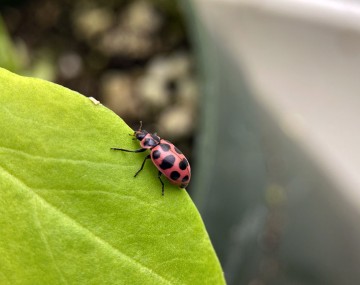
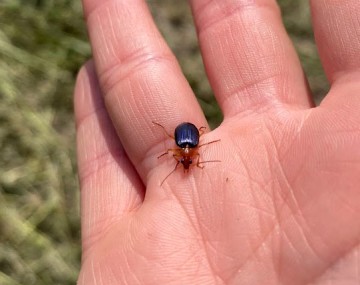
Biological control involves using natural predators, parasites, or pathogens to manage pest populations. This approach reduces reliance on chemical insecticides and supports sustainable pest management.
Insecticide resistance of Colorado potato beetle
CPB is notorious for rapidly developing resistance to insecticides.
Documented resistance to over 50 active ingredients, including organophosphates, carbamates, pyrethroids, neonicotinoids and spinosyns.
To mitigate:
- Use a combination of cultural control (rotating potato crops) and different insecticide application approaches (see above).
- Rotate insecticide classes (different IRAC groups) for each CPB generation.
- Reduce insecticide use by limiting numbers of insecticide applications to 1-2 per CPB generation.
- Reminder to always follow the label for additional resistance management guidelines.
Any time you use a pesticide, you must read and follow the label directions and comply with all applicable laws and regulations related to pesticide use. Also be sure that any pesticide used is approved for use in your country and state/province.
Authors
Laura Martinez
Ph.D. candidate, Department of Entomology, Cornell AgriTechBrian Nault, Ph.D.
Professor, Department of Entomology, Cornell AgriTech
Last updated: April 2025
Special thanks to Marion Zuefle, Cornell IPM for valuable feedback, and Henry Zelenak, Cornell IPM for assembling the web version.
Alyokhin, A., Benkovskaya, G., & Udalov, M. (2022). Colorado potato beetle. In A. Alyokhin, S. I. Rondon, & Y. Gao (Eds.), Insect pests of potato (2nd ed., pp. 29–43). Academic Press. https://doi.org/10.1016/B978-0-12-821237-0.00027-5
Alyokhin, A., Mota-Sanchez, D., Baker, M., Snyder, W. E., Menasha, S., Whalon, M., Dively, G., & Moarsi, W. F. (2014). The Red Queen in a potato field: Integrated pest management versus chemical dependency in Colorado potato beetle control. Pest Management Science, 70(4), 585–592. https://doi.org/10.1002/ps.3826
Ferro, D. N., Logan, J. A., Voss, R. H., & Elkinton, J. S. (1985). Colorado potato beetle (Coleoptera: Chrysomelidae) temperature-dependent growth and feeding rates. Environmental Entomology, 14(3), 343–348. https://doi.org/10.1093/ee/14.3.343
Hermann, S. L., & Thaler, J. S. (2014). Prey perception of predation risk: Volatile chemical cues mediate non-consumptive effects of a predator on a herbivorous insect. Oecologia, 176, 669–676.
Huseth, A. S., R. L. Groves, S. A. Chapman, A. Alyokhin, T. P. Kuhar, I. V. MacRae, Z. Szendrei, and B. A. Nault. 2014. Managing Colorado potato beetle resistance: new tools and strategies for the next decade of pest control in potato. J. Integ. Pest Mngmt. 5(4): A1-A8. DOI: 10.1603/IPM14009.
Kadoić Balaško, M., Mikac, K. M., Bažok, R., & Lemic, D. (2020). Modern techniques in Colorado potato beetle (Leptinotarsa decemlineata Say) control and resistance management: History review and future perspectives. Insects, 11(9), 581. https://doi.org/10.3390/insects11090581
Lund, M., and B. A. Nault. 2025. Potato seed treatments and in-furrow insecticide applications for Colorado potato beetle management and considerations for resistance management. Cornell Cooperative Extension, Cornell Vegetable Program. VegEdge 21(3): 1-4. https://rvpadmin.cce.cornell.edu/pdf/veg_edge/pdf309_pdf.pdf.
Pallis, S., Alyokhin, A., Manley, B., Rodrigues, T. B., Barnes, E., & Narva, K. (2023). Baseline susceptibility to a novel dsRNA-based insecticide across US populations of Colorado potato beetle. Agriculture, 13(12), 2283. https://doi.org/10.3390/agriculture13122283
Sexson, D. L., & Wyman, J. A. (2005). Effect of crop rotation distance on populations of Colorado potato beetle (Coleoptera: Chrysomelidae): Development of areawide Colorado potato beetle pest management strategies. Journal of Economic Entomology, 98(3), 716–724. https://doi.org/10.1603/0022-0493-98.3.716
University of Massachusetts Amherst. (n.d.). Colorado potato beetle. Center for Agriculture, Food, and the Environment. Retrieved April 10, 2025, from https://www.umass.edu/agriculture-food-environment/vegetable/fact-sheets/colorado-potato-beetle
Voigt, D., Schuppert, J. M., Dattinger, S., & Gorb, S. N. (2008). Sexual dimorphism in the attachment ability of the Colorado potato beetle Leptinotarsa decemlineata (Coleoptera: Chrysomelidae) to rough substrates. Journal of Insect Physiology, 54(5), 765–776. https://doi.org/10.1016/j.jinsphys.2008.02.006
Weber, D. C., & Riddick, E. W. (n.d.). Lebia grandis. Biological Control: A Guide to Natural Enemies in North America. Cornell University. Retrieved April 8, 2025, from https://biocontrol.entomology.cornell.edu/predators/Lebia.php
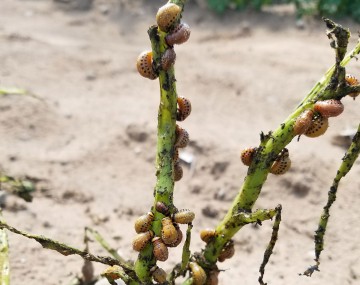
- Mass of Colorado potato beetles - photo by Laura Martinez
- Untreated plot damaged by Colorado potato beetles - photo by Brian Nault
- The extent of their damage can be prolific - photo by Brian Nault
- CPB large larvae - photo by Brian Nault
- Adult CPB damage - photo by Brian Nault
- Colorado potato beetle life cycle - created using BioRender by Laura Martinez
- Colorado potato beetle eggs - photo by Laura Martinez
- Colorado potato beetle pupa - photo by Laura Martinez
- Colorado potato beetle larva - photo by Laura Martinez
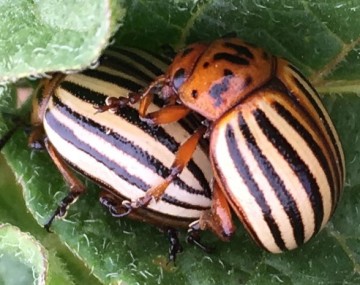
- Colorado potato beetle adults mating - photo by Brian Nault
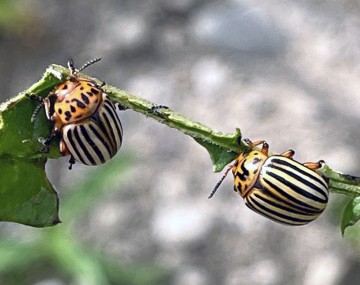
- Colorado potato beetle adults are oval shaped… - photo by Brian Nault
- A single adult can eat up to 10cm2 of foliage per day… - photo by Brain Nault
- Twelve-spotted lady beetle (Coleomegilla maculata) - photo by Laura Martinez
- Ground beetle (Lebia grandis) - photo by Laura Martinez
- Spined Soldier bug (Podisus maculiventris) - photo by Laura Martinez
- (315) 787-2354
- ban6 [at] cornell.edu
PhD Student
Department of Entomology
- lm699 [at] cornell.edu
- (315) 787-2379
- mez4 [at] cornell.edu