Botrytis Fruit Rot and Blossom Blight of Strawberry

Disease Fact Sheet

Authors: and

Categories: Fruit • Strawberries • Plant Diseases

Botrytis fruit rot, also called gray mold, is a devastating disease of strawberry found worldwide. The disease is widely prevalent in production regions with temperate climates and frequent rainfall during the growing season. Outbreaks of this disease typically occur in the field, but can be observed on transplants, post-harvest prior to and during shipping, and even in the consumer’s home. The disease is most devastating to young flowers and fruit in the field, and post-harvest as fruit makes its way to the consumer. If left unmanaged, yield and fresh market crop losses may quickly exceed 50%. 

Causal Agent

Botrytis fruit rot and blossom blight is caused by Botrytis cinerea, a fungal pathogen able to infect not just strawberry, but several hundred plant species, including many other important fruit crops (e.g. blackberry, grape, raspberry). Given its wide host range, it is difficult to exclude B. cinerea from plantings as it may reside unchallenged on weeds, among plant detritus as mycelium and sclerotia, and in other vulnerable unmanaged fruit plots or crops.

Symptoms & Signs of Botrytis Fruit Rot

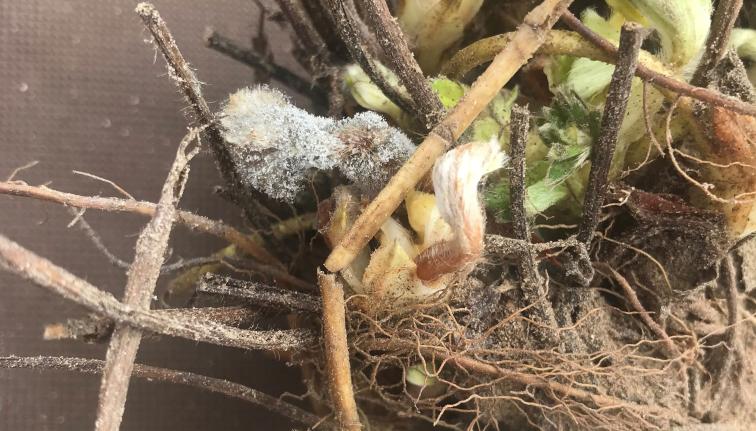
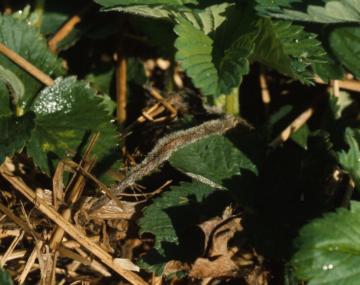
In strawberry, B. cinerea can colonize most host tissues including flowers, fruit, leaves, runners (stolons), and shoots when they are damaged, senescing, or even dead. Infected tissues turn light to medium brown in color, and under high relative humidity become covered in a velvety, grayish-colored mass of fungal mycelium. This mycelium produces branched structures called conidiophores, which in turn produce numerous microscopic asexual spores referred to as conidia (Fig. 1). If humidity is low, infections may not sporulate and tissues remain brown, shriveled, and leathery. 

Flowers are highly susceptible and are often initial site of infection for fruit that will develop several weeks later. Petals and reproductive organs are typically infected within a few days of opening, although infections may only become apparent as the flowers senesce or develop into fruit. A spreading blight may encompass the petals, sepals, and receptacle (the center green part that develops into the fruit), completely killing the flower and developing fruit (Fig. 2).  

On young green fruit, infections often result from quiescent flower infections as lesions often first appear under edge of the calyx on green fruit (Fig 3). If conditions remain favorable, such infections may encompass the entire fruit as it ripens (Fig 4). Under dry conditions, lesions on green immature fruit develop slowly, causing the fruit to become misshapen and possibly killed before full maturity is reached. Direct infection of ripe fruit by conidia later in the growing season is also possible. Infections first appear as a soft, sunken water-soaked lesion (Fig. 5), which may rapidly expand outward and mass of gray fungal mycelium and conidia (Fig. 4), In a fruit cluster, conidia produced on infected fruit may infect neighboring healthy fruit by direct contact. Fruit infections under dry conditions or low humidity may not readily sporulate, and fruit may become shriveled, leathery, and hardened over time. These fruits are referred to as mummies and may serve as source of inoculum in following seasons (Fig. 6). Infections may also develop post-harvest in storage as the result of quiescent infections in the field or conidia inoculum present on the fruit at harvest that initiates infection in the cool, humid conditions of storage. Symptomatic strawberries in storage may be covered with a fluffy, white-colored mycelium and may not produce conidia, as the characteristic gray (melanized) conidia will only completely develop in full sunlight.

A hardened, black (melanized), oblong structure called a sclerotium (plural: sclerotia) may also form on severely infected tissues when nutrients are exhausted and temperatures cool. This resistant structure allows the fungus to overwinter more effectively than as mycelium in plant tissues. Sclerotia can withstand a wide range of environmental conditions (i.e., drought and temperature extremes) and then germinate to infect the host under optimal environmental conditions in the following spring. It should be noted that these structures are rarely observed in plantings and are of minor importance as overwintering inoculum. 

A strawberry runner covered with gray fungal growth.
Figure 1.

Sporulation of Botrytis cinerea on dead vegetative strawberry tissue serving as a source of inoculum on the planting floor. Photo: M. C. Heidenreich.

A healthy, white blossom adjacent to a dying, infected brown blossom covered in fungal growth.
Figure 2.

Advanced infection of a strawberry flower covered with the gray conidia of Botrytis cinerea. Photo: D. Strickland.

An immature, white strawberry fruit with a brown lesion indicating infection.
Figure 3.

Immature strawberry fruit between the white and green stage with an infection at the point of calyx contact. Such infection is likely the result of quiescent floral infection at bloom. Photo: M. C. Heidenreich.

Healthy, red, mature fruit adjacent to strawberries covered in gray fungal mycelium.
Figure 4.

Advanced infection of strawberry fruit by Botrytis cinerea. Infected fruit has been enveloped in sporulating fungal mycelium of B. cinerea. These conidia can infect neighboring fruit and be dispersed to neighboring plants by wind and rain. Photo: M. C. Heidenreich.

A mature red strawberry with some wet, soft tissue that has begun to decay. In its center grows the gray fungus.
Figure 5.

Early infection of a ripe strawberry by Botrytis cinerea. Note the sunken, discolored tissue on the periphery of the gray fungal growth. Photo: M. C. Heidenreich.

A shriveled, dark brown strawberry fruit, called a mummy. The result of advanced Botrytis infection and exhaustion of the fruit’s nutrients and moisture to feed the fungus.
Figure 6.

Mummified strawberry fruit resulting from a rapid colonization by Botrytis cinerea. Mummies may become dehydrated so quickly that they may not sporulate. Mummied fruit serve as a source of overwintering inoculum for the following season. Photo: K.D. Cox.

Disease Cycle & Epidemiology

Botrytis cinerea may be introduced to a strawberry planting by several means. Strawberry leaves colonized with fungal mycelium from the previous growing season are often the primary source of inoculum for the growing season. Mummified fruit (Fig 6), susceptible weed species infected with Botrytis at the field’s perimeter, and sclerotia hidden among straw mulch from the prior season are other potential sources of inoculum. During the establishment of new plantings, strawberry transplants infected with mycelium or contaminated with conidia are often responsible for the initial inoculum (Fig. 7). Regardless of source, in the presence of cool spring temperatures become conducive, precipitation, and increasing humidity, infected tissues will begin to sporulate with conidia. Symptom development and sporulation is most severe under cool (59°F to 72°F /15°C to 22°C) wet environmental conditions with prolonged leaf wetness greater than 13 to 16 hours. Free moisture is essential for conidia to successfully germinate and infect host tissues. It should be noted that wounded ripe fruit produce sufficient free moisture to allow for conidial germination, so dry spells are no guarantee of safety if sufficient infections have already established in a planting. Infection sites will continually produce conidia in multiple secondary cycles as long as suitable environmental conditions prevail. Conidia are then dispersed throughout the planting via wind and rain (Fig. 8).

Conidial infections of vegetative tissues and new unexpanded leaves do not typically produce symptoms. Instead, mycelium remains quiescent within the tissue until the leaf begins to senesce and decline. At this point, the mycelium begins to rapidly colonize the dying tissues and sporulates to produce new conidia. It is important to note that infection by Botrytis does not increase the rate of senesce, and conidia are not able to infect mature leaves unless the host tissue is wounded or otherwise senescing.

Since fruit infections are often the result of floral infections, spring frosts during bloom may greatly increase the risk of infection. The petals and reproductive parts of flowers are most susceptible to infection with first few days of opening. Floral infections typically remain quiescent for weeks as the mycelium spreads through floral tissues into the developing fruit. Symptoms may not be apparent until the fruit begins to expand and is between green and white stages of development. In this scenario, symptoms first develop at the point of contact with the calyx (Fig. 3). Direct infection may also occur on ripe fruit if conidia land on wounded tissue, resulting from insect predation, or physical contact with neighboring fruit or hard detritus on the planting floor.

Post-harvest, Botrytis fruit rot may appear days to weeks after harvest on apparently “healthy” ripe fruit with quiescent infections that occurred prior to harvest (or due to contamination with conidia during storage and packing). Post-harvest infections may spread quickly between diseased and healthy fruit at wound sites resulting from compression or mishandling during harvest, storage and packing.

Figure 8.

Disease cycle of Botrytis fruit rot and blossom blight. Illustration: K. Cox.

Management of of Botrytis Fruit Rot

When establishing a strawberry planting, there are several cultural management practices that can greatly reduce disease. Increased spacing between plants will promote air movement and improved drying times, reducing free moisture required for infection. Similarly, optimal nitrogen fertilization will ensure that canopies do not become overly dense and impede air circulation. Drip irrigation is preferable as it eliminates the potential for wetting of susceptible tissues and splash dispersal of conidia throughout the planting. Finally, covered production systems can nearly eliminate most sources of free moisture needed for conidia dispersal and infection. 

Sanitation practices can be an important component of a disease management plan. Seasonal plot maintenance in the form of mowing and renovation will contribute to disruption and removal of inoculum sources on the planting floor. Scouting and sorting out contaminated transplants prior to planting will further reduce inoculum. Removing dead strawberry tissues and diseased fruit from the previous and current seasons can be somewhat helpful but may be too labor intensive for large commercial operations.

Presently, there are no commercial strawberry cultivars fully resistant to B. cinerea, and the few cultivars with reduced susceptibility do not eliminate the need for a robust cultural and chemical management program. That being said, cultivars with an upright growth habit will keep fruit elevated from the planting floor and will have improved air circulation, which can reduce the risk of infection. In addition, varieties with a reflexed calyx will be less likely to develop fruit infections if the developing calyx becomes colonized during infections at bloom.   

Chemical management is the most effective means to manage B. cinerea fruit rot and blossom blight. Since strawberries bloom over several weeks, especially in the case of day neutral varieties, several applications will be necessary. The first application should be made when flowers begin to open, preventing the blossom infections that often initiate the epidemic. 

Fungicide resistance in populations of B. cinerea is common and widespread worldwide. Given the short time between clonal reproduction cycles, selection for resistance may quickly occur following frequent applications of fungicides with the same chemical groups. To prevent the emergence of fungicide resistance, apply fungicides in accordance with label instructions and in rotation with other fungicide classes as described by the Fungicide Resistance Action Committee (FRAC). To further reduce the risk of fungicide resistance, maximize product effectiveness, and reduce chemical inputs, it is advisable to use disease forecasting to appropriately time fungicide applications. Refer to the Network for Environment and Weather Applications for disease forecasting options, and the Cornell Pest Management Guidelines for Small Fruit Production for specific fungicide options and application timings.

During harvest, efforts should be taken to reduce physical handling to avoid injuring ripe fruit. After picking, refrigerate fruit immediately to reduce the potential for infection and to maximize shelf life. Optimal storage conditions fall between 32°F and 37°F (0°C and 3°C). Finally, harvest frequently to avoid the buildup of overripe fruit in the planting, which can easily become injured and infected. 

A man stands smiling in a fruit orchard
Kerik Cox

Professor

School of Integrative Plant Science

Plant Pathology and Plant-Microbe Biology Section

Cornell AgriTech

Kerik Cox
Fruit pathology
Antimicrobial resistance and disease forecasting
Biological control and germicidal light