Apple Scab (Venturia inaequalis)
Fruit Fact Sheet
Apple scab, one of the most devastating fungal diseases of apple, occurs worldwide, wherever apples are grown. The fungal pathogen, Venturia inaequalis, can also infect crabapple, hawthorn, mountain-ash, firethorn, and loquat.
In this fact sheet
- Symptoms of apple scab
- Disease cycle and epidemiology of apple scab
- Management of apple scab
Symptoms of apple scab
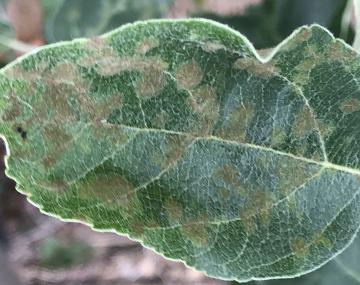
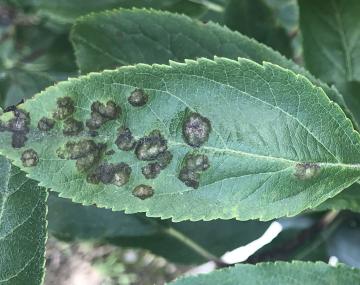
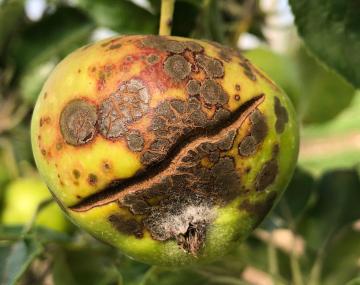
On leaves, initial symptoms will appear as light, olive green lesions that become velvety as the fungus develops conidia, the asexual infectious spores. With time, lesions may darken to brown and become bumpy as symptoms progress. Depending on apple cultivar and other factors, scab lesions can vary in their appearance on leaves (Fig. 1a-c). On fruit, lesions start out small and slowly enlarge, similar to symptoms on leaves, sporulating with conidia that contribute to secondary infections. As fruit mature, lesions may crack, deform the fruit, and contribute to reduced storage life and rots (Fig. 2a-c).
Apple scab symptom appearance
Disease cycle and epidemiology of apple scab
Cool, wet weather favors apple scab infections, and, therefore, this disease is more problematic in temperate climates. Initial infection requires 6 to 23 hours of leaf wetness when temperature ranges between 42°F and 75°F, with colder temperatures requiring longer durations of leaf wetness. Symptoms will appear approximately two weeks after initial infection when conducive weather conditions prevail.
Primary apple scab infections are caused by ascospores, the spores resulting from sexual reproduction. Ascospores develop in pseudothecia, microscopic fungal structures that grow from the previous year’s scab lesions on the overwintering leaf litter in the fall, winter, and spring. In spring, ascospores are forcibly discharged from the pseudothecia, in coordination with apple tree growth.
From green tip through tight cluster until shortly after petal fall, ascospores continue to mature and release with rainfall. Wind disperses ascospores to the susceptible young leaves and young fruit of apple trees to cause primary infections.
Apple scab lesions produce a superficial olive green to almost black, microscopic layer of conidia (Figs. 1 and 2). Conidia cause secondary infections on newly developing leaves and fruit during wetting events. Both primary and secondary apple scab lesions give rise to conidia. The repeated cycles of secondary infections throughout the growing season can, if unmanaged, result in high levels of apple scab on leaves and fruit. Infected leaves may drop prematurely and heavily infected trees may defoliate, reducing vigor and potentially decreasing return bloom. Infected leaves in the leaf litter will serve as sources of inoculum in the following season, developing pseudothecia that will overwinter and mature to form ascospores in the spring (Fig. 3).
Figure 3: Disease cycle for Venturia inaequalis on apple
A drawing of the disease cycle of Venturia inaequalis.
- Pseudothecia develop in leaf litter underneath overwintering apple trees. An inset shows a microscopic view of a pseudothecia with ascospores in an ascus.
- Ascus mature with ascospores inside of pseudothecium
- Ascospore infect susceptible, young tissue in the spring.
- Brown apple scab lesions develop on leaves of apple tree.
- Conidia develop as a result of the primary infection and lead to secondary infection on other leaves and developing fruit. This cycle is repeated throughout the season. An inset shows a microscopic view of conidia with conidiophores in an acervulus.
- Infected leaves and fruit with apple scab fall to the ground and contribute to the following year’s inoculum.
Management of apple scab
Based on the disease cycle of apple scab, management should aim to limit primary (ascospore) infection as well as reduce overwintering inoculum. Orchard scouting in the fall can provide useful insight to better inform management decisions. An integrated management approach incorporating cultural tactics, resistant varieties, and fungicides to prevent primary infection is the most sustainable and effective at managing this disease and achieving season-long control.
Cultural practices to reduce overwintering inoculum include leaf shredding with a flail mower and urea applications to fallen leaf litter. These will increase the rate of decomposition of overwintering leaf litter and reduce carryover inoculum. To create a less conducive environment for apple scab, prune trees to create an open canopy. This will increase air circulation, hasten drying time and reduce leaf wetness time, as well as improve fungicide spray penetration into the tree canopy, all important factors in reducing apple scab infection in the spring.
Cultivars of apple trees vary in their susceptibility to apple scab. Highly susceptible cultivars include cvs. Jersey Mac, McIntosh, Cortland, and Jonagold while more moderately susceptible cultivars include cvs. IdaRed, Gala, Crispin, and Northern Spy. ‘Honeycrisp’ is relatively resistant to apple scab. Resistant apple cultivars include cvs. Enterprise, Liberty, William’s Pride, Prima, Redfree, Goldrush, Dayton, Pristine, and CrimsonCrisp. Breakdown of host resistance by the emergence of V. inaequalis strains that can overcome the main resistance gene used in apple breeding has been reported, especially in areas that rely almost exclusively on host resistance to manage scab.
Use of fungicides to prevent apple scab infection of fruit is essential when growing susceptible cultivars. The most effective fungicides include single-site products belonging to the succinate dehydrogenase inhibitors, quinone outside inhibitors, and demethylation inhibitors (Fungicide Resistance Action Committee (FRAC) groups 7, 11, and 3, respectively). To prevent the emergence of fungicide resistance in V. inaequalis and conserve the efficacy of these products, rotate the modes of action or FRAC groups according to label directions. Other tactics to prevent fungicide resistance include applying a mixture of two single-site fungicides or applying a single-site fungicide with a multi-site, protectant fungicide. Organic management options include lime-sulfur, organic copper, or biopesticide products.
Applications may be required throughout the growing season from green tip through cover sprays on highly susceptible cultivars, integrated with cultural practices to achieve adequate control. The apple scab ascospore maturity model and the infection risk disease forecasts on the Network for Environment and Weather Applications (NEWA) online at newa.cornell.edu can be used to ensure appropriate timing of fungicide applications. Refer to the Cornell Pest Management Guidelines for Commercial Tree Fruit Production for specific fungicide products and application timing for managing apple scab, as many products exist with many different chemical modes of action.
Authors
- Katrin Ayer
Plant Pathology and Plant-Microbe Biology Section, Cornell University - Juliet Carroll
New York State Integrated Pest Management Program, Cornell University - Kerik Cox
Plant Pathology and Plant-Microbe Biology Section, Cornell University
Last updated: May 2020
- Early, light olive-green symptomatic apple scab lesions. Photo: K. Ayer, Cornell University.
- Brown sporulating apple scab lesions on leaves. Photo: K. Ayer, Cornell University.
- Darkened, raised apple scab lesions on leaves. Photo: K. Ayer, Cornell University.
- Symptomatic apple scab lesions on developing fruit. Photo: K. Ayer, Cornell University.
- Sporulating, expanding apple scab lesions as fruit matures. Photo: K. Ayer, Cornell University.
- Advanced apple scab lesions resulting in cracked fruit. Photo: K. Ayer, Cornell University.
- Apple scab disease cycle for Venturia inaequalis on apple. Illustration: K. Cox, Cornell University.
- aew232 [at] cornell.edu
Professor
School of Integrative Plant Science
Plant Pathology and Plant-Microbe Biology Section
Cornell AgriTech
- (315) 787-2401
- kdc33 [at] cornell.edu
Senior Extension Associate, Emerita (retired – active)
School of Integrative Plant Science
- jec3 [at] cornell.edu