

About the speaker
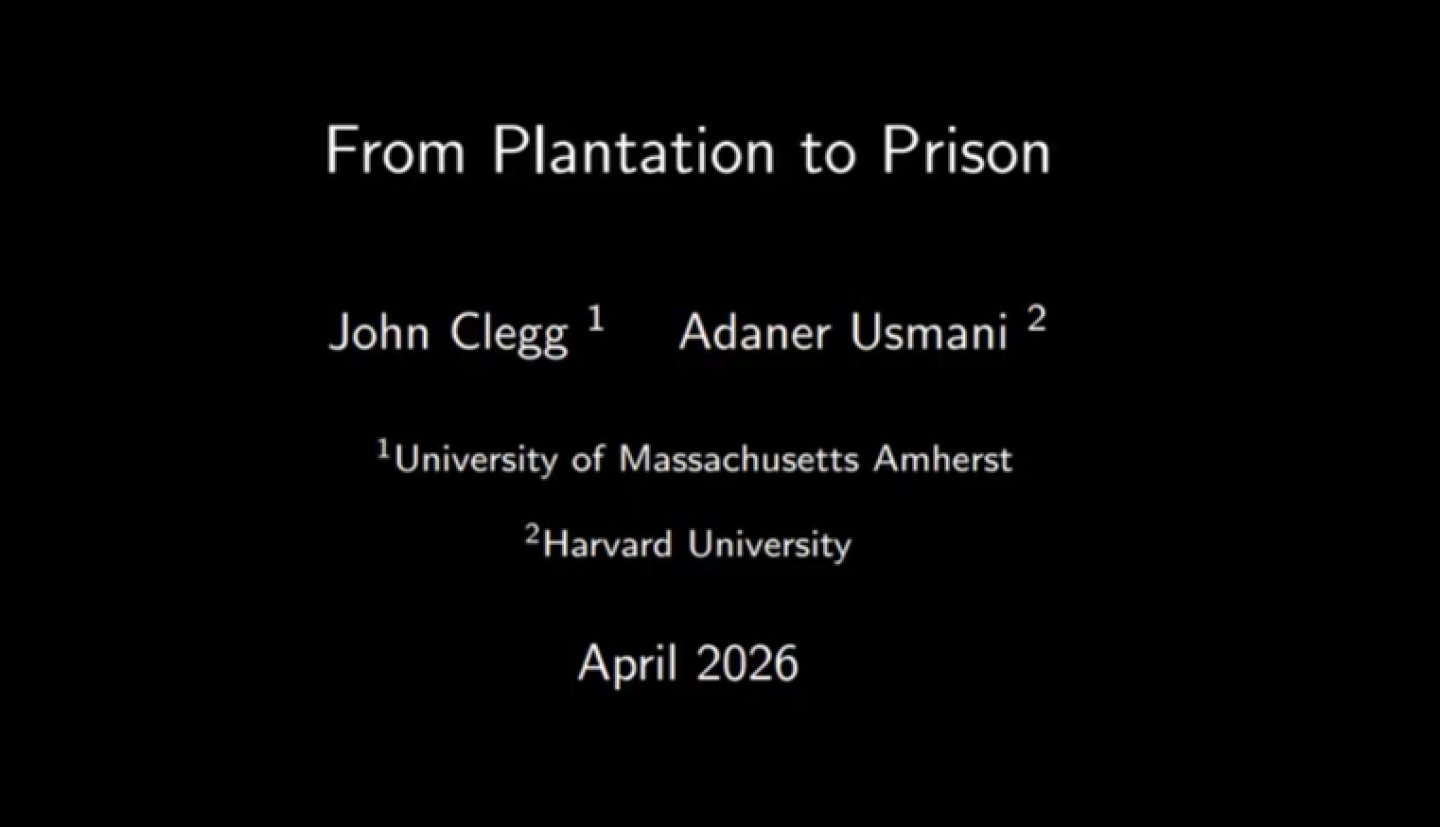
Adaner Usmani is an associate professor of sociology and social studies at Harvard University. His research is driven by some simple questions about the distribution of flourishing and suffering in modern societies. He is also interested in the often-fraught relationship between our normative commitments and our empirical work. Most of his ongoing work is on American mass incarceration. With John Clegg, he is working on a book in which they seek to explain American punishment by studying it in comparative and historical context. The book is based on a multi-year effort to collect comparative and historical data on prisons, policing, penal spending and related series. With Chris Lewis, he is working on a book explaining what is wrong with mass incarceration if the standard story of its origins is false.
Abstract
With few exceptions, no country in world history has incarcerated as large a share of its population as does the contemporary United States. Yet while most research on punishment observes this comparative and historical fact, historical and especially comparative research into mass incarceration is rare. We use original data on penal states from the mid-19th century to the present to illustrate dimensions of mass incarceration that previous work has mostly overlooked. Mass incarceration is the result of America’s exceptional combination of high violence and high state capacity, but high state capacity distributed in a peculiar way for a developed country. We argue that this combination of facts has its roots in American slavery, though not in ways commonly supposed. American slavery explains mass incarceration not via its cultural legacies, but because of the way it divided both the elite and the working-class. Thus, we suggest, the case of mass incarceration can be used to develop a general theory of the relationship between capitalist development and the penal state.
About the series
The Critical Development Studies Seminar Series is a graduate student-led effort that aims to provide space for junior scholars to share innovative research and discuss emergent debates within critical development studies.
Invited speakers cover a range of geographical areas, disciplinary backgrounds, and research topics. Examples of potential topics include agroecology and food justice issues, state-building, land and labor, extractivist politics, the gendered and racial dynamics of ongoing capitalist development, and the political ecological histories of the global development project. The target audience for the series is graduate students and faculty interested in critical development studies both within the Cornell community as well as external scholars.
Date & Time
April 24, 2026
2:00 pm - 3:30 pm
Location

More information about this event.
Contact Information
Mariah Doyle-Stephenson
- md2237 [at] cornell.edu
Speaker
Departments
Global Development Section
Natural Resources and the Environment Section
Polson Institute for Global Development
Related Events
Conference
Seminar

We openly share valuable knowledge.
Sign up for more insights, discoveries and solutions.