

July 30, Aurora, N.Y.
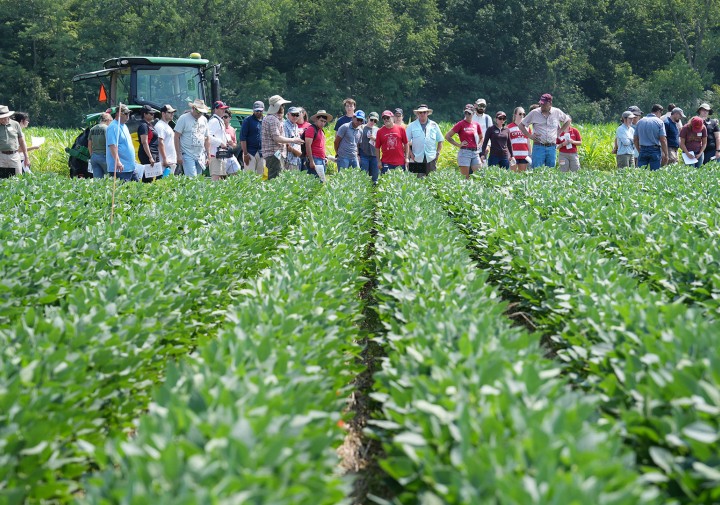
The annual Cornell Field Crop Research Field Day will be Thursday, July 30 at the Musgrave Research Farm, Aurora, N.Y. The program will features walking and hay wagon tours in the morning and afternoon.
NYSDEC pesticide training course credits and CCA CEUs:(Nutrient Management: 1, Soil & Water Management: 0.5, Integrated Pest Management: 1.5, Crop Management: 1) have been approved
Please register online by July 22 if you plan to stay for lunch. This will help us to plan and order enough food for everyone.
Program line-up:
Subject to change.
Walking tour
Louis Longchamps and Farmers Datalab members: New Digital Tools for On-Farm Experimentation
Digital tools can improve the collaboration between farmers and scientists. While scientists need precide data, farmers have little time to digitize what they know about their fields. In this session, we will show a few tools that we use to lower the bar for productive collaboration.
Yun Yang: OpenET and how satellite data can help farmers
Satellite observations provide new opportunities to monitor crop water use across entire fields and farms. We will highlight how OpenET transforms satellite data into practical information that can help farmers and agricultural professionals monitor crop conditions, assess drought impacts, and better understand field-to-field variability across agricultural landscapes.
Vipan Kumar: Field Demonstration of Integrated Weed Management in Corn and Soybean Production
Recent spread of invasive weeds such as Palmer amaranth, waterhemp, Johnsongrass, and Italian ryegrass, along with confirmed herbicide resistance, poses a growing threat to corn and soybean production in New York and the Northeastern U.S. Growers are increasingly seeking effective integrated weed management (IWM) solutions to address these challenges. This field demonstration will highlight practical IWM strategies that combine cultural, chemical, and mechanical weed control tactics to improve weed management and support sustainable crop production.
Bosen Jin: PFAS in Agricultural Systems: Soil Health and Crop Uptake
PFAS are emerging contaminants of concern in agricultural systems because they can persist in soils, move through water, and be taken up by crops. This station will introduce how PFAS may enter agricultural soils, why soil health and crop uptake are important for understanding risk, and what research is needed to support practical management decisions for farmers.
Deborah Aller and NY CORE team: Rethinking Organics Management on Farms
Organic materials are an incredible source of carbon and nutrients that, when managed properly, can reduce input costs, build healthy soils, and improve crop yields on farms. A cornerstone of our work is providing hands-on technical assistance to farmers to improve organics handling at the farm level; reducing resources that are landfilled and producing beneficial materials for use back on fields. We will share some of the research and extension efforts ongoing at NYCORE.
Quirine Ketterings, Juan Carlos Ramos, and NMSP team: Working with Data to Rebuild A Manure Crediting System for New York
Manure is a great source of nutrients and when applied in the right rate, right timing and right method, it can boost yield not only in the year of application but for several years in a row. Join us to learn more about ongoing on-farm research and laboratory studies to expand manure crediting to include novel manure sources.
Wagon tour
Dana Russell and Toni DiTommaso: Weed Ecology and Management in an Agrivoltaic System
I will be presenting my research on the effects of agrivoltaic cropping systems on weed management and weed pressure in soybeans and providing recommendations for adapting weed management strategies to these systems.
Camilo Rojas and Camila Rocco da Silva: Field crop disease diagnostics and management updates from the Field Crops Pathology Lab
The Field Crops Pathology Lab will share updates from ongoing disease monitoring and field trials in corn, soybean, and small grains. We will display disease symptoms for in-field diagnosis and discuss how these observations connect to current research and management questions across New York field crop systems.
Todd Ugine and Lilly Eliott from Poveda lab: Effect of local management practices and removal of neonicotinoid seed treatments on seed damage and yields in field corn
Organic matter additions, such as manure and cover crops residues incorporation, may increase seedcorn maggot damage in corn. As neonicotinoid seed treatments are phased out, alternative management options are needed. We compared seedcorn maggot abundance and corn seed damage among neonicotinoid-, diamide-, fungicide-treated, and untreated seed planted with or without liquid dairy manure incorporation.
Sam Mosher, Dinesh Ghimire, Tian Gong and the CROPPS team: ‘Red Alert’ plant-based sensors for accurate nitrogen management
We have bioengineered tomato plants that respond to nitrogen deprivation within a day with a visible pigment (betanin—the purple pigment native to beet roots) in their leaves. This human- and machine-visible signal can provide a rapid, in-planta report of nitrogen status to allow efficient management of nitrogen. In this session we will explain the technology and future applications.
Matt Ryan: Regenerative Grain Crop Production
Participants will learn about new research aimed at using cover crops to suppress weeds and improve soil health. New tools and practices will be discussed along with results from recent experiments.
Schedule
- 9:00–9:45 am: Registration & light refreshments (outside Field House)
- 9:45–9:50 am: Welcome & instructions
- 10:00–11:55 am: Morning walking and wagon tours
- 12:00–12:55 pm: Lunch
- 1:00–2:55 pm: Afternoon walking and wagon tours
- 3:00 pm: Opportunity for discussion with presenters
Date & Time
July 30, 2026
9:00 am - 4:00 pm
More information about this event.
Contact Information
Louis Longchamps
- ll928 [at] cornell.edu
Speaker
Departments
Soil and Crop Sciences Section
School of Integrative Plant Science
Cornell AES
Website
Related Events
Conference
Seminar

We openly share valuable knowledge.
Sign up for more insights, discoveries and solutions.