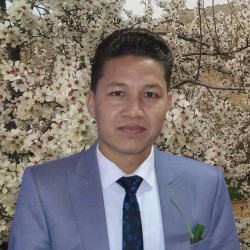
Hamidullah Nikzad is an advocate and researcher in the fields of climate change, sustainability, and food security, with a particular focus on advancing climate justice and sustainability in fragile contexts. Born in Afghanistan—a country that contributes minimally to global greenhouse gas emissions yet suffers disproportionately from the impacts of climate change—he has dedicated his career to addressing climate impacts intensified by conflict and advocating for fair and sustainable solutions.
Experiencing the devastating 1999–2001 drought, intensified by the political shift, shaped Hamidullah’s understanding that climate is not just weather but survival. As a teenager, he volunteered as a teacher in a girls’ school, an experience that reinforced his belief in education as a form of resilience and solution. Later, as director of environmental protection in his home province, he worked with communities to safeguard natural resources, designate protected areas, and raise public awareness about environmental sustainability and stewardship.
Hamidullah is currently pursuing a master’s degree in Natural Resources at Cornell University, where his thesis examines how climate indicators and conflict incidents interact to shape acute food insecurity in Afghanistan. He is a member of the Civic Ecology Lab, where he contributes to global learning online courses that connect science with practice.
Guided by his personal philosophy— “A kind human is kind with nature”—Hamidullah aims to bridge the gap between scientific research and practical solutions, providing policymakers, NGOs, and international organizations with evidence-based strategies to combat the compounded effects of climate change and instability on vulnerable communities.c
Recent Research
Hamidullah’s research examines the interaction between climate change and conflict in shaping acute food insecurity in fragile agrarian contexts, with a particular focus on Afghanistan. By analyzing seasonal rainfall variability and conflict events across provinces, his work investigates how these stressors contribute to acute food insecurity. His research aims to inform the development of early warning systems, targeted humanitarian interventions, and policies that advance climate justice in regions where environmental change and political instability collide.
Nikzad, H. (2020). Solid Waste Management in Kabul. In S. K. Ghosh (Ed.), Circular Economy: Global Perspective (pp. 43–65). Springer Singapore. https://doi.org/10.1007/978-981-15-1052-6_3
Nikzad, H. (2024, May 4). Spatial Distribution of Food Insecurity in Afghanistan. ArcGIS StoryMaps. https://storymaps.arcgis.com/stories/43b4d24c0071425aac464c80d0dbdf57
Nikzad, H. (2025). Political Instability and the Treadmill of Production: Sustainable Urban Processes in Kabul City. Sustainable Processes Connect, 1(1), 1. https://doi.org/10.69709/susproc.2025.149300