


The USDA Land Capability Classification1 shows the capability of soils to produce common cultivated crops without deteriorating over a long period of time.
All USDA-NRCS Soil Survey map units are grouped according to their limitations and how they respond to management. In the Northeast, the relevant Land Capability System is the Non-irrigated Capability Classes. The criteria used in grouping soils do not include improvements to the land (i.e. tile drainage, etc.).
Land Capability Classes
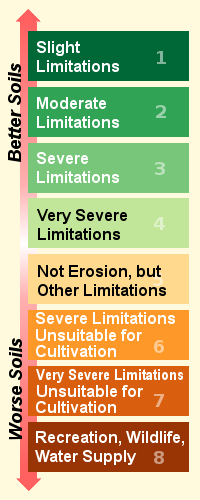
Land Capability Classes are designated as numbers 1 through 8. The numbers indicate progressively greater limitations for practical use. The classes are defined as follows:
- Class 1 soils have few limitations that restrict their use.
- Class 2 soils have moderate limitations that reduce the choice of plants or that require moderate conservation practices.
- Class 3 soils have severe limitations that reduce the choice of plants or that require special conservation practices, or both.
- Class 4 soils have very severe limitations that reduce the choice of plants or that require very careful management, or both.
- Class 5 soils are subject to little or no erosion but have other limitations that restrict their use mainly to pasture, rangeland, forestland, or wildlife habitat.
- Class 6 soils have severe limitations that make them generally unsuitable for cultivation and that restrict their use mainly to pasture, rangeland, forestland, or wildlife habitat.
- Class 7 soils have very severe limitations that make them unsuitable for cultivation and that restrict their use mainly to grazing, forestland, or wildlife habitat.
- Class 8 soils have limitations that preclude commercial plant production and that restrict their use to recreational purposes, wildlife habitat, watershed, or esthetic purposes.
The soils criteria used to determine the USDA Land Capability Classes are coordinated nationally, but the system can be used to differentiate subclasses at the discretion of the State.
NYS Agricultural Land Classification
The NYS Agricultural Land Classification system2 is a production rating system that estimates the relative yield potential under prudent management for soils across the State. The assigned index number percentage for each Mineral Soil Group (MSG) provides an estimate of a soil’s yield potential compared to the highest yielding soils within New York State. The system designates all soil map units to an MSG numbering 1 through 10 based on the soil’s relative yield potential. The numbers indicate progressively lower yield potential. MSG 1 has the highest relative yield potential, whereas MSG 8 has the lowest yield potential (i.e. <30 % yield potential compared to Soil Groups Number 1). Soils are further divided by lime requirements, drainage, slope, and other factors. Groups 9 and 10 are totally unsuited for agriculture. The classes are:
- Group 1 & 2 (High-Lime / Low-Lime): Highly productive mineral soils.
- Groups 3 & 4: Moderately productive mineral soils.
- Groups 5 through 10: Increasingly limited capability, characterized by poorer drainage or steeper topography.
The classification system was developed by NYS in accordance with USDA-NRCS national standards and was adopted by the NYS Legislature in 1980. It works alongside the Agricultural Districts Law that was established in 1971 as a framework to determine agricultural land values for tax purposes. Cornell University maintains the Mineral Soil Group List, and it is revised annually with the official USDA-NRCS Soil Survey Database refresh.
There have been no substantial statewide changes to the extent of Mineral Soil Groups’ 1-4 since the early 2000s.
Table 1.
New York State Mineral Soil Group Numbers and their yield potential indices.