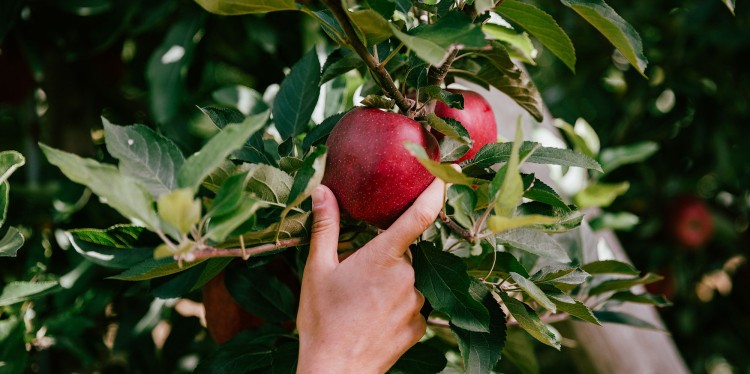
Apple scab is one of the most economically devastating diseases facing apple growers in the Northeast. Managing it has long depended on regular applications of broad-spectrum synthetic multisite fungicides, but two new peer-reviewed studies from Cornell AgriTech suggest there may be a smarter, more sustainable way.
The companion studies demonstrate that disease forecasting tools can help growers reduce their reliance on synthetic fungicides and that biopesticides can serve as viable substitutes in well-timed spray programs. The studies were both published in January in Plant Disease by Līga Astra Kalniņa, a former graduate student, and Kerik Cox of the Section of Plant Pathology and Plant-Microbe Biology at Cornell AgriTech in Geneva, New York.
“A lot of growers feel the need to spray every week,” said Cox. “But our research shows you can be more responsible with your fungicide use if you apply using disease forecasting. A forecasting model can help you save money and reduce the frequency of application.”
The regulatory landscape is adding new urgency to finding more sustainable solutions to managing disease. Captan and mancozeb – the two most widely used multisite synthetic fungicides in apple production – face growing scrutiny for a range of concerns, including potential reproductive and developmental toxicity, probable carcinogenicity, and reduced soil microbial activity. They have already been phased out in Europe and Canada, and the U.S. Environmental Protection Agency is pursuing significant restrictions.
“Growers are trying to figure out how they’re going to manage diseases without these products,” said Cox. “Captan and mancozeb have a long residual – they last a while and they can weather rain, which we get a lot of in the Northeast. So growers understandably rely on them. But by using disease forecasting along with well-designed biological materials and targeted single-site fungicides, we believe growers can move away from these broad-spectrum synthetics.”
The first study tested whether disease forecasting tools – including Cornell’s NEWA (Network for Environment and Weather Applications), disease modeling platform RIMpro and cell phone weather apps – could be used to time fungicide applications more precisely than a standard calendar schedule. Kalniņa and Cox compared several spray programs on Jonagold and Empire apple varieties, swapping out synthetic multisite fungicides for biopesticides and relying on forecasting models to determine when to spray.
On Jonagold, no significant differences in disease control were observed among any of the programs – calendar or forecasting-based, synthetic or biological. For the more scab-susceptible Empire variety, the extended-season program using NEWA-based timing provided the best results.
The second study explored how modern planting systems – specifically super spindle or high-density fruiting wall designs – might further support this transition. These systems train trees into narrow, hedge-like walls roughly 12 feet tall and 3 feet apart, rather than the traditional large Christmas-tree shape. The smaller canopy reduces humidity around the fruit, which in turn reduces disease pressure. Though the planting system effect was not consistent across all years, the study again found no significant differences in disease control between integrated biopesticide programs and conventional synthetic ones.
“I can’t say for certain that using captan or a biopesticide was better, because we never had a window where nothing was applied,” he said.[KC1] “The bottom line is that disease levels were incredibly low when we used the forecasting-based program I’m proposing. And if growers are going to apply something during low-risk periods anyway – as they should, for resistance management – biopesticides are the more environmentally responsible option.”
Cox said the results are also a meaningful validation of Cornell’s NEWA network, developed in partnership with the Northeast Regional Climate Center. “This is a big win for NEWA,” said Cox. “We were able to use it the way a grower would and scientifically demonstrate that it’s a good tool. It’s been validated by peer-reviewed research and can be very effective when implemented in real-world conditions.”
Cox’s advice to New York apple growers starts with the basics: Invest in good horticulture. That means planting high-density fruiting wall systems and choosing varieties with strong disease resistance. From there, he said, growers should lean into forecasting.
“Stick to our newer disease forecasting systems,” he said. “Watch the weekly updates. Keep an eye on Cornell Cooperative Extension alerts for your region. And get a weather station on your farm.”
With those tools in place, he believes growers will be well positioned to move away from synthetic multisite fungicides and toward a more sustainable future.
Christina Szalinski is a freelance writer for the College of Agriculture and Life Sciences.