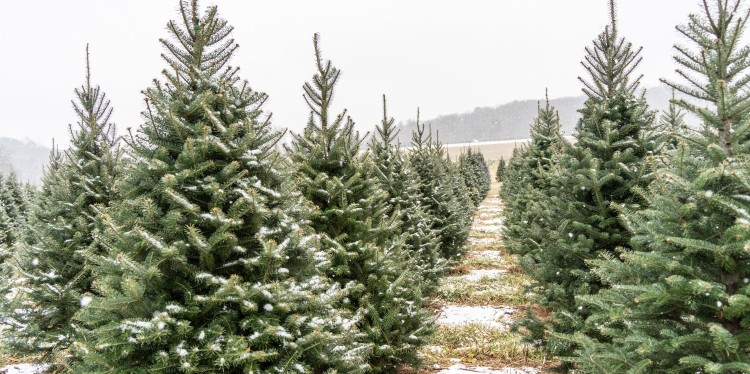
Christmas tree farming is more than a holiday tradition in New York; it’s a vital part of the state’s economy. Spanning more than 22,000 acres and generating up to $22 million in annual sales, the industry delivers festive cheer while sustaining family livelihoods across the region. To keep this cornerstone thriving and environmentally responsible, Cornell’s Integrated Pest Management (IPM) program and Cornell Cooperative Extension (CCE) are working with growers to reduce pesticide use and improve efficiency, ensuring greener practices for a greener holiday season.
Those efforts don’t just protect the environment; they strengthen the small, family-run farms that form the backbone of New York’s Christmas tree industry. At Darling Christmas Tree Farms in Clifton Springs, a three-generation operation, Jeff Darling is committed to growing healthier trees through IPM. “If we don’t have to spray chemicals, we don’t want to,” Darling says.
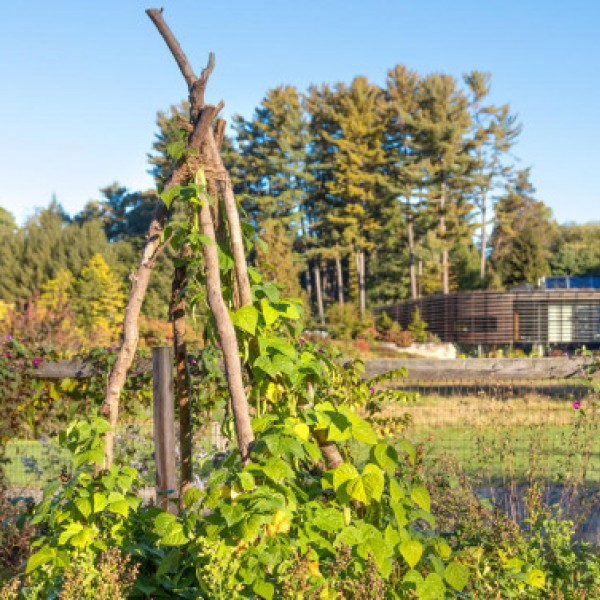
That commitment to reducing pesticide use led the Darlings to work with Cornell IPM senior extension associates Elizabeth Lamb and Amara Dunn-Silver on an innovative solution: turning their least productive acre into a pollinator garden. By planting native flowers and grasses, they created a habitat for beneficial insects like lady beetles that prey on pests threatening their Fraser, Concolor and Canaan firs. “We learned there are insects that can help you manage the insects you don’t want,” Darling explains.
That same spirit of collaboration and problem-solving extends across New York’s Christmas tree industry. On Long Island, Joe Shipman runs Shamrock Christmas Tree Farm in Mattituck, a popular destination for holiday shoppers. For years, he has partnered with CCE extension specialist Mina Vescera, who analyzes soil across his fields to create custom nutrient management plans. These plans help ensure Shipman’s trees stay healthy and vibrant, ready to bring holiday cheer to families across the state.
Each August, Vescera visits Christmas tree farms to sample their oldest trees—the ones destined for holiday homes. She clips 3-inch tips from trees across the fields, then analyzes the needles for nitrogen levels. If concentrations fall below 2%, she recommends a light nitrogen application to give the trees a vibrant color boost. “It greens up the tree and makes it more appealing to shoppers,” Vescera explains.
Just as nutrient management requires precision, so does pest control. On Long Island, Dan Gilrein, a CCE entomologist at Cornell’s Long Island Horticultural Research and Extension Laboratory, provides growers with expert diagnostics and timely solutions. His lab receives samples and even texted photos for quick insect identification. Recently, Gilrein tackled a gall midge fly infestation, a pest that can distort or kill Douglas fir needles. To manage it, traps are placed beneath trees in early spring to detect when the flies emerge, allowing growers to act during the narrow window when treatment is most effective.
“It’s a tough one,” Gilrein says. “There’s a very narrow window for timing management when flies are active. Like most insect and disease issues, effective control—and minimizing costs—depends on understanding the biology of the pest and the plant, as well as what growers can realistically do.”
Elizabeth Lamb says her ultimate goal is to help growers increase yields, speed up production and reduce input costs through IPM. She notes that Christmas tree farms are often family-run businesses, which makes education especially personal.
“A Cornell workshop might include a couple of people who handle production and another who makes wreaths,” Lamb says. “Like any business, they want to make more money, but they’re also deeply invested in doing things the right way.”
Lamb has found that growers are naturally curious and eager to share insights with one another. In fact, it was farmers who first approached Lamb and colleague Amara Dunn-Silver with an observation: trees planted near wildflowers seemed to have fewer insect problems. Intrigued, the Cornell team launched an experiment in 2018, planting an acre of Christmas trees bordered by perennial wildflowers and native grasses to test the idea.
The results weren’t exactly what researchers expected. “This happens in research—when you plan to study a pest, sometimes the pest doesn’t show up,” Dunn-Silver says with a laugh. Still, the project proved valuable. It allowed researchers to advise growers on creating habitats rich in pollen and nectar, which attract beneficial insects. At Darling Christmas Tree Farm, for example, Dunn-Silver and Lamb helped identify species like New York ironweed and golden Alexanders. These perennials take time to establish, and their distinctive blooms may not appear for several years, but they play a critical role in supporting natural pest control.
Christmas tree farming in New York is more than an economic driver; it’s a family tradition rooted in care for the land and community. Through research, education and hands-on partnerships, Cornell is helping growers adopt practices that protect the environment, reduce costs and keep trees healthy and vibrant. From pollinator gardens to precision nutrient management, these efforts ensure that holiday traditions remain sustainable for generations to come—bringing joy to families while preserving the landscapes that make New York special.