December 3, 2025
Awards
Assistant Professor Monica Cornejo et al., received the Top Paper Award in the Interpersonal Communication Division from the National Communication Association. Their paper, titled “Exploring the Effects and Content of Gratitude Expression on Latina/o/x/e Couples Experiencing Migration-Based Family Separation: A Mixed Methods Study,” was recognized for its outstanding contribution to interpersonal communication research.
Conferences & Lectures
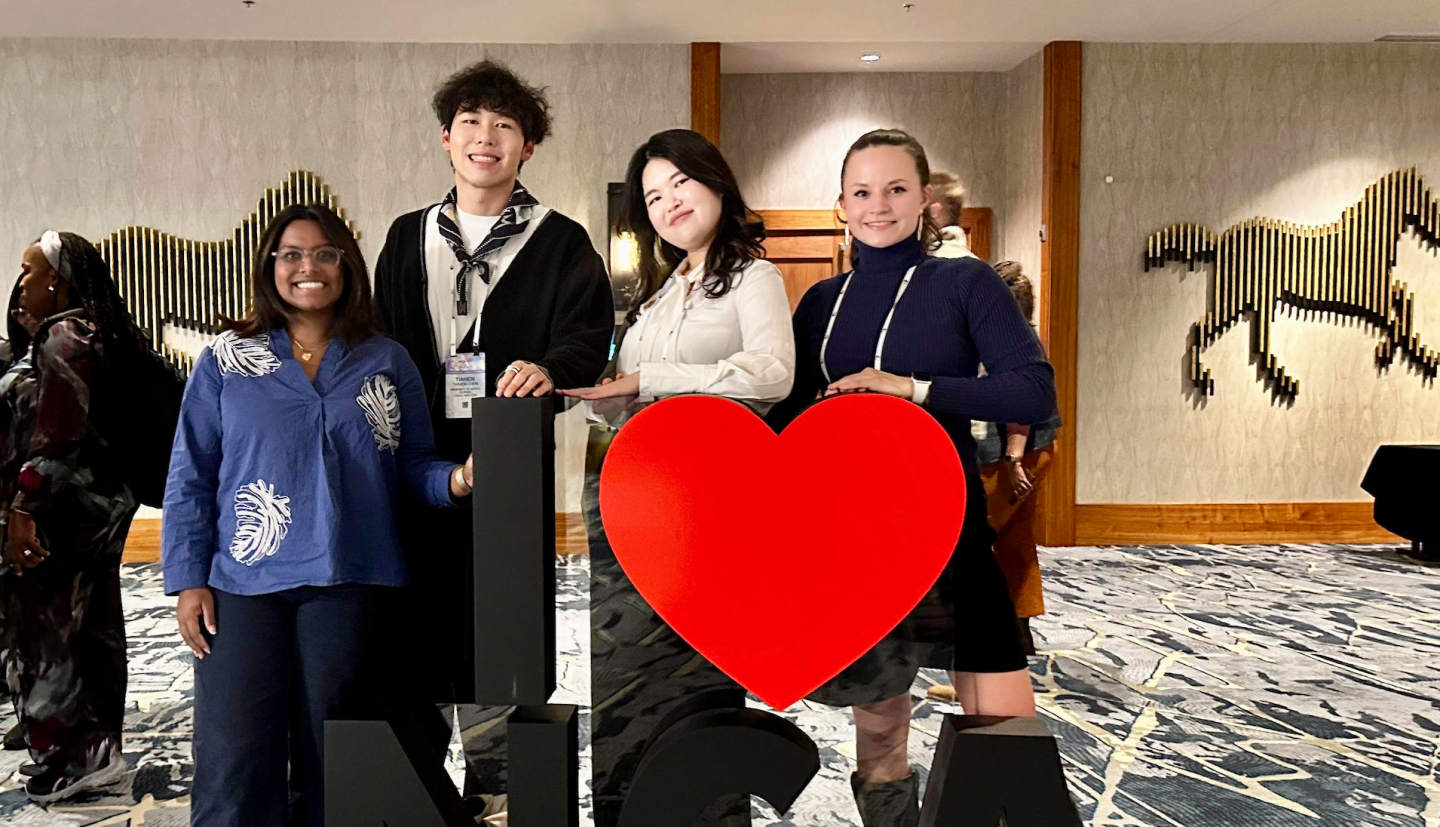
Graduate student Sohinee Bera co-delivered a presentation titled “When Fast Technologies Meet Slow Foods: Diverse Visions of Emerging Plant Biotechnologies” at the National Communication Association Annual Convention. Their work draws on an upstream public engagement activity conducted at Slow Foods: Terra Madre in Italy, where they explored community perspectives on emerging plant biotechnologies among sustainable agriculture enthusiasts. Responses to the open- and closed-ended questions revealed a wide range of views—often both supportive and sharply critical—highlighting the deeply diverse and sometimes competing visions surrounding these technologies.
On December 4, Professor danah boyd will deliver a talk titled “What to Do When the Kids Are Not OK.” In this talk, danah will discuss her current work on how youth mental health intersects with technology – and why many of the necessary interventions don’t start with public policy or even technology. Register to attend her talk here.
Assistant Professor Monica Cornejo served as a panelist for the National Communication Association in a presentation titled “How Can We Expand on Interpersonal Communication Theories to Elevate the Voices of Objectified Migrants in U.S. Immigration Detention?” The panel focused on broadening interpersonal communication theories to more fully represent and elevate the voices of migrants in the U.S. who experience immigration-based incarceration.
Associate Professor Brooke Duffy returned to her undergraduate alma mater, The Pennsylvania State University, to deliver the annual Pockrass Memorial Lecture. Her lecture explored labor, power, and resistance in the creator economy.
Professor Jeff Niederdeppe served as a panelist on a webinar titled “Communicating About Public Health and Health Policy in a Complex Media Environment and Challenging Political Climate,” hosted by the Boston University School of Public Health. The event was part of the Public Health Conversation Series, Public Health and New Media: Modes of Persuasion. Jeff was also quoted in a related Boston University School of Public Health Newsroom article covering the discussion, titled “SPH Panel Discusses How to Share Health News in Era of Misinformation.”
At a conference held from November 17 to 20, Assistant Professor Wunpini Mohammed delivered a talk titled “Ghana to the World: Challenging African Stereotypes One Story at a Time.” Her lecture, presented at the University of Richmond during International Education Week, centered on Ghana and explored how storytelling can challenge and reshape dominant narratives about Africa.
Grants
Graduate student Sohinee Bera has been awarded a CCSS QuIRI Small Research Grant for Fall 2025, receiving $2,000 from the Cornell Center for Social Sciences (Qualitative and Interpretive Research Institute). She will serve as Principal Investigator for the project. This grant supports Sohinee’s dissertation fieldwork examining how community health workers navigate, negotiate, and resist communicative marginalization within a rural health program in India.
Graduate student Maggie Sardino received a $200 CALS Alumni Association Grant. This grant will fund her travel for the fieldwork she is doing this summer with an Assistant Professor in Madison, Wisconsin. The project will involve conducting interviews and developing a documentary with Occupy Madison, an organization born out of the Occupy Movement that now maintains tiny home villages for previously unhoused folks and maintains a democratic governing structure. The project will explore the history of Occupy Madison and how participating in cooperative housing influences political knowledge, efficacy, and engagement in impoverished communities.
Graduate student Amanda Vilchez has been awarded a CCSS Qualitative and Interpretive Research Institute Small Research Grant for Fall 2025, receiving $2,000 in support of her dissertation research. She will serve as Principal Investigator for the project. Her dissertation, titled “Where Bats, Farmers, and Scientists Meet: Cross-Epistemic Dialogues Between Traditional Ecological Knowledge and Western Science in the Sacred Valley of the Incas,” examines collaborative efforts between local farmers and scientists who are co-analyzing the traditional use of vampire bat guano for maize production. Building on this partnership, Amanda’s research explores inter- and intra-group boundary-crossing dynamics, the role of perceived expertise, and evolving visions of transdisciplinary ‘success.’ She also received a $1,700 Graduate School Research Travel Grant for her dissertation.
Media Coverage
Assistant Professor Monica Cornejo was quoted in a Cornell Daily Sun article titled “’It Just Continues to Divide Us’: University Faculty React to Turning Point USA Professor Watchlist.” The article examines the renewed attention on TPUSA’s Professor Watchlist, its impact on Cornell faculty, and the ways such listings shape academic freedom, campus climate, and the experiences of marginalized scholars. Monica reflects on the personal and professional consequences of being added to the watchlist, as well as the broader implications for open dialogue and community trust.
Deputy Citizens and Technology Lab Director Elizabeth Eagen was interviewed on Aspiration's podcast, “Funders on Fundraising.” In the November 17 episode, Elizabeth drew on her decade of experience as a Senior Program Officer at the Open Society Foundations, where she funded global digital rights and emerging technology work, to discuss the philosophy behind her 50/30/20 funding model, the internal dynamics that shape grantmaking, and the value of clarity, consistency, and long-term commitment.
In a November 20 podcast episode, Associate Professor Neil Lewis Jr. was interviewed by health policy professors Michael Shepherd (University of Michigan) and Miranda Yaver (University of Pittsburgh) about his forthcoming article in the Journal of Health Politics, Policy, and Law, titled “The Importance of Dreaming About (and Mobilizing to Create) Equitable Futures.” The article appears in a special issue on Public Health Under Siege.
Publications
Assistant Professor J. Nathan Matias & Megan Price, November 2025, “How Public Involvement Can Improve the Science of AI,” Proceedings of the National Academy of Sciences.
As AI systems from decision-making algorithms to generative AI are deployed more widely, computer scientists and social scientists alike are being called on to provide trustworthy quantitative evaluations of AI safety and reliability. This article reviews common models of public engagement in AI research alongside common concerns about participatory methods, including questions about generalizable knowledge, subjectivity, reliability, and practical logistics. To address these questions, the authors summarize the literature on participatory science, discuss case studies from AI in healthcare, and share their own experience evaluating AI in areas from policing systems to social media algorithms. Overall, they describe five parts of any quantitative evaluation where public participation can improve the science of AI: equipoise, explanation, measurement, inference, and interpretation. They conclude with reflections on the role that participatory science can play in trustworthy AI by supporting trustworthy science.
Assistant Professor Wunpini Mohammed & Charity Markus Fawe, November 2025, “Disrupting the Netflix Hegemony in Nollywood: The Case of A Tribe Called Judah G,” Communication, Culture and Critique.
Since Netflix started expanding its reach to the Global South, some scholars have raised concerns about cultural imperialism. Contextualizing Nollywood within discussions of global media flows, contra flows and platform imperialism, we examine how the industry has evolved in production and distribution in recent times. Using A Tribe Called Judah, we analyze the complex evolving relationship between two media powers: Netflix and Nollywood. We argue that although streaming platform collaborations with Nollywood can bring some advantages, it does not erase Nollywood’s ability to produce and distribute successful movies independently; demonstrating the existence of two media powers encountering and shaping each other.
Graduate student Rosie Nguyen, November 2025, “The Vortex of Visibility: Platformization and Literary Practices in an Emerging Economy,” Platforms & Society.
This article examines how book authors navigate the platformization of literary production amid the interplay of local publishing norms and global platform capitalism. Drawing on in-depth interviews with Vietnamese published authors and online participant observation, Rosie introduces the concept of a vortex of visibility, which shows how authors are pulled toward the platformization of their work despite the risks entailed. Moving beyond paradox-based frameworks, she emphasizes the dynamic tensions that shape cultural workers’ engagement with platforms, offering new insights into how cultural workers in the Global South balance visibility, livelihood, and artistic integrity through hybrid practices.
Graduate student Lucas Wright, November 2025, “The Salesforce of Safety: Software Vendors as Infrastructural/Professional Nodes in the Field of Online Trust and Safety,” Platforms & Society.
As new online safety laws and advances in AI reshape digital markets, a new class of third-party software vendors has emerged, offering platforms for managing trust and safety. This article examines how these vendors reshape platform governance not merely as secondary labor providers but as positioned actors in a social and professional field.