Academic focus: Environmental change in terrestrial and aquatic systems
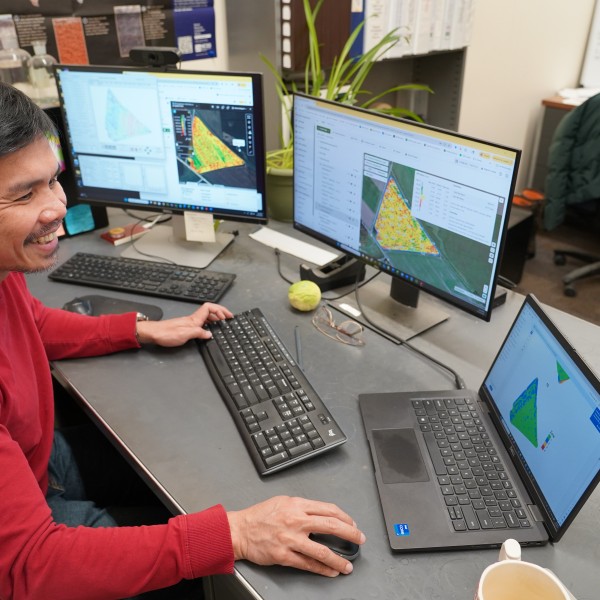
Research summary: My research integrates geophysical methods with computational approaches to study environmental and ecological change across terrestrial and aquatic systems. I use near-surface geophysical techniques for applications including permafrost dynamics, archaeological investigations, mining waste characterization and ecosystem monitoring. These direct measurements are combined with machine learning analysis of large environmental datasets to characterize patterns of change in both physical and biological systems.
What do you like to do when you’re not working?
I run, read, hike, camp, swim, travel, garden and lift weights. I’m also currently learning Finnish; if anybody speaks fluently, I would love to meet! Similarly, if anybody enjoys shooting a basketball or playing racquetball poorly but with enthusiasm, send me a note.
What are your current outreach/extension projects?
I work with Indigenous groups in Alaska, both with youth steward programs and with community leaders, to teach about geophysical methods and to help manage climate change impacts on the communities.
What brought you to Cornell CALS?
The focus in CALS on local communities and impacts on the communities, e.g., local to a particular region.
Why did you feel inspired to pursue a career in this field?
Numerous generations of my family have worked outdoors. I wanted to work outdoors also and to use the cumulative knowledge of being in the woods passed down to me through generations. To this I wanted to add a scientific and computational perspective to be able to better understand the mechanisms and drivers of change in natural systems across time scales. In my career I am able to use my upbringing and my education together to work with communities, gather data and analyze data from natural systems. I focus on understanding change in order to mitigate the impacts of change.
What advice do you have for students interested in your field of study?
Spend time outside and be comfortable outdoors, even if that takes time. Learn computational methods but remember to collect and study the raw data too.