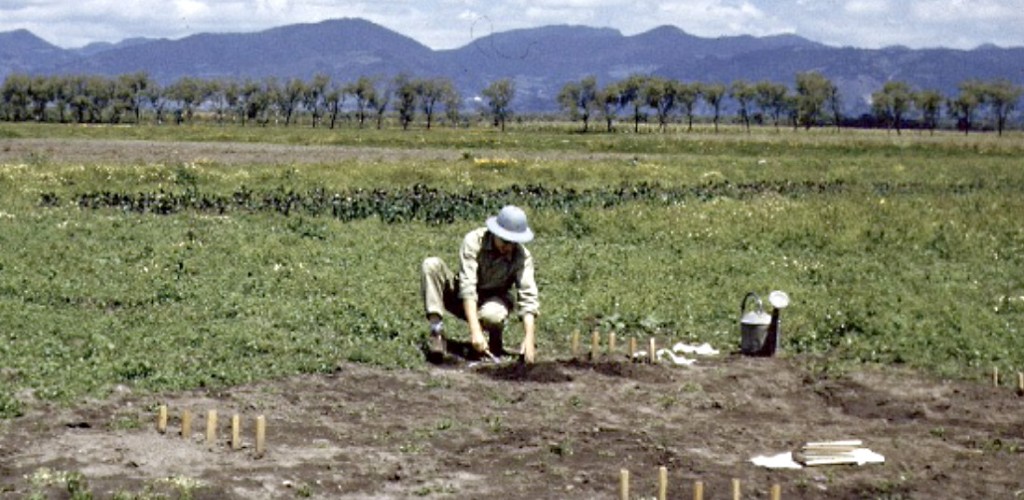
While in Mexico, Ewing isolated the causal organism – Pythium (now Globisporangium) fungus. He also found that seeds from purple-flowered peas were highly resistant to rot whereas the more common, white-flowered ones were very susceptible.
Ewing returned to Ithaca and conducted additional experiments, demonstrating the key to high resistance lay with seed coat tannins. He also found that pink-flowered peas had a different kind of tannin and were slightly less resistant than purple-flowered peas.
Making connections
But before Ewing could finish his dissertation, he was pressed into service as an instructor, and soon after wrapping up his dissertation moved into a faculty position that focused on potato research.
“At the time, there wasn’t a lot of interest in my pea work because the standard solution for seed rot was just to treat the seeds with a fungicide,” recalls Ewing, who squeezed in a few more pea studies around his potato research until the mid ‘60s. Moreover, the tannins responsible for resistance also discolored cooking broth and imparted an astringency detectable by some.
In 2016 – 10 years after he retired – Ewing decided to revisit his pea studies, motivated by the trend to use fewer fungicides in food production and the recognition that tannins can be healthful phytochemicals. Forced to don a mask to avoid breathing the accumulated dust on his old lab notebooks, Ewing double-checked his decades-old data with the aid of a magnifying glass.
Ewing’s efforts intensified during the pandemic. He teamed up with Norman Weeden, a Montana State University pea geneticist who formerly worked at Cornell AgriTech, and recruited Ivan Simko, a former postdoctoral associate of Ewing’s who is now a USDA-ARS lettuce breeder, as co-authors for the paper. The team collaborated with Sheng Zhang and Elizabeth Anderson at the Cornell Institute of Biotechnology’s Proteomics and Metabolomics Facility, who used modern methods to confirm and expand on Ewing’s tannin identifications from the '50s.
“Dry peas have become a vital source of protein in many parts of the world,” notes Ewing. “Unlike the white flowers characteristic of garden peas, many varieties of dry peas have colored flowers.”
The study’s most important finding was that -- compared to purple-flowered dry peas -- pink-flowered ones have a different type of tannin, one reported to tie up less iron when consumed. The findings also suggest pink-flowered peas still have sufficient seed rot resistance that they can be grown without treating seeds with fungicides.
“Surprisingly, it seems no one had noticed the association between flower color and the kind of tannin in the seed coats,” says Ewing. “Science has become so specialized that it is hard to make connections between the old-fashioned genetics we used and modern disciplines such as plant pathology and chemistry. With helpful advice from experts in these fields, we were finally able to make the connection work.”