Symposium
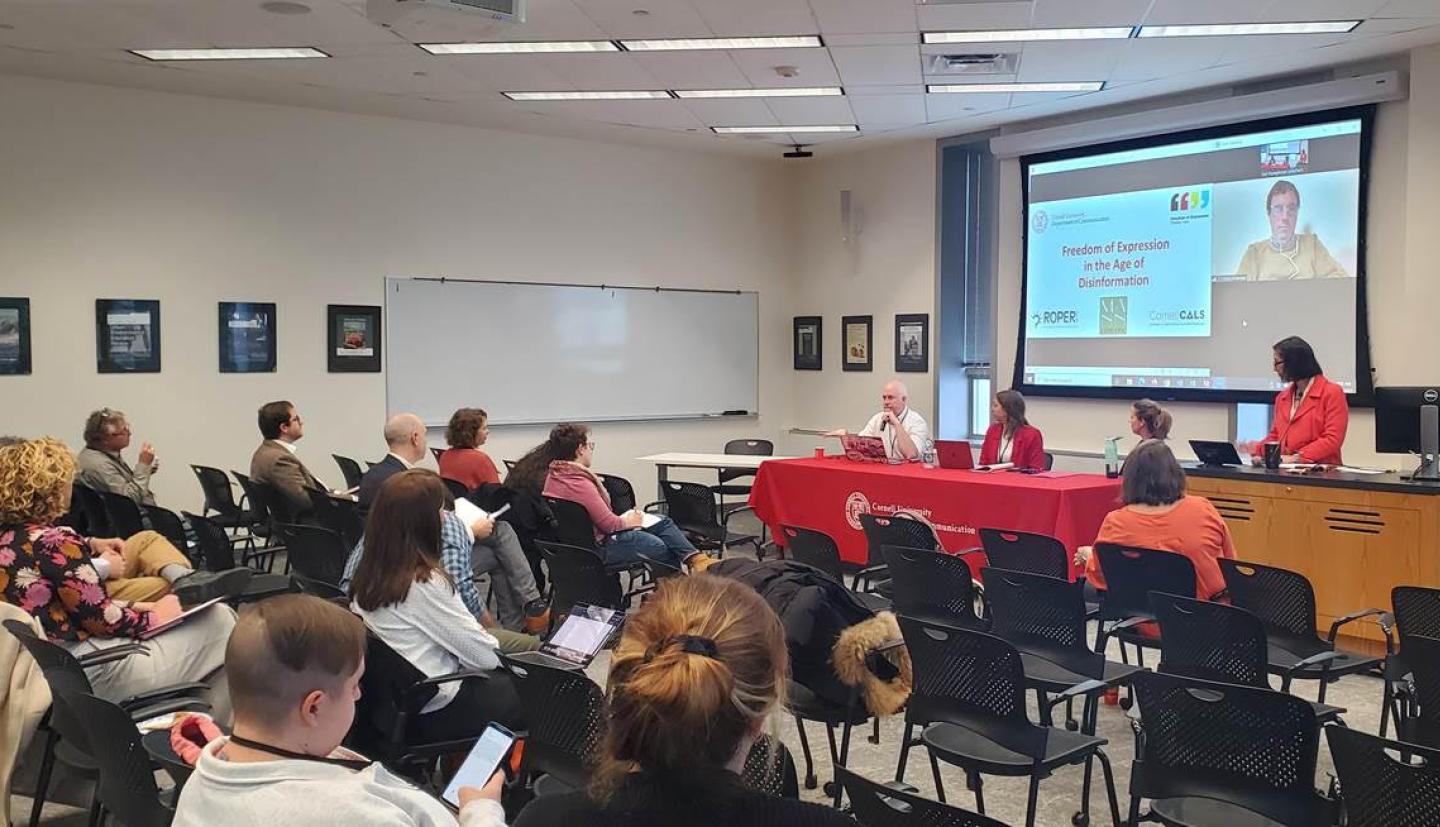
On December 7 and 8, the Department of Communication hosted the two-day symposium “Freedom of Expression in the Age of Disinformation,” part of President Pollack’s Freedom of Expression initiatives. The event, co-sponsored by the Department of Communication, Cornell’s Freedom of Expression Theme Year, the Roper Center for Public Opinion Research, and the College of Agriculture and Life Sciences, brought together scholars, students, and community members from across the world to explore this critical topic. The event featured four panels: 1) Historical Media Propaganda, Disinformation, and Freedom of Expression; 2) Freedom of Expression vs. Content Moderation on Social Media Platforms; 3) Public Opinion as a Form of Freedom of Expression in Democracies; and 4) Freedom of Expression and Other Core Values and Responsibilities. Ben Houlton (Ronald P. Lynch Dean of CALS), Martha Pollack (President), and Elaine Westbrooks (Carl A. Kroch University Librarian) provided remarks. Of particular note was the plenary lecture by Claire Wardle, Brown University. Dr. Wardle argued that we have to think about global human rights law—and not just the first amendment—when we consider the contemporary technological and geo-political moment. In doing so, we can see the need to consider not just the right of individuals to express themselves, but also the right to hear and seek information, which has important implications for social media platforms as well as public institutions like libraries and schools. The event was organized by Lee Humphreys (Professor and Chair, Department of Communication), Jeff Niederdeppe (Professor, Department of Communication, and Senior Associate Dean of Faculty Development, Jeb E. Brooks School of Public Policy), and Jon Schuldt (Associate Professor, Department of Communication, and Executive Director, Roper Center), with assistance from Communication undergraduate students Ashley Paik and Abby Ruggiero.
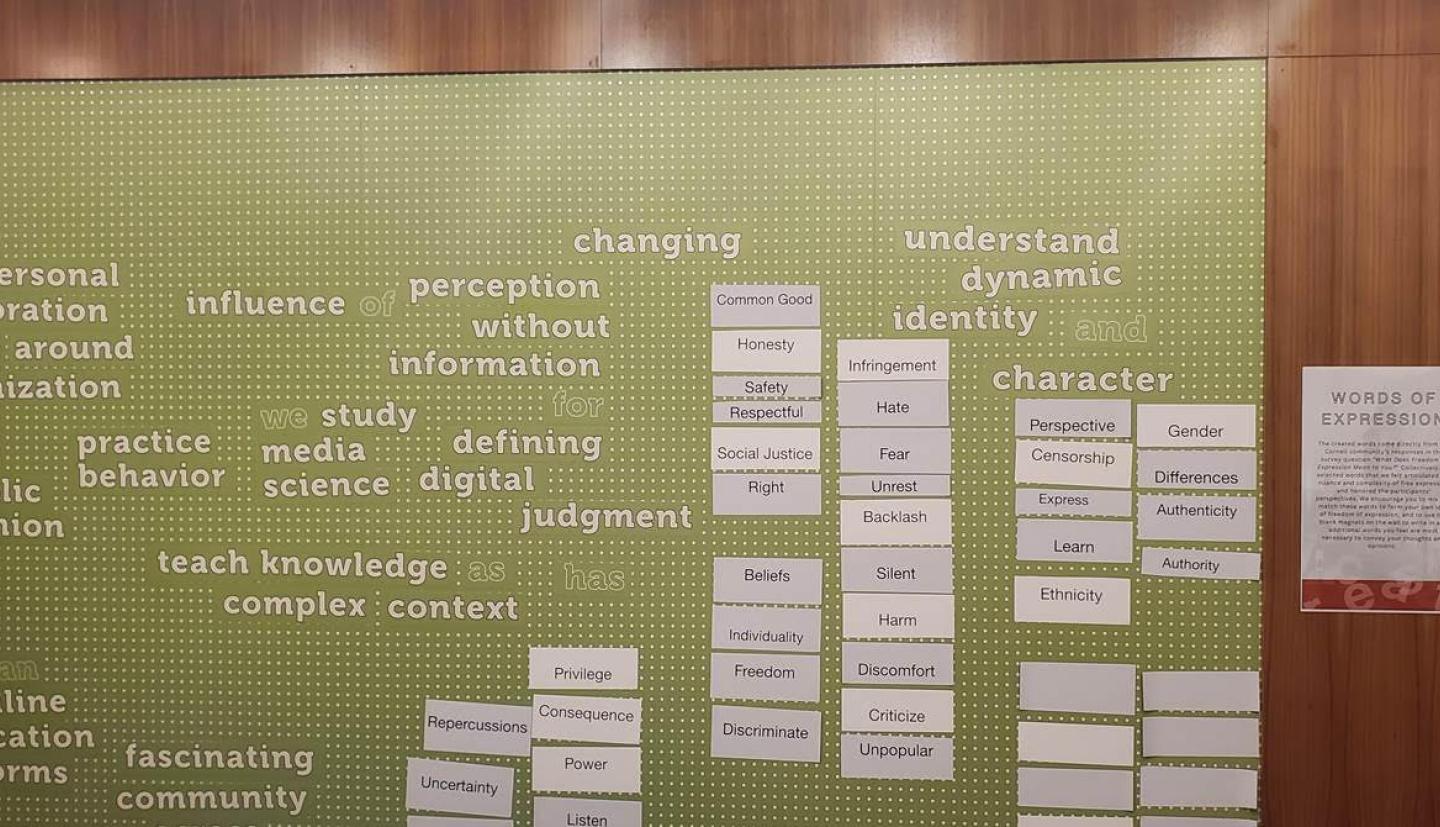
In tandem with the symposium, Lee and Ashley Shea (Instructional Librarian, Mann Library, and Ph.D. Student, Department of Communication) taught an undergraduate course entitled Freedom of Expression in the Archives. Their class project on the history of freedom of expression at Cornell developed into an exhibition, which the students displayed in the department Hub. During the opening and closing receptions, the students were on-hand to talk about the research that led to the exhibition. They also created new tiles for our magnetic communication wall and provided blank tiles, encouraging people to contribute words that reflect communication, free expression, and disinformation. (It provided a nice refresher for the wall, which hasn’t changed a great deal since it was installed several years ago.) They created a “freedom of expression” playlist that played during the receptions and listed a QR code linking to the music. Finally, they connected an “old style” handset to a recording device and encouraged people to speak into it about what freedom of expression means to them.
Read more about the symposium in the Cornell Chronicle.