Back

Discover CALS

See how our current work and research is bringing new thinking and new solutions to some of today's biggest challenges.

Share
  • Cornell University Agricultural Experiment Station
  • School of Integrative Plant Science
  • Horticulture Section
  • Nature
  • Plants
  • Horticulture

On October 4, students in the course Plant Science and Systems (PLSCI 1101) assisted in the planting of 40,000 daffodil bulbs into the sod along both sides of Taughannock Boulevard (Route 89) just south of Ithaca Children’s Garden.

“It only took us about two hours,” says flower bulb expert Bill Miller, a professor in the School of Integrative Plant Science’s Horticulture Section, who teaches the course. That’s because Miller and his students used a tractor-drawn bulb planter imported from the Netherlands which can plant thousands of bulbs in just minutes.

The students poured bulb mixes by the bucketful into the planter’s hopper. The blends included a variety of cultivars with different flower sizes and colors and flowering dates.

As it’s towed across the grass, the planter slices open the carpet of sod, lifts it, and drops the bulbs underneath. Then it firms the sod back over top of the bulbs. (View video.) Tractor operations were expertly handled by Lucas Thomas, Cornell University Agricultural Experiment Station (Cornell AES) farm services mechanic.
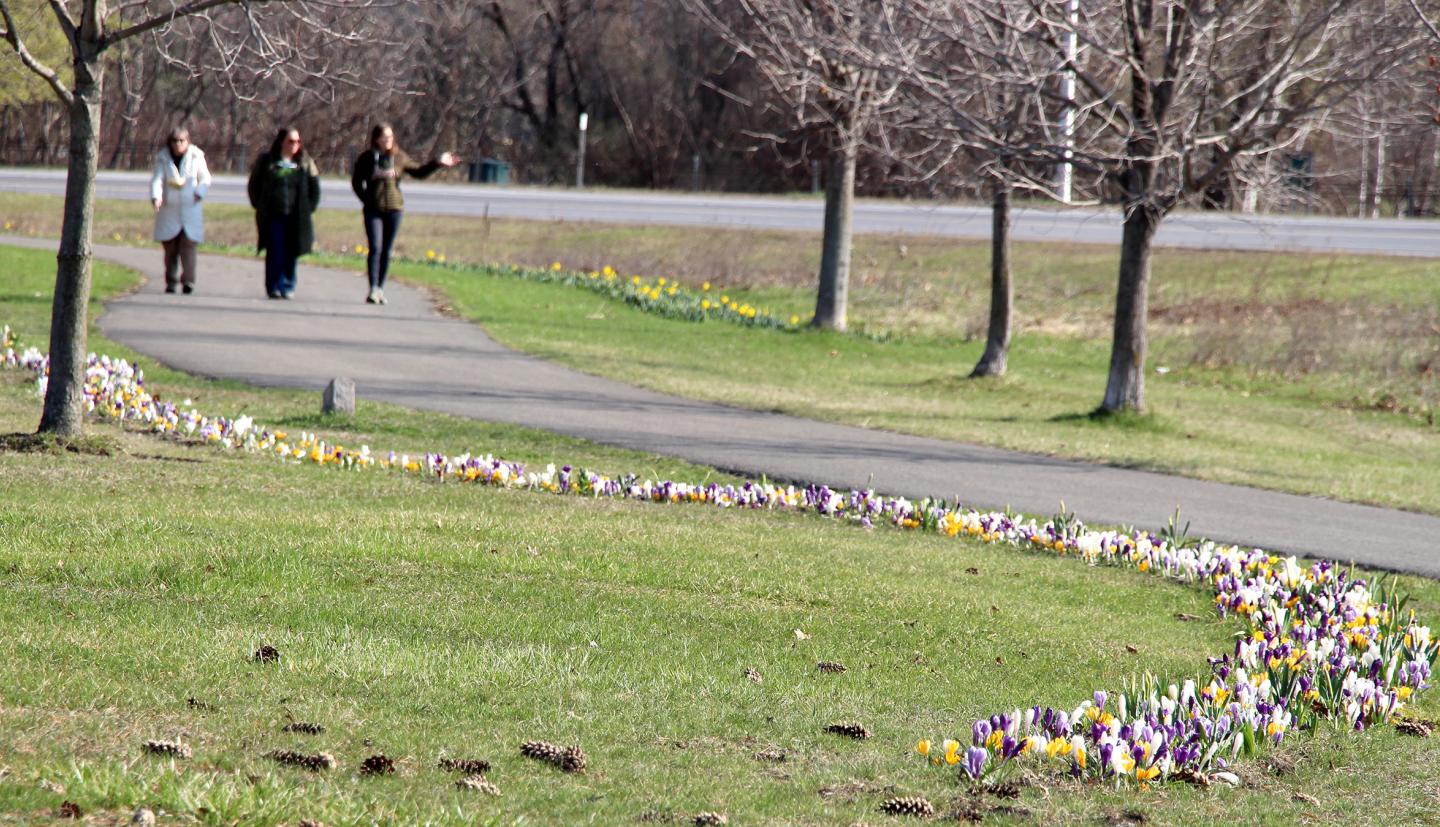
Bulbs planted this way flower the following spring and for many springs to come. Because of the need to wait to mow the grass until the bulbs have finished growing in late spring, these “naturalized” bulb plantings help reduce greenhouse gases associated with mowing.

Since 2019, Miller has used the Dutch planter to sock in more than 250,000 bulbs in Cass and Stewart Parks. He has also used the planter to establish naturalized plantings along the bioswale near the Nevin Welcome Center parking lot at Cornell Botanic Gardens and the walking path along Pier Road south of Newman Golf Course. (See ‘Naturalized’ bulb plantings bloom around Ithaca for other locations and more information.)

The Ithaca Garden Club purchased and donated the bulbs. Last May’s inaugural Daffodil Dash 5K and 1-mile run/walk sponsored by the club raised more than $5,000 to help fund future flower bulb plantings around Ithaca.

“It has been a real pleasure to collaborate with the Ithaca Garden club to get these bulbs planted,” said Miller. “I am especially grateful to the City of Ithaca and city forester Jeanne Grace for helping to make these plantings happen. Jeanne has picked the sites and taken care of any red tape, and her crew has been involved in all of the plantings that we have done.” Additional support for the planting came from Cornell Cooperative Extension.

“It was also a blast having students involved,” added Miller. “It’s great to get them off campus, get their hands dirty and get them involved in the community.”

Keep Exploring

Hand watering a small sprout in the ground

News

A new model offers a proof-of-principle for how AI might be used to shed light on obscure biological processes.

  • School of Integrative Plant Science
  • Soil and Crop Sciences Section
  • Climate Change
Laurie VanNostrand (right), Cornell Cooperative Extension master gardener coordinator in Wayne County and statewide coordinator for the Vegetable Variety Trial Garden project, chats with a master gardener volunteer at a plant pick-up day on campus on May 12.

News

Across 37 counties, Cornell Cooperative Extension master gardeners are growing and evaluating select vegetables to find what grows best in New York state.

  • Cornell Cooperative Extension
  • School of Integrative Plant Science
  • Plant Breeding and Genetics Section