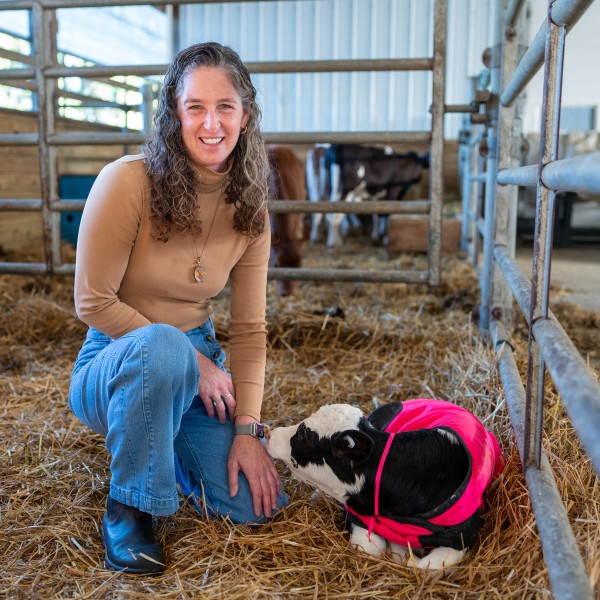
“The global population doubled in the last 40 years. The most important thing we do as humans is feed ourselves,” Martin said. “The work CALS is doing on soils, genetic modification, optimization of food production and so many other things –that feels like the most important work for me to support right now.”
“We are enormously grateful to Cynthia for this timely and generous gift, which will accelerate CALS’ efforts to collaborate across the agricultural, environmental, life and social sciences to build more resilient, equitable and sustainable global food systems,” said Benjamin Houlton, the Ronald P. Lynch Dean of CALS. “This fund also provides opportunities to respond to other entrenched and emerging challenges facing our world, allowing the college to lead forward-looking, transdisciplinary discoveries where they’re needed most.”
Martin established the fund to honor her husband, Norman, who died 10 years ago. They met in 1979 when he hired her to manage construction and lease office space in a hospital in Philadelphia.
“At the time, I had absolutely no experience with either of those things, but he thought, ‘She went to Cornell; she’ll be a quick learner,’ and thankfully I was,” said Martin, who spent her career in construction and property management, and financial consulting with doctors’ groups and hospitals.
Norman Martin was supportive of her growth in his company and accommodated her schedule so she could complete an MBA at Wharton (’86) while working full time. The pair worked together for years before marrying in 1997.
Martin, who majored in industrial labor and relations as an undergrad, said the most important lesson she learned at ILR was to have the ability and desire to negotiate and find win-win solutions. She said she’s inspired by CALS’ like-minded commitment to finding collaborative solutions that benefit as many people as possible.
“I don’t believe in zero-sum games. Being able to look at things from all sides, to find win-win solutions –that kind of mentality of negotiation is important, whether you’re talking about how to lease office space, or who’s going to do the dishes, or how to feed 8 billion people,” Martin said.
Martin wanted her gift to CALS to be as open-ended as possible because “you never know where innovation is going to come from,” she said.
“Cornell is an incredible place, and I learned so much. The thing I’ve taken with me through the years is the love of knowledge for the sake of knowledge,” said Martin, who intentionally took at least one course in all the colleges, including a memorable Astronomy 101 course taught by Carl Sagan and Frank Drake ’51.
Martin is also generous to Cornell with her time: she’s a member of the Cornell Club of New York and has served as a volunteer with the Cornell Alumni Ambassador Network, meeting with potential undergraduates in the Philadelphia area since 1984.
Krisy Gashler is a writer for the College of Agriculture and Life Sciences.