

periodiCALS, Vol. 9, Issue 1, 2019
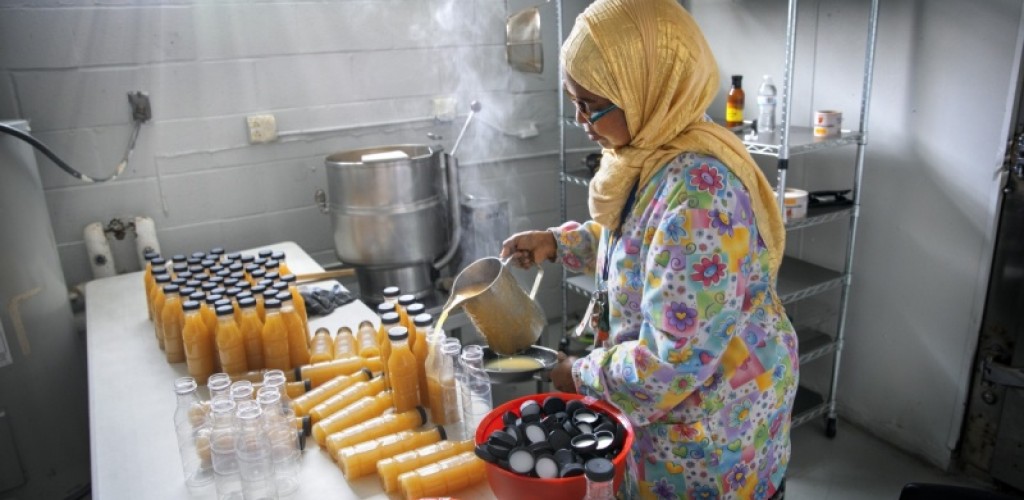
Bisharo Ali and her family arrived in the U.S. as refugees from Somalia in the mid-1990s. At their home in Buffalo, New York, Ali regularly experimented with family recipes using fenugreek and tamarind, traditional ingredients known for their health benefits in Somalia. Over time, she perfected an apple fenugreek drink and marinade, and dipping sauces made from a tamarind base.
Friends and family who tasted Ali’s sauces recognized something special, and they encouraged her to start her own company. Najah Foods, using the Somali word “najah,” which means “success,” was born.
Entering into the startup world is no easy task, so Ali turned to the Cornell Food Venture Center (CFVC) for help in turning a family favorite into a store-ready product.
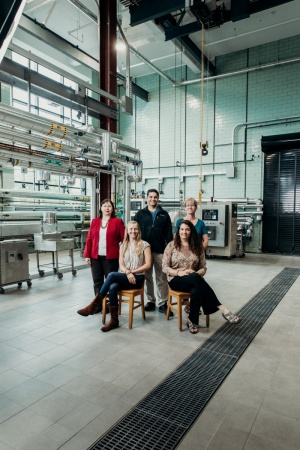
“Experienced cooks can make the same delicious food without ever writing a recipe down, but a set formulation and manufacturing process is the first step to ascertain safety of the final product,” said Bruno Xavier, Ph.D. ’08, a food microbiologist and extension associate at the CFVC. “So, our first goal is to work with the manufacturer to translate the recipe into a scheduled process—which is an exact and reproducible formula that is revised to ensure safety—without compromising the quality of the final product.”
With Ali, the center worked closely to optimize her products so that they conformed to food safety regulations. The Cornell food scientists recommended acidity adjustments to keep the sauces stable on the shelf and offered guidance on creating a standard overall production process, like shifting from fresh tomatoes to canned to accommodate larger scheduled production.
Today, Ali sells her healthful sauces in eight stores in the Buffalo area, with a goal to “move my product through every store in America,” she said.
More than 500 small food manufacturers like Ali work with the CFVC each year on food safety standards and regulations as the experts provide tools, techniques and solutions for meeting those codes. Now in its 30th year, the center helps in bringing approximately 2,000 products to market each year, aiding startups and established companies alike.
“Technology-driven solutions are key to advancing today’s food industry, and our facilities here at Cornell allow food entrepreneurs across New York and the Northeast to develop products that are safe, stable and marketable,” says Olga Padilla-Zakour, Ph.D. ’91, director of the CFVC and professor and chair of the Department of Food Science.
The family-owned, Rochester-based grocery chain Wegmans, with 98 stores across New York, Pennsylvania, New Jersey, Virginia, Maryland and Massachusetts, has long relied on its partnership with CFVC food science experts. Collaborations to ensure safety, stability and shelf-life extension of more than 400 products have enabled them to focus on innovation.
The Wegmans deli operations, for example, which rely on sandwich toppings prepared in bulk and shipped to stores across the chain, would not have been possible without collaboration with the CFVC, explains Kathleen O’Donnell ’83, M.S. ’95, director of food science and regulatory affairs at Wegmans Food Markets.
“The Cornell Food Venture Center is an invaluable resource for New York companies. We use it not just for what we are doing at Wegmans, but we’ve sent many of our suppliers to Cornell to develop and work on their products,” O’Donnell said. “It’s something that we have in New York state that is so important to the food industry and agriculture.”


