

periodiCALS, Vol. 9, Issue 1, 2019
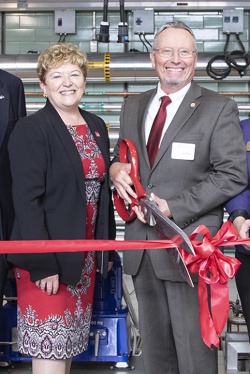
Dean Kathryn Boor ’80 and New York State Department of Agriculture and Markets Commissioner Richard Ball open the renovated Cornell Food Venture Center pilot plant at Cornell AgriTech. Photo by Jason Koski
Throughout U.S. history—including during the early days of our college at the turn of the 20th century—farms and rural communities have faced immense pressures from disruptive factors. Chronic stresses in agriculture include always being at the mercy of nature, while needing to maintain a labor force and to secure a reliable market. In addition to these ongoing challenges, more recent stresses include long-term low commodity prices, trade uncertainty and an increasingly unpredictable climate. These conditions have an impact on the rural and upstate communities we serve as New York’s Land-Grant university and the rural economies across our nation and around the world.
In the face of such challenges, innovation and technology are essential. For example, farmers in the 1930s faced a great global economic depression and extended drought conditions. For those able to invest in new technologies—such as replacing draft horses with tractors—farm productivity and yield improved. By 1945, tractors overtook horse power on U.S. farms, helping to provide better returns. We are at a similar turning point today. Low commodity prices are constraining resources available to farmers for reinvesting in new capital equipment at a time when such investments are more important than ever to ensure a farm’s future.
Cornell CALS aims to help farmers, communities and businesses embrace new technologies through innovation and the application of pioneering solutions to today’s vexing challenges.
In this issue of periodiCALS, you’ll read about our investment in innovative programs, collaborations and technologies that are focused on today’s needs while anticipating tomorrow’s areas of inquiry.
Specifically, you’ll learn about our cross-campus research, teaching and extension initiative focused on digital agriculture. This pan-university initiative leverages Cornell’s strengths at the intersection of engineering, data and information science and food systems research.
You’ll also discover how we’re transforming the traditional lecture-style classroom experience to an active learning environment to engage students who are used to immediately accessing any possible fact with the swipe of a finger.
And you’ll read about our newly renovated Cornell Food Venture Center, which offers state-of-the-art food-processing technology to help New York’s food businesses of all sizes turn their innovative ideas into safe commercial food products while fueling our economy from upstate to downstate.
These advancements illustrate the college’s goal of meeting the changing needs of our world through investments in innovative research, teaching and extension. I hope these examples—along with the rest of the content featured in this issue—inspire your optimism for the future.
Thank you, as always, for your continued support and interest in CALS.
Kathryn J. Boor, Ph.D.
The Ronald P. Lynch Dean of the College of Agriculture and Life Sciences


