

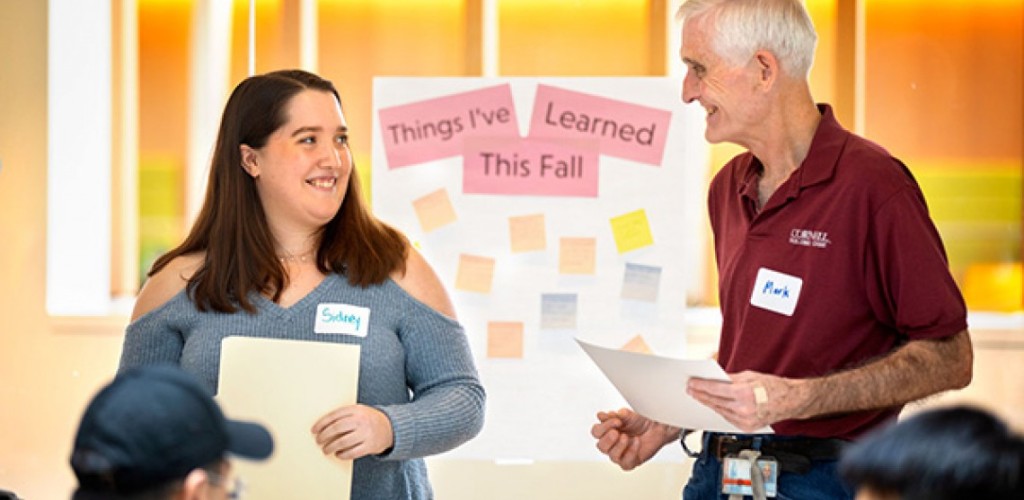
“I learned how to use gradients in Photoshop.”
“If something doesn’t work, try a different approach.”
“Always measure your shed before buying a tractor.”
It is not always easy to tell who is doing the learning – the Cornell employee or the student learning partner – in a mentoring session of the Community Learning and Service Partnership (CLASP). In CLASP, learning goes both ways.
Celebrating the completion of this fall semester’s projects and goals, CLASP students and staff gathered Dec. 5 in Schurman Hall to share their experiences and publicly thank their learning partners for participating in the program.
“Lifelong learning is vital for everyone at any age, at any level of education,” said Annalisa Raymer, director of CLASP. “Lifelong learning can lead to enhanced personal growth, it can lead to more satisfying career development and it can foster a culture of learning for everybody.”
Mary Opperman, Cornell vice president and chief human resources officer, noted that CLASP began as a partnership between the local United Auto Workers 2300 and Cornell University to support Cornell employees working toward their GEDs. That learning goal has expanded to include English as a second language, computer skills and other subjects.
This semester, Cornell staff members enhanced their skills through projects such as writing a short autobiography, designing posters and websites, writing cover letters and poems, improving photographic skills, and setting up accounting and budgeting sheets.
As the workforce has changed, and as CLASP has changed with it, “what has not changed is our commitment and the UAW’s commitment to this program,” Opperman said. “We are very grateful to students who give their time to be in partnerships and to help somebody advance their learning goals.”
Opperman noted that the partnerships also give students the opportunity to learn from hardworking staff, who can share valuable life stories and show how dedicated they are to “creating an educational environment in which all students can thrive.”
The education courses in adult learning for Cornell students are offered through the Department of Development Sociology in the College of Agriculture and Life Sciences. The CLASP program for adults is offered university-wide, and employees interested in CLASP should talk with their supervisors about participation. Staff generally meet with their student learning partners for a minimum of one hour each week for eight weeks over the course of a semester.
More information, including a video of employees and student learning partners, can be found on the CLASP website.


