Back

Discover CALS

See how our current work and research is bringing new thinking and new solutions to some of today's biggest challenges.

Share
  • Food Science
  • Viticulture and Enology
  • Food
Open (left) and closed (right) stomata.  Stomata (plural of stomate) are the portal through which plants regulate transpiration and gas exchange.  When closed, they restrict water use – but also restrict photosynthesis and carbohydrate production.  As water deficits intensify, stomatal closure limits evaporative cooling and can delay ripening.  Leaves heat up, and cellular function can be permanently degraded.  Finally, leaves from basal nodes out start to senesce, dry up, and fall off the vine.  Photos by (L) Bhaskar Bondata, Washington State University and (R) Markus Keller, Washington State University.

How Grapevines Respond to Water Stress

Water relations are a key factor in grapevine growth and development.  Plants take up water to maintain cell turgor, to make and expand new tissues, to provide evaporative cooling, and to facilitate gas exchange for photosynthesis (C02) and respiration (O2).  Vines actively regulate the flow of water in response to environmental conditions. 

Water availability dramatically affects vine vegetative growth, fruit composition, and potentially winter hardiness.  An overabundance of water is associated with excessive shoot vigor, canopy shading, and reduced fruit quality - and may delay the cessation of shoot growth and periderm formation, leading to poorer winter hardiness.  

Moderate water stress at the right time can reduce vegetative growth and help vines achieve the appropriate balance between vegetative growth and fruit yield and quality. Severe water stress limits photosynthesis, and can delay ripening, reduce bud fruitfulness, reduce winter hardiness, and result in sudden vine collapse.

Riesling

  • 0.8-1.5 Acre-inches/week

  • 22-40,000 Gal. per acre/week

Concord High Cordon (Single Curtain)

  • 1.2-1.5 Acre-inches/week
  • 32-42,000 Gal. per acre/week

Concord Geneva Double Curtain

  • 1.4-1.7 Acre-inches/week
  • 38-45,000 Gal. per acre/week

Soils Have Different Water Holding Capacity

Soil texture and depth determine how much water soils can supply.  Under estimated usage rates above, silty loams at field capacity can supply water for 6 weeks; sandy soils will run out of water in a week. 

Water stress will affect vines on coarse, shallow soils earlier and more severely than vines on deep, loamy soils.

Water Holding Capacity of Different Soils

Sandy or Gravelly Loam

  • 0.15 Inches of water per inch of soil
  • 3.6 Acre-inches of water in 24 inches of soil

Loamy Sand

  • 0.10 Inches of water per inch of soil
  • 2.4 Acre-inches of water in 24 inches of soil

Sandy

  • As low as 0.03 Inches of water per inch of soil
  • 0.7 Acre-inches of water in 24 inches of soil

Clay or Silty Loam

  • 0.25 Inches of water per inch of soil
  • 6.0 Acre-inches of water in 24 inches of soil

How Much Does Water Stress Reduce Vine Function?

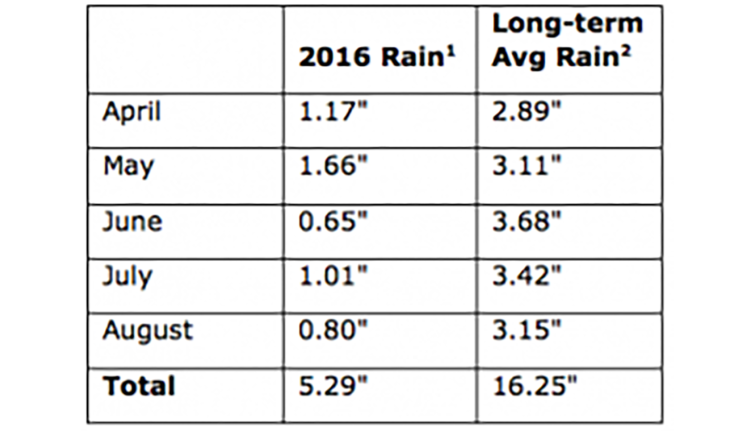
In 2002, we conducted a study that looked at irrigation and foliar nitrogen and its impact on vine function, yield, and fruit composition in a vineyard with shallow soils.  Drought that year brought us seven weeks from late July to early September with no rainfall.

We measured vine water status in irrigated and non-irrigated vine.  Mid-day leaf stem water potential (a measure of water tension due to drought) was -12 to -15 bars from early August through the start of September in unirrigated vines, and -5 bars in irrigated vines. As a general reference, growers in irrigated production regions often start applying irrigation when stem water potential reaches -9 to -10 bars.


Sources

Acknowledgements

Thanks to Michelle Moyer and Justine Vanden Heuvel for valuable comments and review of this article, and to Bhashkar Bondada and Markus Keller for the photos of leaf stomata.

Keep Exploring

three woman stand together eating orange slices

Field Note

by Harley Wolfanger '28 Where does our food really come from? That question followed our group throughout our agricultural expedition to California this past January. I decided to embark on this trip because I wanted to understand how the...
  • Dairy Fellows Program
  • Animal Science
  • Agriculture
person standing next to poster at conference

News

The New York Chapter and Northeastern Division of the American Fisheries Society annual meeting was held in Saratoga, New York, from February 4-6. Seven Cornell Biological Field Station (CBFS) representatives attended, including Tom Brooking...
  • Biological Field Station
  • Ashley School of Global Development and the Environment
  • Natural Resources and the Environment Section