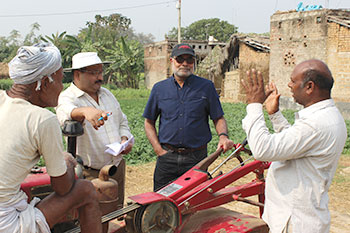
During the past 50 years, the Green Revolution helped transform India’s countryside into productive plots dedicated to the staple grains wheat, rice and maize, but the displacement of vitamin and mineral-rich foods has left much of the rural population chronically malnourished despite growing abundance in their midst. A $13.4 million grant from the Bill & Melinda Gates Foundation to the Tata-Cornell Agriculture and Nutrition Initiative (TCi) will promote a more nutrition-sensitive food system aimed at bolstering the diet of the rural poor.
“The push toward staple grains has inadvertently crowded out micronutrient-rich food,” said Prabhu Pingali, professor of applied economics and management and director of TCi. “To enact meaningful reform it’s not enough just to say, ‘let’s produce a more diverse diet.’ You need a behavioral change.”
Pingali said the project has three core missions: to collect data and evidence that informs policy reform related to diet quality; to redesign agricultural projects with a focus on nutrition; and to help build capacity to make reforms possible. TCi launched in 2013 as a research initiative to develop solutions where chronic nutrient deficiencies threaten long-term health and development. The new four-year grant establishes Technical Assistance and Research for Indian Nutrition and Agriculture (TARINA), a consortium led by TCi, linking Cornell with university and nongovernmental organization partners.
The consortium plans to influence the design of agricultural projects and policies with an eye on increasing the rural poor’s year-round access to an affordable food system replete with fresh fruit, vegetables, livestock products and pulses—the high-protein, micronutrient-dense legumes such as beans, peas and lentils essential to a predominantly vegetarian population.
The role of women is central to effecting change. In rural India, most homestead farms grow staple grains on two to four acres of land with labor largely supplied by women, and it’s typical for men to dine first, leaving less desirable food to the women in a custom that reinforces malnourishment, according to Pingali. The project aims to empower women by, in part, strengthening their access to leadership roles in producer groups and promoting labor saving techniques, such as mechanical rice-planting technologies that eliminate the grueling labor needed to plant rice by hand.
Pingali anticipated that the project will tap into expertise across Cornell, including the Charles H. Dyson School of Applied Economics and Management, Cornell’s Division of Nutritional Sciences, the School of Integrative Plant Science, the Department of Animal Science and the Department of Communication.