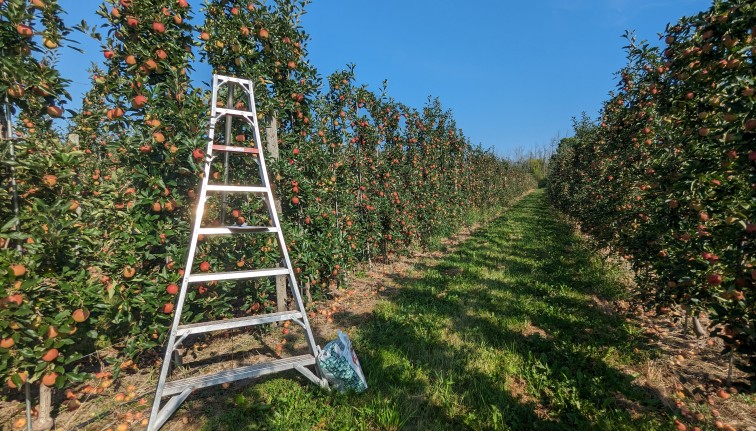
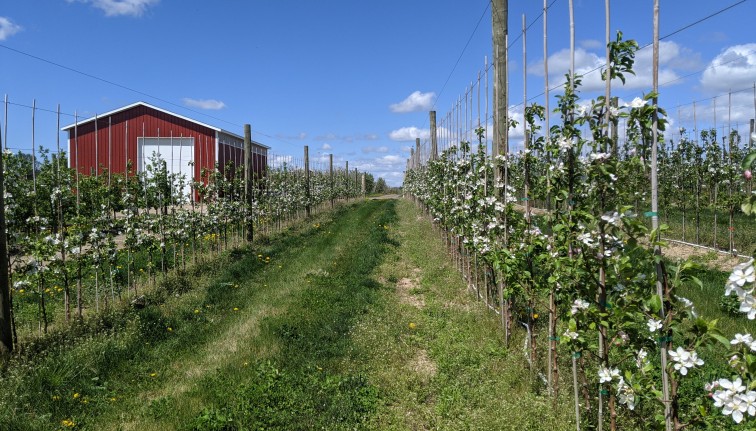
Tree Fruit Scouting—Online Course

This course trains tree fruit growers, orchard employees, industry professionals and interested students on the biology, identification and monitoring of major economically significant orchard pests, using an integrated pest management (IPM) approach. This course is FREE and provides an annual opportunity for growers to refresh their knowledge in advance of the growing season.

February 25–March 25, 2026

Live Webinars

Five sessions
Wednesdays
6:30-8 p.m. EST

Live Webinars 

You will have the opportunity to engage with expert presenters and ask questions.

Recordings Available

Can’t make a live webinar? No problem. The webinars are recorded and posted in the online classroom to watch any time. 

Ongoing Access

Once enrolled in this course, you will retain access to all materials indefinitely and can return to participate in the live webinars in future offerings of the course.

Tree Fruit Scouting Course Learning Objectives

By the end of this course, you will know:

  • The basic principles of Integrated Pest Management and how strategies and tactics are implemented in an orchard setting, primarily in apples.
  • The major economically significant insect, disease, weed and wildlife pests of orchards (primarily apples), the biology of these pests and how to identify them.
  • The methods used to monitor major orchard pests, critical times during the season when pests are active and require management and the appropriate thresholds used to implement a management tactic.
  • How to use the pest forecasting models on the NEWA website to predict pest activity and thresholds for making management decisions.

This course will focus on orchard scouting and monitoringIt will only offer an introduction to management tactics (i.e. pesticide efficacy). We will review resources and how to use them to determine tactics that are most effective and make educated decisions on selecting effective management tools.

Attend the LIVE webinar while logged in to a personal computer or device for verification of identity. (Credits are not available for watching the recording). 

Email Anna Wallis a copy of your pesticide applicator certification card.

Fill out a poll at the beginning and end of the webinar.

Questions?

Anna Wallis
aew232 [at] cornell.edu (aew232[at]cornell[dot]edu)

Schedule

Wednesdays 6:30–8 p.m. EST

  • Week 1—IPM Fundamentals + Tools
  • Week 2—Insects: Part 1
  • Week 3—Insects: Part 2
  • Week 4—Diseases
  • Week 5—Weeds, Wildlife, + Wrap-Up

February 25 (week 1)

IPM Fundamentals and Tools

  • What is IPM?
  • Tools and Tactics
  • An overview of the season

March 4 (week 2)

Insects: Part I

  • Degree Days and NEWA
  • Plum curculio
  • Tarnished Plant Bug and European apple sawfly
  • Lepidopterans

March 11 (week 3)

Insects: Part II

  • Mites and aphids
  • Apple maggot
  • Stink bug
  • Black stem borer

March 18 (week 4)

Diseases

  • Apple scab
  • Fire blight
  • Powdery mildew
  • Leaf spots and fruit rots

March 25 (week 5)

Weeds and Wildlife

  • Weed identification
  • Voles, deer, and rabbits

Instructors

portrait of Anna Wallis
Anna Wallis

Fruit IPM Coordinator

Cornell Integrated Pest Management

Anna Wallis
  • aew232 [at] cornell.edu
A headshot photo of Hannah Tolz
Hannah Tolz

Extension Support Specialist

Cornell Integrated Pest Management

Hudson Valley Research Laboratory

Hannah Tolz
Andres
Carlos Andres Antolinez Delgado

Senior Research Associate

Department of Entomology

Hudson Valley Research Laboratory

Carlos Andres Antolinez Delgado
  • caa245 [at] cornell.edu
Pest management
A man stands smiling in a fruit orchard
Kerik Cox

Professor

School of Integrative Plant Science

Plant Pathology and Plant-Microbe Biology Section

Cornell AgriTech

Kerik Cox
Fruit pathology
Antimicrobial resistance and disease forecasting
Biological control and germicidal light
Lynn Sosnoskie
Lynn Sosnoskie

Assistant Professor

School of Integrative Plant Science

Horticulture Section

Cornell AgriTech

Lynn Sosnoskie
Weed ecology
Weed management
Specialty crops