

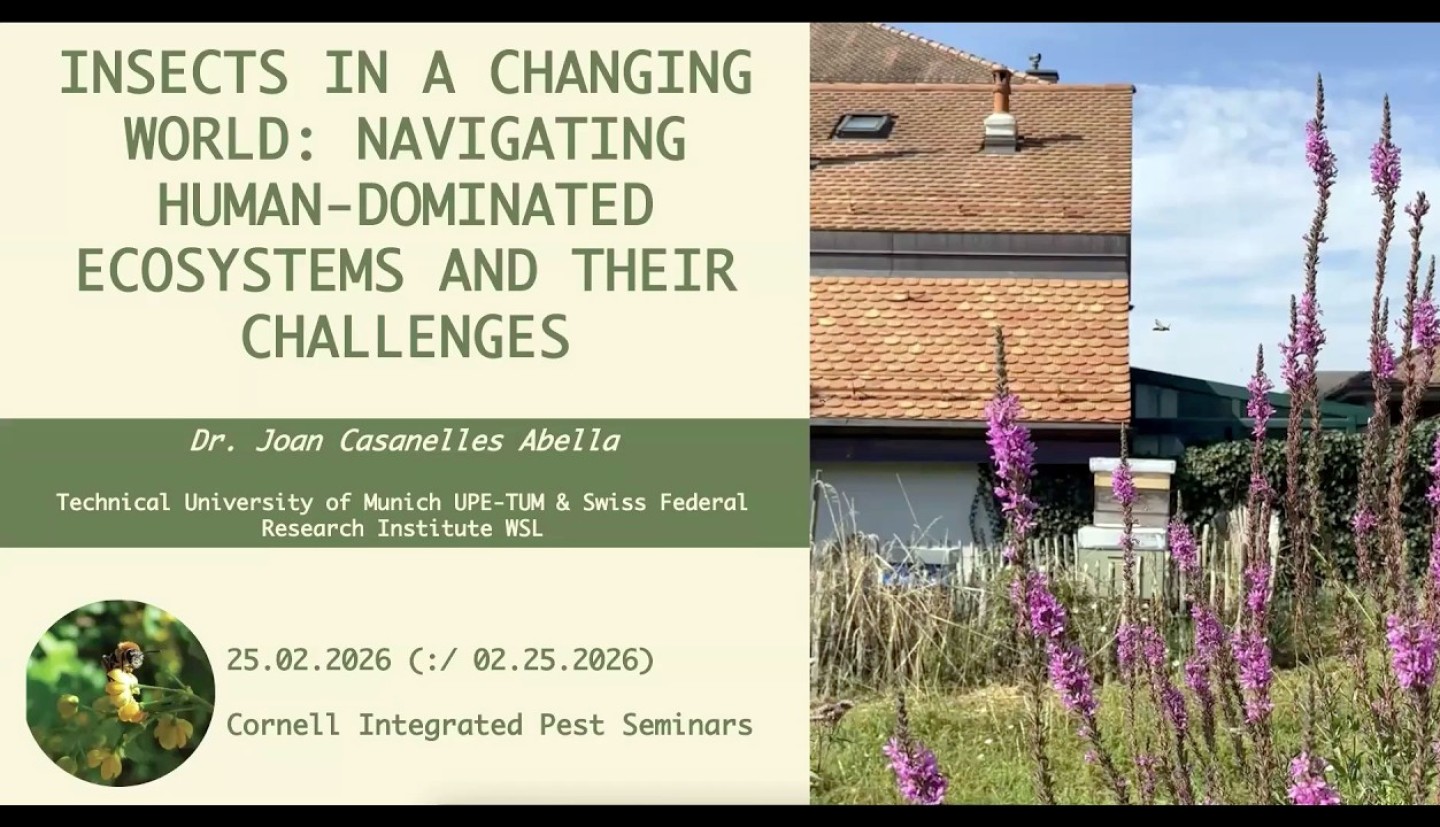
Land-use changes, like agricultural intensification and urbanization, have contributed to the decline of insects, resulting in complex and novel foraging landscapes, which are compounded by changing climates. Insect conservation efforts cannot be limited to natural and semi-natural ecosystems and there is growing interest in improving habitats for insects in human-dominated environments.
Historically, research has focused on how land-use change—often measured by plant diversity or landscape heterogeneity—affects the abundance and species richness of specific insect groups, such as pollinators. However, to gain deeper insights into how insects cope with and potentially thrive in human-dominated ecosystems, it is important to examine individual and population-level metrics, particularly those focusing on functional traits that reveal how species respond to these landscapes.
During his presentation, Casanelles Abella will present findings from past and ongoing projects aimed at understanding the factors influencing insects in human-dominated ecosystems through the lenses of nutritional ecology, human-plant-insect interactions, managed pollinators and intraspecific trait variability. The talk will also examine the insights that can be gained from focusing on how species cope and might thrive in human-dominated ecosystems by focusing on individual and population-level metrics, specifically, regarding functional traits that explain how species respond to human-dominated landscapes.
Date & Time
February 25, 2026
11:15 am - 12:15 pm
Location
More information about this event.
Contact Information
Bryan Brown, Ph.D., Integrated Weed Management Specialist, Cornell Integrated Pest Management
- bryan.brown [at] cornell.edu
Speaker
Joan Casanelles Abella, Ph.D., Postdoctoral fellow, Technical University of Munich
Departments
Cornell Integrated Pest Management
Website
Related Events
Conference

Seminar

We openly share valuable knowledge.
Sign up for more insights, discoveries and solutions.