

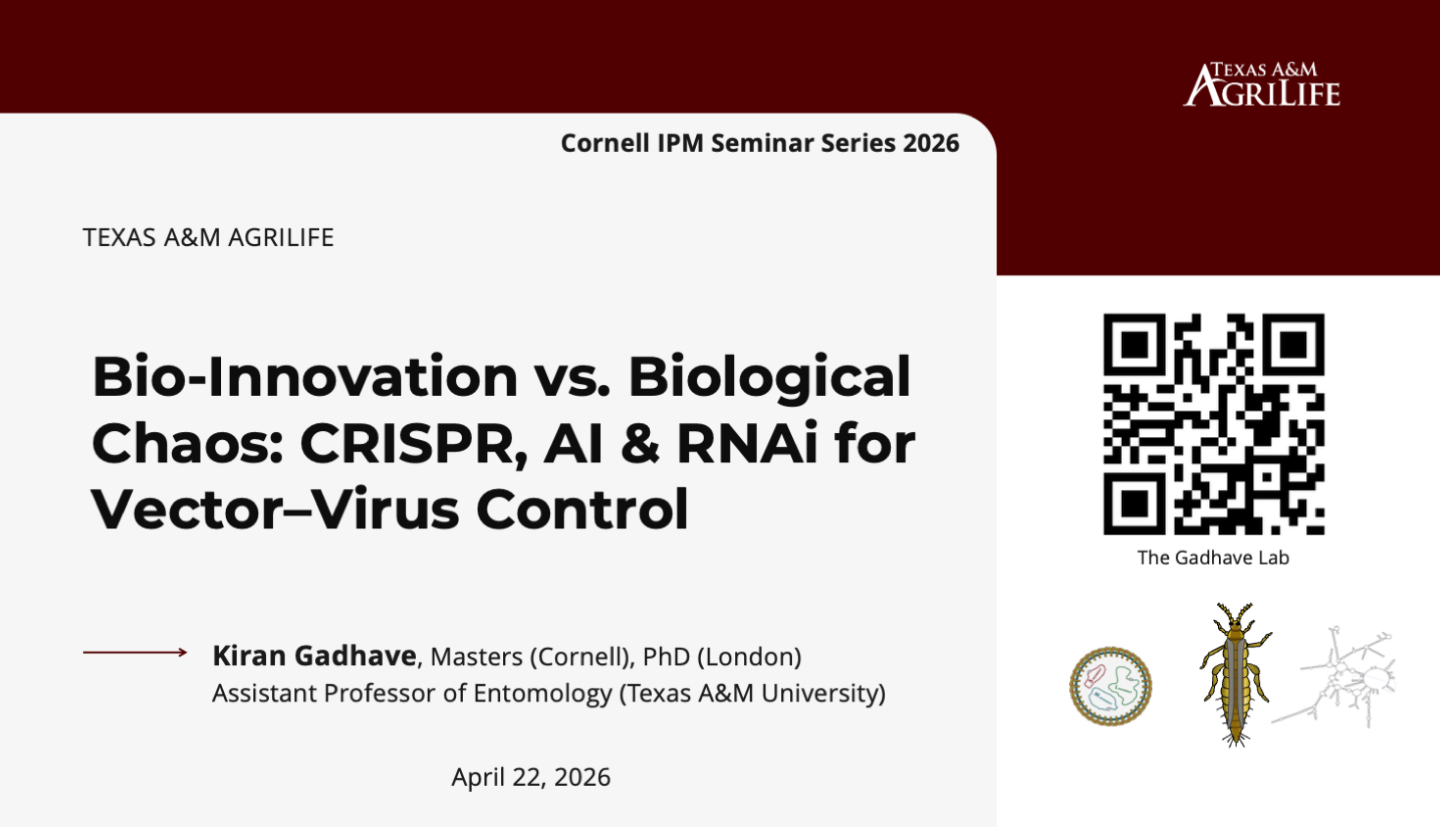

Plant–virus–vector interactions aren’t quiet biological relationships—they’re live battlegrounds where evolution, adaptation and molecular strategy collide. In this seminar, Gadhave will share how emerging technologies can help confront agricultural pandemics and the supervectors that drive them.
The talk will begin by unpacking how tomato spotted wilt virus (TSWV) overcomes single-gene resistance in tomato and pepper—revealing why long-trusted defenses fail and what that means for growers. From there, Gadhave will explore new technological frontiers: proof-of-concept CRISPR-based assays for rapid TSWV detection, and machine learning models that expose the microclimate-specific forces shaping thrips population dynamics. The talk then dives deeper into the molecular choreography between hosts, viruses and vectors—highlighting protein-level determinants that govern infection, acquisition, and transmission. Finally, Gadhave will explore how RNAi-based approaches, including mobile RNA and dsRNA sprays, are reshaping what sustainable, precision pest management can look like. By weaving together classical vector biology with CRISPR diagnostics, AI-driven ecology and programmable RNAi, this seminar uncovers the mechanisms that fuel pathogenesis and transmission,while charting a path toward durable, system-wide strategies to protect crops in a rapidly changing world.
Date & Time
April 22, 2026
11:15 am - 12:15 pm
Location
More information about this event.
Contact Information
Bryan Brown, Ph.D., Integrated Weed Management Specialist, Cornell Integrated Pest Management
- bryan.brown [at] cornell.edu
Speaker
Kiran Gadhave, Ph.D., Assistant Professor of Entomology, Texas A&M University
Departments
Cornell Integrated Pest Management
Website
Related Events
Conference

Seminar

We openly share valuable knowledge.
Sign up for more insights, discoveries and solutions.