

Search for News & Stories

News
Ultraviolet light, which has been used successfully to suppress fungal powdery mildew in grapes, strawberries and cucumbers, can also destroy the bacteria that causes devastating fire blight in apples, according to new research from Cornell...

Field Note
VM Agritech has spent the last five years developing Curezin, a broad-spectrum, copper-and-zinc-based fungicide that thanks to its unique chemistry, won’t lead to pathogenic resistance. When in-vitro testing by the University of Exeter showed...


News
Study charts how orchards can leverage mechanical thinning and pruning without spreading fire blight
New findings from the lab of Kerik Cox, associate professor of plant pathology and plant-microbe biology, indicate that there may be hope for producers vying to use these technologies. Published by the American Phytopathological Society in...

News
The U.S. Department of Agriculture’s National Institute of Food and Agriculture has awarded a $779,000 grant to Cornell AgriTech researchers to combat fire blight, one of the most devastating bacterial diseases for the apple and pear industries...
Field Note
What drew you to the program at Cornell AgriTech? Apples! I’ve been working with tree fruit since I was an undergraduate at the University of Maryland, and I was previously a regional apple specialist with Cornell Cooperative Extension. Not only...

Spotlight
Cornell University’s berry team provides expertise in horticulture, entomology, plant pathology, agricultural economics, plant breeding and management practices for New York state’s $20 million berry industry.
News
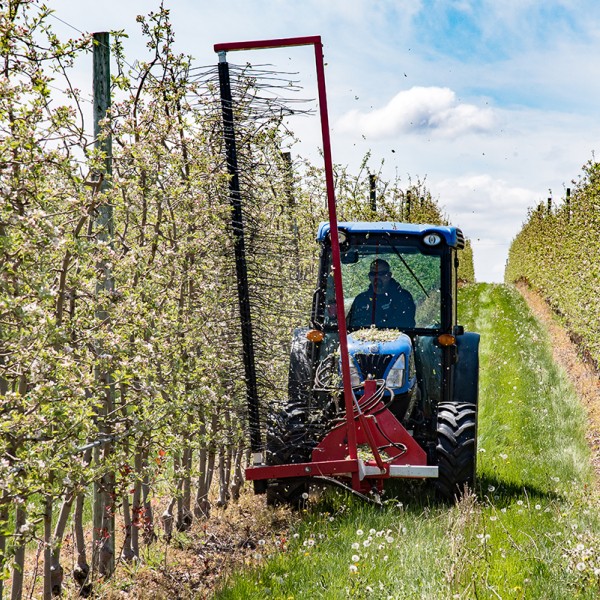
Concerns about the banning of a plant-thinning chemical prompted New York apple producers, CCE educators and Cornell researchers to study a mechanical blossom-thinning alternative to carbaryl.

We openly share valuable knowledge. Often through email.
Sign up for more insights, discoveries and solutions.
Please enter a valid email address to subscribe to the newsletter.