Back

Discover CALS

See how our current work and research is bringing new thinking and new solutions to some of today's biggest challenges.

Search for News & Stories

RNA

News

Researchers developed machine-learning models that can sift through cell-free RNA and identify key biomarkers for chronic fatigue syndrome, a debilitating disease that is difficult to confirm in patients because its symptoms can be easily...

  • Molecular Biology and Genetics
  • Health + Nutrition
  • Disease
Scenic view of McGraw Tower

News

The honor is presented annually, recognizing awardees on campuses across the SUNY system for their commitment to sustaining intellectual vibrancy, advancing the boundaries of knowledge, providing the highest quality of instruction and serving...

  • Molecular Biology and Genetics
  • Neurobiology and Behavior
  • School of Integrative Plant Science
Chronic fatigue syndrome patient.

News

The study found that key CD8+ T cells showed signs of constant stimulation that lead to an exhausted state, a condition that is well-studied in cancer.

  • Molecular Biology and Genetics
  • Neurobiology and Behavior
  • Genomics
Ben Cosgrove works in a lab

News

A Cornell multidisciplinary research center that studies chronic fatigue syndrome has received a five-year, $9.5 million grant from the National Institutes of Health – funding that will enable experts to continue work on the mysterious and...

  • Molecular Biology and Genetics
  • School of Integrative Plant Science
  • Plant Biology Section
Two people in the lab.

News

A Cornell study describes a breakthrough in the quest to improve photosynthesis in certain crops, a step toward adapting plants to rapid climate changes and increasing yields to feed a projected 9 billion people by 2050.
  • Molecular Biology and Genetics
  • Genetics
  • Plants
Maureen Hanson and a student in a lab.

News

Blue-green algae (cyanobacteria) are known to photosynthesize more efficiently than most crops, so researchers are working to put elements from cyanobacteria into crop plants. A new study describes a significant step towards achieving that goal...
  • Molecular Biology and Genetics
  • Biology
  • Environment

News

Anurag Agrawal, the James A. Perkins Professor of Environmental Studies in the College of Agriculture and Life Sciences, and Maureen Hanson, the Liberty Hyde Bailey Professor in the Department of Molecular Biology and Genetics (CALS, Arts and...

  • School of Integrative Plant Science
  • Plant Biology Section
  • Molecular Biology and Genetics

News

Maureen Hanson, the Liberty Hyde Bailey Professor in the Department of Molecular Biology and Genetics in the College of Agriculture and Life Sciences and in the College of Arts and Sciences, and Bernice Grafstein, the Vincent and Brooke Astor...
  • School of Integrative Plant Science
  • Plant Biology Section
  • Molecular Biology and Genetics
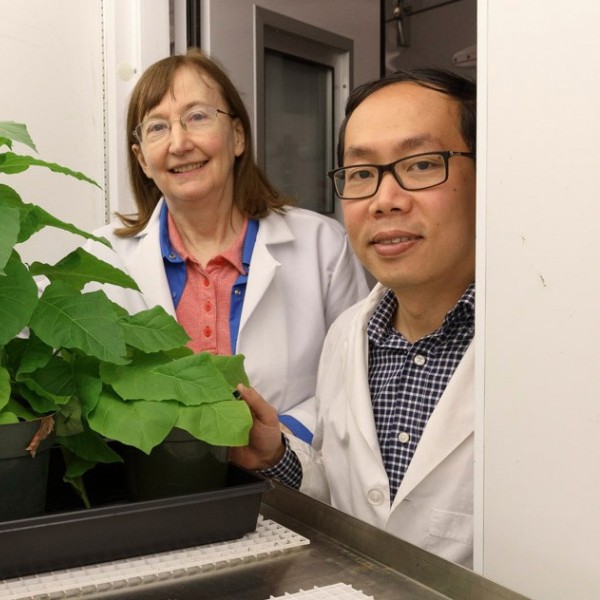
A man and woman standing next to green plants

News

The method is described in a paper, “ Small subunits can determine enzyme kinetics of tobacco Rubisco expressed in Escherichia coli,” published Sept. 14 in the journal Nature Plants. Scientists have known that crop yields would increase if they...
  • School of Integrative Plant Science
  • Plant Biology Section
  • Molecular Biology and Genetics

News

Imagine if plants could be engineered to produce vaccines, pharmaceuticals, proteins and enzymes for medical, agricultural and industrial applications at a fraction of their current cost. A new Cornell-led study describes a major advancement in...

  • Molecular Biology and Genetics
  • Biological and Environmental Engineering
  • Medicine