

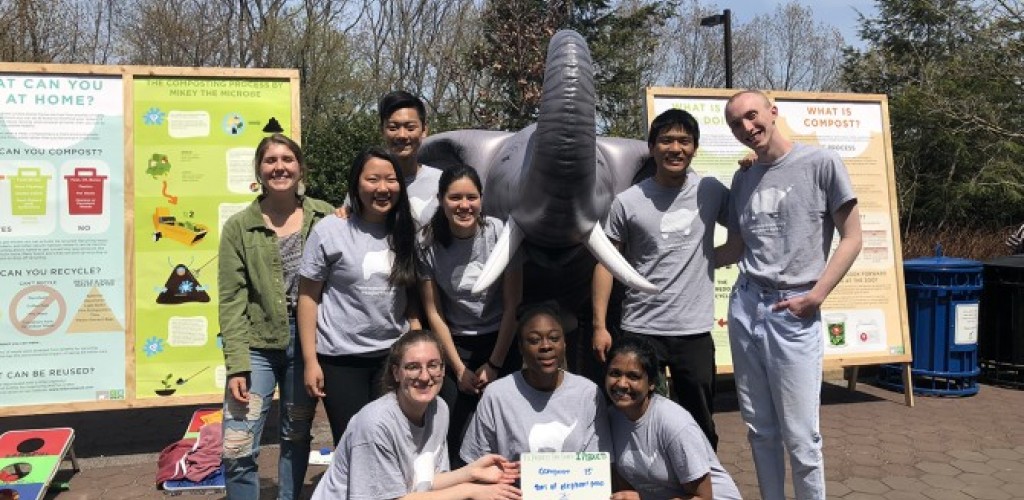
Nine members of the Cornell University Sustainability Design (CUSD) student group spent Earth Day weekend April 21-22 at Smithsonian facilities in Washington, D.C., dispensing environmental education to the public.
To celebrate Earth Optimism Day at the Smithsonian’s National Zoo, CUSD’s Team REDO – Recycling Elephant Doo Organically – introduced zoo visitors to animal waste recycling and composting, said Dora Tan ’18.
At the Q?rius Earth Optimism Teen Event at the Smithsonian’s Museum of Natural History, Cornell students taught middle and high school students about the composting process and the importance of reuse. Anekha Goyal ’21 participated in a panel discussion, where she shared her passion for sustainability.
The students helped to facilitate the Smithsonian Recycling Challenge competition, where participants sorted waste into landfill, recycling and composting piles.
“We had a bucket of fresh elephant poop compost on display,” said Ajara Cobourne ’19. “Initially hesitant, teens at the Q?rius event eventually stuck their hands into the bucket to feel and smell the nutritious material made from the elephant poop.”
CUSD students helped visitors create seed balls made from soil, seeds, clay and water for the Smithsonian’s Pollinator Garden. “Many families with young children had fun making the seed balls and learning about sustainability,” said Allie Sawin ’21, who worked with Cole Sikon ’19 at the event. “These seed balls can then be gently tossed anywhere in a backyard … [and] they will grow into a wildflower garden,” she said.
Off the beaten path at the Smithsonian National Air and Space Museum’s Paul E. Garber Facility in Suitland, Maryland, elephant waste is being composted by an in-vessel composter system, which can produce up to 1,600 pounds of compost a day.
“We helped people load their buckets and trucks with elephant waste compost, as CUSD hopes to help implement a similar on-site system at the zoo,” said Michael Zhang ’21, who worked the event with Hilary Paul ’19.
After the Earth Day festivities ended, Goyal, Sikon, Solina Kennedy ’19 and Zeyu Hu ’19, who leads REDO, gave a brief overview of a possible CUSD waste management project for the zoo to Smithsonian executives on April 23.
“We received great feedback for our proposed project,” Hu said. “It was nice to hear that our work – for the next generation of scientists and sustainability leaders – is inspiring.”


