

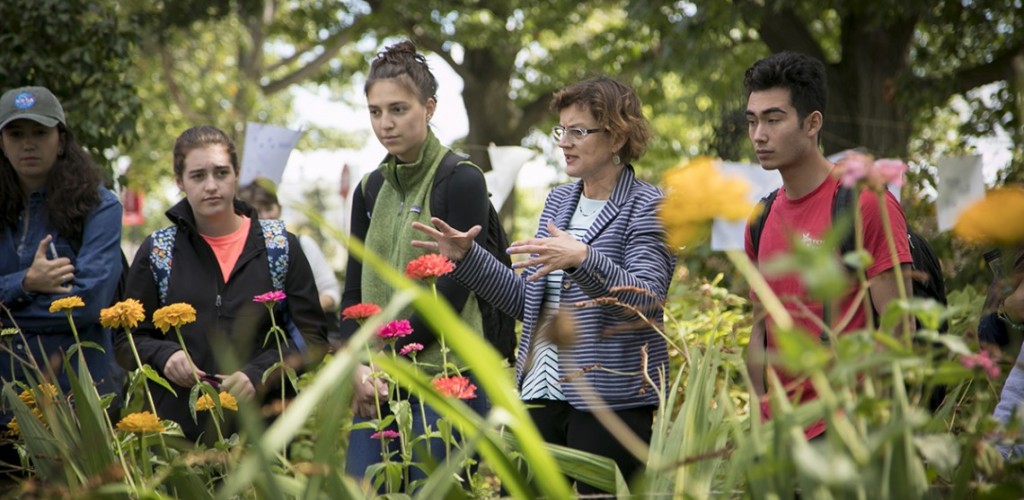
In a celebration of the biodiversity found in Minns Garden, more than 70 environmental and sustainability sciences majors turned the garden into an ephemeral art gallery Sept. 29.
On a balmy autumn afternoon, students observed and then drew flora found in the garden from three perspectives: standing, kneeling and lying down. The purpose was not to create fine art. Rather, the course invited students to engage in the process of careful observation, according to Philadelphia-based artist Marion Wilson, who led the session known as an “art intervention.”

A student draws a sketch in Minns Garden. Photo by Jason Koski/University Photography.
“Essentially, I was asking them to use their bodies like a microscope – to start out taking in the whole and then zooming in for a closer look,” Wilson said.
After receiving instruction, the students fanned out through the Tower Road garden. Each worked in silence in their desired spot in the half-acre garden brimming with hundreds of plant species.
“It was amazing how quiet it was,” Wilson said. “By asking them not just to observe, but to create drawings from the three different perspectives helped lead them to the essence of contemplation – thinking in a deep way that connects art and science.”
Students hang their work in the garden to make an outdoor gallery space. Photo by Jason Koski/University Photography.
The students hung their finished works from twine festooned across the garden, creating a “[public art] installation of this small natural world on campus,” said Johannes Lehmann, professor in the Soil and Crop Sciences Section of the School of Integrative Plant Science.
Wilson was invited by Lehmann and Susan Riha, the Charles L. Pack Professor in the Department of Earth and Atmospheric Sciences, who co-teach the course, in part because of her celebrated use of ecology in art. Wilson has done similar activities with other groups, often focusing on urban environments.
Marion Wilson, right, works with a student in Minns Garden. Photo by Jason Koski/University Photography.
“What was different this time was the stunning beauty of the garden. I think it really helped draw in the students,” she said.
The instructors are organizing a place to display the student works from the event.
Craig Cramer is a communications specialist for the School of Integrative Plant Science.


