

Drew Margolin, a professor of communication at Cornell University who studies human dynamics through social media, isn’t just tracking how the electorate is reacting to candidates in one single moment via Twitter, but how they have been reacting since the beginning of the primaries. This historical data gives Drew and his collaborator Yu-Ru Lin, University of Pittsburgh, a unique window into changing sentiment within a party about candidates and topics, as well as across party affiliations.
For example, how are early Trump or Hillary supporters reacting differently from more general Republicans and Democrats who originally favored another candidate? What about those who may have been #NeverTrump or #NeverHillary? And what does it mean for Election 2016?
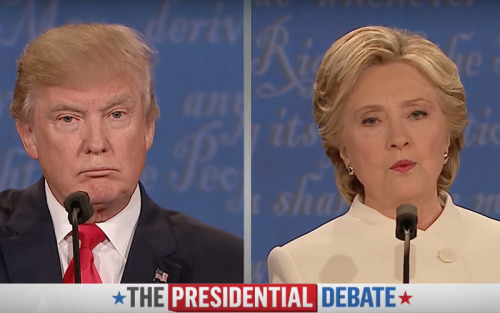
Margolin’s analysis of the third, and final, Presidential Debate below.
The make up of the computational focus groups, and general thoughts on using Twitter as a sentiment barometer can be found here. If you’d like to monitor how the groups are responding throughout the campaign, check out our interactive tool at debatemeter.com.
Our Twitter groups’ reaction to tonight’s final debate suggests the campaign has settled into three basic patterns we’ve come to see throughout this campaign. First, the country is divided along partisan lines. Second, Donald Trump draws lots of attention for controversial things he says off the cuff, drawing attention away from issues his supporters and other GOP members care about. And third, his supporters and other GOP members don’t agree on what is important.
First, as we’ve seen throughout the debates, each group focused more attention on the candidate from the opposing party than on its own candidate, and in each case the sentiment expressed about this opposing candidate was relatively negative. Also, consistent with this campaign, there wasn’t much positive sentiment for either candidate. Trump drew negative sentiment from all 4 Democratic groups, and also the GOP candidate avoiders (people dropped Trump earlier in the campaign and didn’t follow another GOP candidate) and Glincton drew negative sentiment from all 4 Republican groups and also the Hillary Dumpers (people who dropped Hillary and switched to another Democratic candidate, usually Sanders).
There was, however, one bright spot: Chris Wallace, the moderator, drew more attention than moderators have in the other debates, getting consistently mentioned in 2-4% of tweets. Tweets mentioning Wallace were also positive across the board, with 7 out of 8 groups using relatively positive sentiment when tweeting about Wallace.
So at the aggregate level, this debate seemed to follow typical partisan lines. Beneath the surface, however, one can see the problems that the GOP has been having. In 6 of the 8 groups there was a clear triplet of top phrases – all quotes from Trump: “No one has more respect for women [than I do]”, “[Hillary’s a] nasty woman” and “you’re the puppet.” Within Democratic groups these phrases were mocked and treated with incredulity. Within 2 Republican groups (Candidate Avoiders; Trump Avoiders), these were also laughed at and criticized, though some concurred regarding Hillary’s nastiness. But the other two Republican groups seemed to be watching another debate. The Trump Dumpers (people who initially followed Trump but then switched to another GOP candidate during the campaign) focused on traditional Republican issues. Their most quoted phrase was Hillary’s claim that she would not “add a penny to the debt.”
They also reacted strongly to her statement that she did not want to “rip families apart” by making references to the violence of partial birth abortion. But in a microcosm of the struggles that the GOP has had in this campaign, these issues were not only ignored by the somewhat less political “avoider” Republican groups, they were ignored by the Defectors to Trump – those who initially followed another GOP candidate but switched to Trump during the campaign. This group quoted Trump directly by retweeting his Twitter account, with their top phrases being “make america great” and “We have no country.” They also focused more on Trump’s “nasty woman” comment than on Hillary’s “penny to the debt” or “rip families apart.”
This pattern doesn’t bode well for Trump’s short term chances. The only consistent reaction to him is one of mockery and negativity among Democrats and those not inclined toward him to begin with. But this also suggests that Hillary’s lead does not indicate a consensus of support for her. From the point of view of our groups, this campaign has been about Trump. The polls show Hillary in the lead, and there is nothing in the reaction to tonight’s debate that suggests this will change. However, there is much to suggest that, if elected, a President Hillary Clinton will face a divided GOP whose main point of solidarity is their dislike of her.
The Twitter groups Margolin is studying throughout the 2016 presidential election:
- Defectors to Hillary: People who started out with another Democrat, but now follow Hillary
- Hillary Dumpers: People who started out with Hillary, now follow another Democratic candidate instead (almost always Sanders)
- Hillary Avoiders: People who started out with another Democrat, dumped them, don’t (yet) follow Hillary
- Democratic Candidate Avoiders: People who started out with Hillary, now follow no Democratic candidates
- Defectors to Trump: People who started out with another Republican, but now follow Trump
- Trump Dumpers: People who started out with Trump, now follow another Republican candidate instead
- Trump Avoiders: People who started out with another Republican, dumped them, don’t (yet) follow Trump
- Republican Candidate Avoiders: People who started out with Trump, now follow no Republican candidates
For media interviews contact:
Rebecca Valli
Office: 607-255-7701
Cell: 607-793-1025
rv234 [at] cornell.edu
Ellen Leventry
Office: 607-255-2722
Cell: 607-793-1441
eel2 [at] cornell.edu


