

Drew Margolin, a professor of communication at Cornell University who studies human dynamics through social media, isn’t just tracking how the electorate is reacting to candidates in one single moment via Twitter, but how they have been reacting since the beginning of the primaries. This historical data gives Drew and his collaborator Yu-Ru Lin, University of Pittsburgh, a unique window into changing sentiment within a party about candidates and topics, as well as across party affiliations.
For example, how are early Trump or Hillary supporters reacting differently from more general Republicans and Democrats who originally favored another candidate? What about those who may have been #NeverTrump or #NeverHillary? And what does it mean for Election 2016? Margolin’s analysis of the Vice Presidential debate below.
The make up of the computational focus groups, and general thoughts on using Twitter as a sentiment barometer can be found here.
If you’d like to monitor how the groups are responding throughout the campaign, check out our interactive tool at debatemeter.com.
Stay tuned for analysis of Sunday’s town hall-style Presidential Debate!
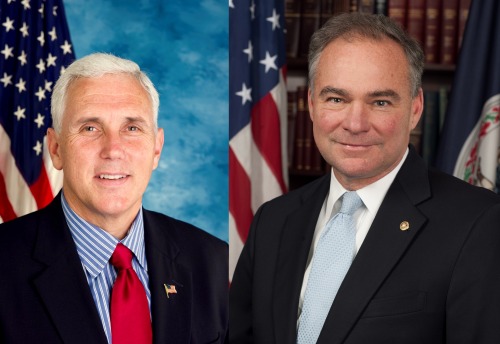
Last night’s VP debate showed much of the same pattern as the first presidential debate, with one interesting difference. Republicans were positive about something, but it wasn’t Donald Trump. It was Mike Pence.
First, consistent with the results from last week, Twitter was more of jeering section than cheering section. Mike Pence drew mention in the most tweets in each of our Democratic groups, and each group expressed relatively negative sentiment in these tweets. Tim Kaine drew mention in the most tweets in our Republican groups, and each group expressed relatively negative sentiment in these tweets. We also observe, similar to last week, that the presidential candidates themselves were mentioned more by groups drawn from the opposing party than by their own groups. We even see this difference in the mentions of President Obama and Vladimir Putin. Neither attained much attention (mentioned in only 1-2% of tweets), but Putin was mentioned more by Democratic groups and Obama mentioned more by Republican groups.
Also, similar to last week, the partisanship shift applied less to Trump. That is, Trump was mentioned much more by Democrats than Hillary was, but only slightly less by Republicans. To the extent to which these mentions reflect being targeted for criticism, this reflects a problem for Trump.
Mike Pence’s results were not similar to his running mate’s, however. While Pence was panned by Democratic groups, tweets mentioning him were relatively positive in 3 out of 4 Republican groups. This level of positivity was not achieved among Democrats by Kaine, where sentiment was mostly neutral, and indicates the most consistent positive reaction we have observed for any candidate in either debate so far. In particular, this positivity was not achieved by Trump himself, even among Republicans. Echoing the night of the RNC when the Trump Dumpers (people who used to follow Trump and then switched to another GOP candidate) cheered Ted Cruz’s non-endorsement of the nominee, Trump dumpers expressed significantly positive sentiment in tweets about Mike Pence and significantly negative sentiment in tweets about Trump himself. In fact, both groups that used to follow Trump (Trump Dumpers, GOP Candidate Avoiders), expressed relatively negative sentiment in tweets that mentioned Trump.
The split nature of the GOP ticket was also reflected in the phrases most quoted from the candidates’ remarks. There were some cheers for favorite lines. Democrats acclaimed Kaine’s “why don’t you trust women [to make abortion choices for themselves]” and Republicans cheered Pence’s “police officers are the best of us.” But the phrase of the night across all groups was “insult driven campaign.” This phrase was the first or second most quoted line from the candidates’ in most groups. It’s interpretation mostly shifted with group loyalties but, not entirely. Democrats mocked Pence’s claim that their campaign was the “insult driven” one, while Trump Dumpers celebrated this zinger pinned on the Clinton-Kaine campaign. However, reaction among the GOP Candidate Avoiders – people who used to follow Trump but did not pick up a new GOP candidate – was mixed. Some cheered the line, but others expressed incredulity.
In a way last night’s results reflect the interesting dynamics of the Republican party in this election year. Measuring the responses of our groups, it would appear that Pence outperformed Kaine, but whether his display of traditional GOP values and tactics actually helped his running mate is less clear.
For media interviews contact:
Rebecca Valli
Office: 607-255-7701
Cell: 607-793-1025
rv234 [at] cornell.edu
Ellen Leventry
Office: 607-255-2722
Cell: 607-793-1441
eel2 [at] cornell.edu


