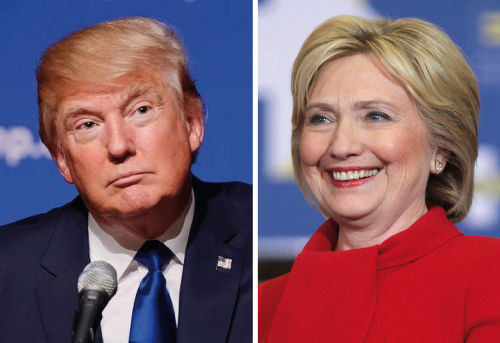
Drew Margolin, a professor of communication at Cornell University who studies human dynamics through social media, isn’t just tracking how the electorate is reacting to candidates in one single moment via Twitter, but how they have been reacting since the beginning of the primaries. This historical data gives Drew and his collaborator Yu-Ru Lin, University of Pittsburgh, a unique window into changing sentiment within a party about candidates and topics, as well as across party affiliations.
For example, how are early Trump or Hillary supporters reacting differently from more general Republicans and Democrats who originally favored another candidate? What about those who may have been #NeverTrump or #NeverHillary? And what does it mean for Election 2016?
Margolin’s analysis of the second Presidential Debate below.
The make up of the computational focus groups, and general thoughts on using Twitter as a sentiment barometer can be found here. If you’d like to monitor how the groups are responding throughout the campaign, check out our interactive tool at debatemeter.com.
Reaction to the “locker room talk” comment epitomized the campaign. Democrats were outraged and offended, and so were some Republicans, but others felt focusing on specific statements made by Trump was distracting from issues they cared more about.
Specifically, many members of Democratic groups found the claim absurd, often restating the phrase with an incredulous question mark or pointing out that, whatever it was, it justified sexual assault. Others pointed out that he was “pivoting” to ISIS, which some derided but others simply reported.
Republican groups were more mixed. None defended Trump directly, but many minimized the issue and advocated Trump’s logic that ISIS was a more serious problem. In fact, the Trump campaign sent a tweet to this effect during the debate that several individuals in Republican groups retweeted. Others felt it was “old news” and wanted to focus more on Hillary’s e-mail server, which they felt was a greater infraction. Several individuals retweeted a tweet by Frank Luntz that showed his focus group subjects cared more about the e-mails. That said, there were also many individuals in the Republican groups who criticized Trump for promoting a culture that justified sexual assault.
While the “locker room talk” was either the top or second most quoted phrase for 6 of the 8 groups, and was top for 3 of the democratic groups, Republican groups’ top phrase was Trump’s promise to Clinton that if he were president “you’d be in jail.” It should be noted this is the first time Trump’s most quoted line has been one received favorably.
In general, the reaction to tonight’s debate was consistent both with the general pattern for this campaign – negative – and the trend in the country as a whole – polarized.
First, both candidates generally received more attention from opposing groups than from their own, and these tweets sent about the candidates from these opposing groups were negative. In fact, this is the first debate where this was true for each opposing group– tweets from all 4 of the Democratic groups that mentioned Trump had relatively negative sentiment, and tweets from all 4 of the Republican groups that mentioned Hillary had relatively negative sentiment.
Beyond this basic division, however, there were some small differences. Much as Republican groups were able to muster positive sentiment for Mike Pence the other night, some Democratic groups showed positive sentiment. First, the Defectors to Hillary, her most loyal group, tweeted relatively positively about Hillary. This is actually something they did during the VP debate as well. Also, the Hillary Avoiders tweeted relatively positively about Barack Obama.
Once again, however, Trump was not able to muster any relatively positive sentiment from any group, and consistent with other events, received tweets with relatively negative sentiment from both the Trump Dumpers and the GOP Candidate Avoiders, groups of individuals who used to follow Trump but no longer do. Whether the tendency to speaker negatively when talking about Trump means tweets direct negative feeling toward him, or simply reflect his channeling of negative feelings toward the nation’s situation, is hard to say. But the lack of positivity is striking given that Pence received positive sentiment from 3 of 4 Republican groups during last week’s VP debate and, as mentioned above, Hillary and Obama were able to obtain at least some positive sentiment as well.
For media interviews contact:
Rebecca Valli
Office: 607-255-7701
Cell: 607-793-1025
rv234 [at] cornell.edu
Ellen Leventry
Office: 607-255-2722
Cell: 607-793-1441
eel2 [at] cornell.edu