

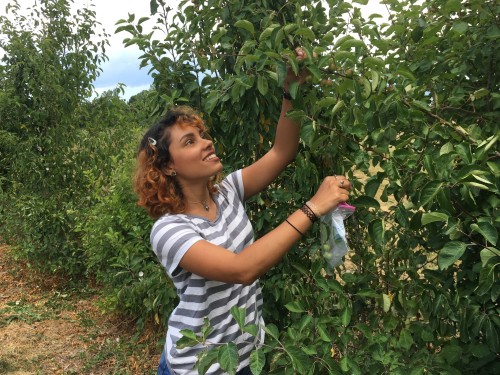
Growing up in Puerto Rico meant Sofia González Martinez never saw apple orchards dotting the landscape. The thought of studying apples as an academic pursuit seemed like a remote possibility for a young student with a love of all plants.
That all changed this summer for the horticulture student from the University of Puerto Rico. For nine weeks she received a world-class education at Cornell’s New York State Agricultural Experiment Station (NYSAES), where as a Geneva Summer Research Scholar she had the opportunity to perform research for Susan Brown, one of the top apple breeders on the planet.
Working under the mentorship of Brown, the Goichman Family Director of the NYSAES and the Herman M. Cohn Professor of Agriculture and Life Sciences, González Martinez spent her summer in the orchard and the laboratory, collecting and analyzing apple spurs from 138 trees at the Geneva campus. There she learned how to perform sophisticated data analysis using statistical software for a project to determine the viability of using progeny of a native apple species (Malus fusca) crossed with a Cornell breeding selection for use in hard cider production.
“We wanted to see if the small fruit size of Malus fusca would be inherited and thus a limitation for genetic improvement. Crab apples such as Malus fusca are small but resistant to apple disease like fire blight and fruit apple scab, which plague many hard cider varieties,” she said.
Her results gave positive indications that offspring can be bred for fruit size, disease resistance and tannins with an eye toward hard cider production.
González Martinez was one of three students from Puerto Rico and 29 undergraduates in total chosen from universities to explore the fields of entomology, plant pathology, horticulture and plant breeding as part of the Summer Research Scholars Program. Now in its eighth year, the program pairs undergraduates with faculty and research specialists to explore applied agricultural research on specialty fruits and vegetables studied at Geneva.
Larry Smart, director of the Summer Scholars Program and professor in the Horticulture Section of the School of Integrative Plant Science, said the program gives young, ambitious students first-hand experience with the challenging science undertaken at Cornell.
“We attract students from both undergraduate institutions who may not have the opportunity to get involved in applied agricultural research, as well as from our peer land-grant institutions,” Smart said. “We are bringing in a diversity of students to expose them to the agricultural environment in New York state.”
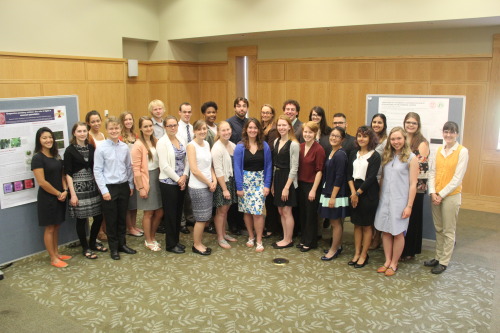
Smart said the rigorous program establishes a unique relationship with promising students. Each of the undergraduates takes on an independent project with the help of a faculty mentor. The work of collecting data, analyzing the findings and presenting the results are all done by students in an environment much like that expected from those performing graduate-level work. Cornell faculty also led informal lunch discussions to help the students excel in the research environment and plan their professional future.
“It’s incredibly rewarding to see the growth in only a nine-week period,” Smart said.
And it’s been an effective tool that exposes students to a side of science they may not have considered. Since its debut in plant pathology in 2009, the program has expanded to include the Section of Horticulture and the departments of Entomology and Food Science, attracting more than 900 applicants and supporting nearly 150 Summer Scholars. Twelve program alumni have gone on to enter Cornell graduate programs, and surveys indicate 65 percent have gone on to or are planning to attend graduate programs at other universities.
This summer Mariama Carter, working with senior research associate David Gadoury, explored how different wavelengths of light control the process of spore production in powdery mildew. This large and economically important group of plant pathogenic fungi devastates many crops across New York. Through her research, Carter explored ways selective lighting might one day be used to suppress disease and protect valuable crops.
“It’s been awesome working with top plant pathologists in the world, and it’s been great to get that exposure and see the techniques that are used here,” said Carter, a rising senior at Iowa State University. “What I’ve done here at Geneva and what I’ve learned I’ll be able to implement in my research when I get back to school.”
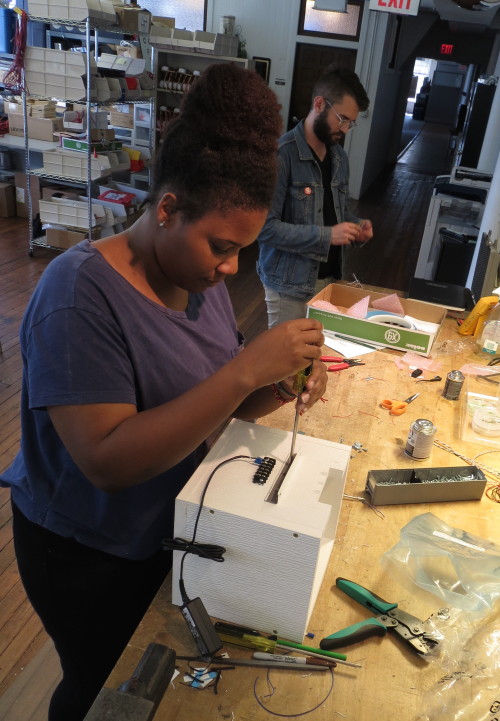
Along with their independent work on projects with faculty members, many of the summer scholars also take part in “The Field Course,” which takes the students on a series of field trips that cover golf courses, vineyards, barley and hops, fruit crops and vegetables.
“The goal is to connect these students to production agriculture and real-world issues in food security at the time they are making critical decisions about advanced studies in the plant sciences,” Gadoury said. “Exposing these students early to the next-generation science that will be needed to solve these challenges is an important part of the summer scholar experience at Cornell.”
The program is funded by U.S. Department of Agriculture through the National Institute of Food and Agriculture and federal capacity grants, along with support from the NYSAES Director’s Excellence Fund, the CALS Alumni Association, the Berman Family Scholarship, Hicks Nursery, HM Clause, the National Science Foundation and grants awarded to individual faculty members.
The following faculty mentors worked with students on agricultural research:
- Professor Art Agnello: Joshua Neal, SUNY ESF
- Professor Susan Brown: Sofia González Martinez
- Professor Thomas Burr: Madeline Metten, University of North Colorado
- Associate Professor Keric Cox: Jean Beacorn, University of Georgia
- Associate Professor Keric Cox: Amelia Zhao, William Smith College
- Associate Professor Marc Fuchs: Madison Flasco, Otterbein University
- Associate Professor Marc Fuchs: Victoria Poplaski, Oberlin College
- Senior Research Associate David Gadoury: Mariama Carter, Iowa State
- Senior Research Associate David Gadoury: Michael Riga, St. John’s University
- Associate Professor Phillip Griffiths: Lisa Keim, Penn State
- Professor Gregory Loeb: Priscilla Glenn, University of Texas-Arlington
- Professor Gregory Loeb: Sofia Schmidt, Williams College
- Professor Brian Nault: Erica Moretti, Allegheny College
- Professor Brian Nault: Rachel Wallace, Cornell University
- Assistant Professor Sarah Pethybridge: Shannon Piper, St. Louis University
- Professor Stephen Reiners and Research Support Specialist Jim Ballerstein: Karin Long, Finger Lakes Community College
- Professor Chris Smart: Andrew Aldcroft, California State Monterey Bay
- Professor Chris Smart: Ali Cala, Rochester Institute of Technology
- Professor Chris Smart: Erica Robinson, Kent State University
- Professor Larry Smart: Anna Agloro, Saint Martin’s University
- Professor Larry Smart: Carlie Leary, New School
- Professor Larry Smart: Brianna Moore, William Smith College
- Professor Alan Taylor: Catharina Ortiz Thomazella, University of Wisconsin, River Falls
- Professor Wang: Rey Cotto Rivera, University of Puerto Rico
- Professor Wang: Brundage Jesse, Keuka College
- Assistant Professor Kyle Wickings: Alejandra Morales, University of Puerto Rico
- Assistant Professor Kyle Wickings: Sami Overby, Brown University
- Assistant Professor Kenong Xu: Ari Heitler-Klevans, Oberlin College
- Assistant Professor Kenong Xu: Alexis Nystrom, Newberry College



