

Drew Margolin, a professor of communication at Cornell University who studies human dynamics through social media, isn’t just tracking how the electorate is reacting to candidates in one single moment via Twitter, but how they have been reacting since the beginning of the primaries. This historical data gives Drew and his collaborator Yu-Ru Lin, University of Pittsburgh, a unique window into changing sentiment within a party about candidates and topics, as well as across party affiliations.
For example, how are early Trump or Hillary supporters reacting differently from more general Republicans and Democrats who originally favored another candidate? What about those who may have been #NeverTrump or #NeverHillary? And what does it mean for Election 2016?
Margolin will be dissecting the data from these randomly selected computational focus groups during both National Conventions, the Presidential Debates, and the National Election.
Coverage of the opening night of the Democratic National Convention can be found here.
Miss Margolin’s analyses of the Republican National Convention (RNC)? Insights from the night first and second nights of the convention, the make up of their computational focus groups, and general thoughts on using Twitter as a sentiment barometer can be found here. Coverage of Ted Cruz’s non-endorsement can be found here, and analysis of Donald Trump’s acceptance speech here.
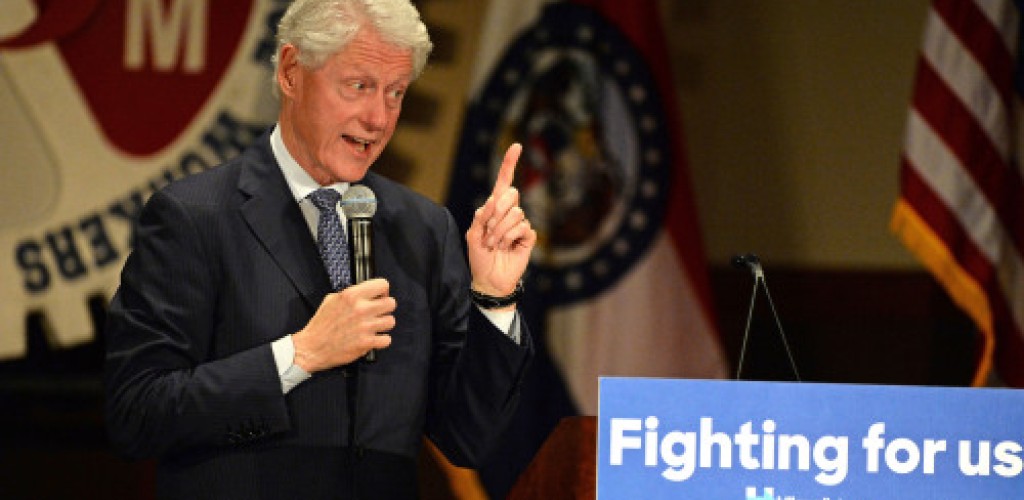
As I mentioned last week in discussing Cruz’s and Trump’s speech, Twitter is particularly useful for understanding immediate responses to events. In that vein, a focus on Bill Clinton’s speech gives us a chance to address a couple of different questions. In particular:
- What effects seemed to carry over from last night’s Berniefest?
- What, if anything, did Bill’s speech do to change support for Hillary?
We can address these questions by splitting the tweets into two sets: those sent before 10:09 P.M. EDT, when Bill Clinton took the stage, and those sent afterward.
What Carried Over From Night 1, What Didn’t?
One of Monday night’s stories was the weak attendance of the Defectors to Hillary, who had tweeted vigorously during the final night of the RNC convention but barely showed up for night 1 of the DNC. They rebounded Tuesday, with about as many individuals sending a tweet before Bill’s speech as did on RNC night #4. Also, both groups that follow Hillary — the Defectors to Hillary and the Hillary Accepters — paid a bit more attention to their candidate Tuesday, in line with the attention (10-15% of tweets) that Trump received during the more normal (i.e. not Ted Cruz) moments of his convention. This suggests their temporary hiatus may have been out of a desire not to engage with Bernie’s big night on Monday.
The Hillary Dumpers and the Bernie Holdouts tweeted relatively positive sentiments about Bernie on Monday, the only groups to do so. They continued to do this again Tuesday. There are signs, however, that their resistance is subsiding (though their support may not be forthcoming). Their use of anti-Hillary hashtags — #NeverHillary and #BernieOrBust — was substantially reduced. On Monday the Hillary Dumpers used one of these tags in 8% of their tweets — much more than any Republican group had used #NeverTrump on any night. On Tuesday, their use of these anti-Hillary tags was about 2%, exactly in line with the #NeverTrump use from the Trump Dumpers last week. Their attention to Bernie was also reduced from about 5% of tweets to 2-3%. Another potentially good sign for the Clinton campaign is that these Bernie-groups were consistent in their expression of relatively negative sentiment about Trump. In fact, they were the only group to show a statistically significant tendency to do so.
One other change from Monday — the other Democratic speakers got very little attention. Whereas Cory Booker drew 2% of tweets and Sarah Silverman about 1%, on Tuesday no speaker got even to this range. In fact, the most heavily tweeted speaker prior to Bill Clinton taking the stage was… Bill Clinton, who got a little over 1% of tweets before he actually spoke.
What Did Bill’s Speech Do?
Bill’s speech had the strongest effect on the Hillary Dumpers, namely, it got them to turn away. In fact, both groups that have unfollowed Clinton (the Dumpers and the Candidate Avoiders) saw substantial reductions in the number of tweets sent and the number of individuals who sent a tweet during Bill’s speech. By contrast, the other groups tweeted at similar rates. The Hillary Dumpers were also much less likely to mention Bill when they did tweet.
By contrast, the two groups that follow Hillary — the Defectors to Hillary and the Hillary Accepters — tweeted heavily about Bill’s speech and expressed relatively positive sentiments about both Bill and Hillary during the speech. For both groups this is an improvement over night 1, where there was no significant positive sentiment toward Hillary in these groups — her presumed base. It’s not quite clear if Bill’s speech is the cause, however, as the amount of positive sentiment expressed by these groups during his and after his speech is not statistically distinguishable from what they expressed prior to the speech tonight. But it is definitely more positive than Monday night.
Perhaps most important is the reaction of the Bernie Holdouts — people who followed Bernie a year ago and still follow him, but haven’t yet (and may never) follow Clinton. The jury is still out — they showed no significant tendency to express positive or negative emotion about Bill or Hillary or the Clinton name in general.
- Drew
For media interviews contact:
Kathleen Corcoran
Office: 202-434-8036
Cell: 607-882-3782
kmc327 [at] cornell.edu


